
.svg)
 United Kingdom
.svg) Australia
Australia

What is a franchise agreement?
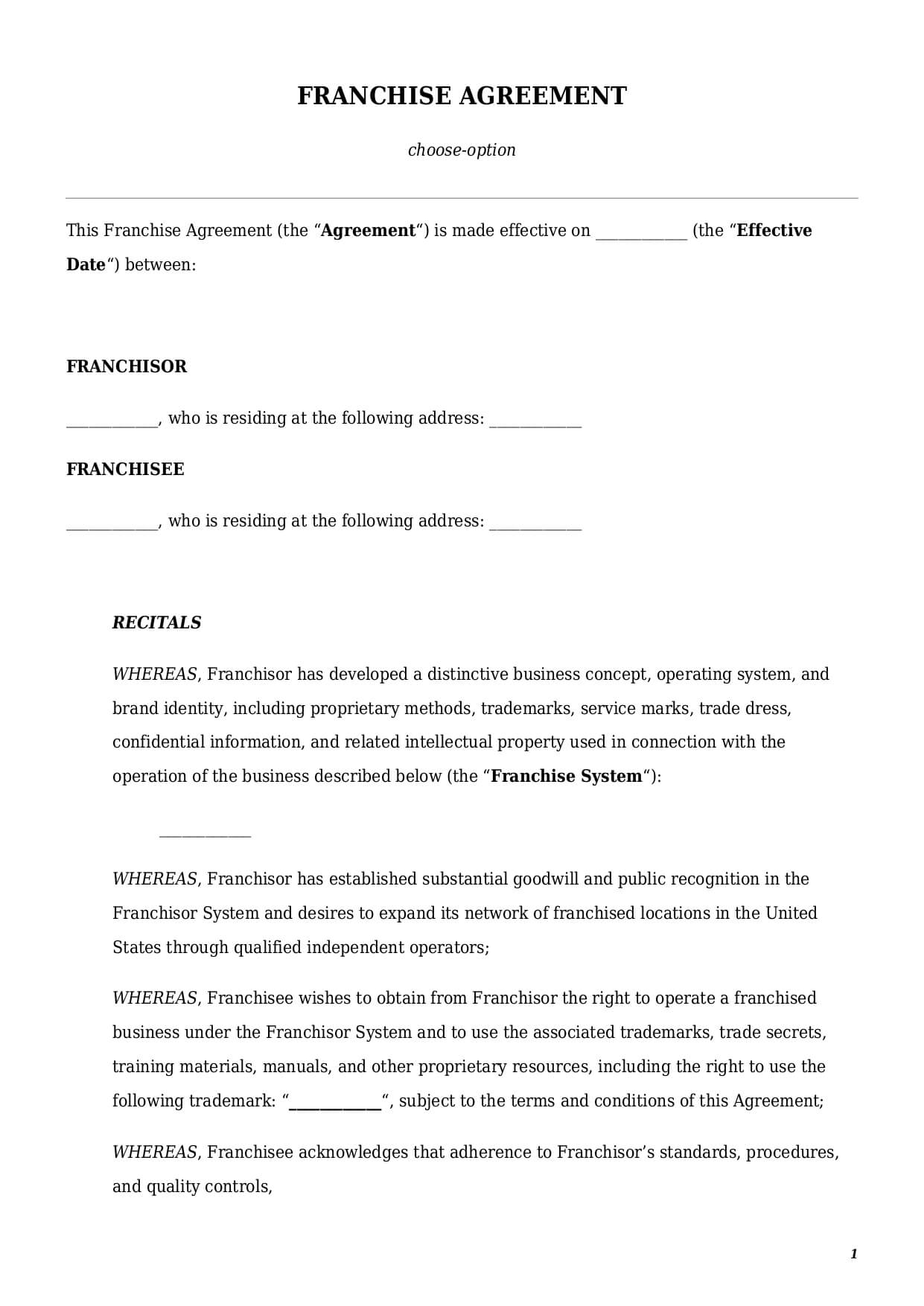
A franchise agreement is a legally binding contract between a brand owner and a franchisee (the business operator). It outlines the rights, obligations, and rules each party must follow when operating under the franchise brand in the United States.
The parties involved in a model franchise agreement are a franchisor and a franchisee. A franchisor is an owner of a franchised business who provides a license to operate that business in exchange for remuneration. A franchisee is a business or partnership that is willing to get a franchising license to operate the business in question within a specific territory.
Having a solid franchise agreement template is helpful for a number of reasons, including:
- Protection against brand misuse. A written franchise agreement ensures the high quality of services or goods that are being delivered under the franchised logo or brand.
- Clarify payment provisions. Franchise agreements define clear payment terms and conditions, which prevent the occurrence of disputes along the road.
- Quality Issues. A good franchise agreement example ensures consistency in delivery services and goods to the customers, maintains the brand’s consistency, and defines the schedule of mandatory training for the personnel involved.
- Safeguard against lawsuits. A well-drafted U.S. franchise contract is a powerful legal tool that allows you to minimize legal risks by clarifying both parties’ expectations.
What does this franchise agreement template include?
Grant of License & Brand Use
The original wording of a franchise agreement should strictly define the right of a franchisee to operate a franchised business. Such a right is also known as a licensed franchise. In its turn, a franchise license could be of two types:
- exclusive (i.e., when the franchisee does the business exclusively in a specific territory or location) or
- non-exclusive (i.e., when the franchisor could issue an unlimited number of licenses to operate the business in the same location).
Franchise Territory
One of the key elements for every franchise contract agreement template is a territorial scope. A franchisee must understand in which geographical area they could do their business. Failure to stay within a designated territory is considered a material breach of a contract. A material breach may lead to either additional penalties or to the immediate termination of the agreement.
Franchise Fees
A franchisee must pay under a franchise agreement contract for the opportunity to operate the franchised business in question. There are several forms of franchise payments that could be used separately or all together in the same contract. They are:
- entrance fee. A fee a franchisee pays for the right to enter this business. Usually it is a fixed fee that is being paid at the moment of signing a franchise agreement or before the opening date.
- franchise fees. Those are regular fixed fees a franchisee pays for doing the franchised business. You can pay them weekly, quarterly, or monthly.
- royalties. Those are another type of fee a franchisee pays for the right to use a brand or a trademark under a model franchise agreement. Royalties could be established as a fixed fee or as a certain percentage from gross sales generated by a franchised business within a specific period of time (e.g., 1% from gross monthly sales).
Training & Operational Standards
Another important element for a franchise agreement template is the list of standards and requirements the franchisee must obey. Those requirements are vital since they ensure the integrity of the brand, the quality of the provided goods or services, as well as a good customer experience.
Usually the text of a franchise agreement includes a general clause specifying that a franchisee should follow all requirements provided to him or her in special pamphlets, manuals, and other documents. All that information is being attached to the agreement.
Renewal and Termination
A well-drafted franchise agreement contract shall specify the exact duration of the contract. Apart from that, it should also define if the renewal is possible. Usually renewal is possible provided a franchisee is able to meet certain important criteria (e.g., profitability).
Termination of a contract is a contractual right of every party. However, parties involved in a franchise agreement could apply this right in different ways. This is because the grounds for the contract’s earlier termination are usually different for a franchisor and a franchisee.
Dispute resolution
This section of the franchise agreement defines the state whose laws must apply for handling disputes between the parties. Even though parties are free to choose any state they want, usually this is the state where:
- a franchisor is located; or
- a franchised business is registered.
The laws of a selected state also define which state’s courts shall control interpretation, execution, and enforcement of this agreement.
Common mistakes to avoid with a franchise agreement
Missing fee definitions
You may define in the text of a franchise agreement that a franchisee must pay fees under the agreement. However, the text of a contract may not contain further explanation of what exactly franchise fees are: 1) a payment for using a franchisor’s intellectual property rights; 2) a payment for the right to operate the franchised business; or 3) both.
Vague territory boundaries
Every U.S. franchise contract must define the exact territory within which the franchised business could be operated. Parties to the agreement could agree about a specific location or territory (e.g., a town, a city, a district, or a state).
No quality-control measures
A solid franchise agreement example shall provide how and when a franchisor has a right to perform quality control. This is an essential right of a franchisor to make sure that the business operated under their brand meets all essential requirements and quality standards. For example, imagine if one of the McDonald’s restaurants in your hometown does not put cheese on a cheeseburger at all.
Weak IP language
The text of a franchise agreement sample shall record the scope of intellectual property (IP) rights a franchisee could use in their franchised business. The scope of transferred rights should clearly define that a franchisee must remain a user only, and not their own. Failure to address that important point may result in loss of IP rights disputes between the parties after a franchise contract expires.
How to customize a franchise agreement sample at FasterDraft?
To get a fully customized legal document template, follow the instructions given below:
- Click the “Create Document” button.
- Answer simple questions in the form.
- Select a template’s format—franchise agreement PDF or Word.
- Make a payment.
- Download, sign, and use the document.