
.svg)
 United Kingdom
.svg) Australia
Australia

What are the bylaws for nonprofit organizations?
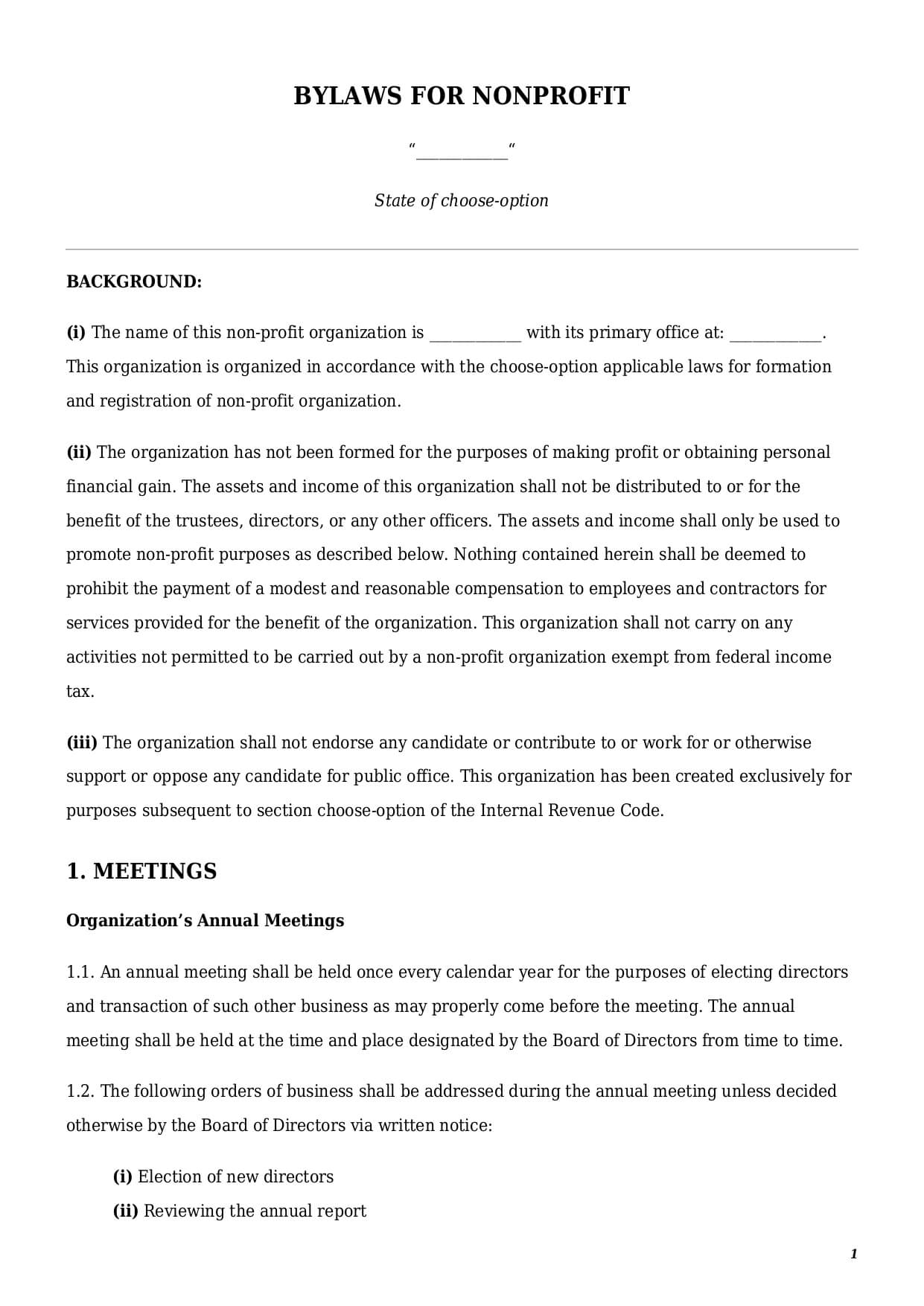
Bylaws for nonprofit organizations are foundational legal documents that outline how a nonprofit operates, how it governs itself, voting procedures, membership, and the appointment of directors and officers. Incorporation and operation of nonprofit organizations is governed at both federal and state levels.
This sample nonprofit bylaws can be used for incorporation of various types of US charitable organization, including under IRC § 501(c)(3), such as charities, educational institutions, religious organizations, scientific organizations, hospitals, museums, animal welfare organizations, private foundations etc.
The parties involved in the creation and formation of a nonprofit bylaws template are incorporators or founders. Those could be individuals or legal entities who wish to establish and run a charitable organization to achieve certain social benefits. Once the template is ready, it should be signed by an organization’s president, secretary, or any other person according to the bylaws.
Which document to use for registration of a nonprofit organization in the USA—nonprofit bylaws vs. articles of incorporation?
If you are a fact-taker to run and operate a nonprofit organization in the USA, you need both documents no matter in which state your nonprofit is registered. Though the documents are used for different purposes:
| Articles of Incorporation | Nonprofit Bylaws | |
|---|---|---|
| Purpose | Legally creates the nonprofit corporation as a legal entity. | Governs how the nonprofit operates and is managed on a day-to-day basis. |
| Required for formation | Yes. Required to incorporate the nonprofit with the state. | Usually required by state nonprofit law or adopted as part of good governance. |
| Filed with the state | Public document. In most of the states must be filed with the Secretary of State, while in others is required to be submitted to equivalent state bodies (e.g., in Virginia submission is done to Clerk of the State Corporation Commission). | This is a private document, kept as an internal organizational document. |
| Typical clauses | Organization name, charitable purpose, registered agent, incorporator, nonprofit status, dissolution clause, and other state-required information. | Board structure, officer duties, meetings, voting procedures, committees, quorum requirements, conflict of interest policies, membership rules (if applicable), amendment procedures, and fiscal year. |
| Signed by | Incorporator(s) of the nonprofit. | Board of directors during the organizational meeting. |
| When prepared | Before or during incorporation. | Before incorporation, after incorporation, or before the nonprofit begins operating. |
| IRS wording | For a 501(c)(3), must include specific charitable purpose and dissolution language to qualify for tax-exempt status. | The IRS generally requests a copy of the adopted bylaws with Form 1023 but does not prescribe specific bylaw language for most organizations. |
To sum up: to officially register the nonprofit organization in the U.S., you must first draft, sign, and file articles of incorporation with the secretary of state. Once the nonprofit is registered as a legal entity, you need a nonprofit bylaws template to govern the daily management and operation of the nonprofit.
Why does having a professional nonprofit bylaws form from FasterDraft matter?
You need a solid and well-written template for nonprofit bylaws for:
- IRS 501(c)(3) tax exemption status. While the IRS’s organizational test looks specifically at your Articles of Incorporation, your bylaws are still requested with your Form 1023 application and reviewed for internal consistency. Incomplete or poorly drafted bylaws can slow down processing and create real governance problems even though they alone won’t trigger rejection on the organizational test (read below).
- Different types of nonprofits. This document can be customized for various types of permitted charitable activities, including religious organizations, or private foundations etc.
- US legal framework compliance. We offer a fully customizable template that aligns with local statutes and state laws, not a generic or multijurisdictional template.
- Sample nonprofit bylaws PDF & Word. You get the document available for immediate digital download in PDF and Word.
- Lifetime license to use. You pay one time and can reuse, update, amend, or change this document an unlimited number of times.
Which legal document templates do I need to run on a daily basis for my nonprofit in the USA?
Once the registration of your nonprofit organization is complete, it does not mean all paperwork is done. You must always have the following internal documents:
- Nonprofit Bylaws. This is the first and the most important document after the articles of incorporation. It defines how the meetings of members are organized, how the notices are sent, which quorum is required to adopt a decision, how the liquidation process takes place, and more. This template allows you to fully customize the bylaws for the internal structure and needs of your nonprofit.
- Donation Request Letter. If the nonprofit is planning to request additional donations or financing for their statutory activities, this is usually done by sending a special donation request letter. The template of the donation request letter allows you to request additional financial resources in a professional and compliant manner.
- Non-profit Meeting Minutes. To record decisions adopted by members of the nonprofit, a separate template of non-profit meeting minutes should be used. This template documents the list of attendees, agenda, and list of adopted decisions for the internal record. Having a professionally drafted template of non-profit meeting minutes is especially important when introducing changes to the articles of incorporation, which should be subsequently submitted for further registration with the Secretary of State or other equivalent body.
- Donation Agreement. Once there is a donor or sponsor who is willing to make a donation to the nonprofit, such a legal arrangement should be recorded in the form of a donation agreement. A professionally drafted template is essential to ensure inclusion of necessary wording compliant with the IRS requirements.
- Gift Acceptance Policy. The nonprofit organization should have a list of strict rules when selecting and approving donors for their organization. The gift acceptance policy template helps to outline strict compliance and selective requirements the employees of the nonprofit must follow when registering donations from third parties.
What are the pitfalls when applying for a nonprofit’s IRS tax exemption?
Most founders do not get right the timeline and main requirements associated with IRS tax exemption status for nonprofits. Common mistakes include:
Mistake No.1: registration of the nonprofit automatically grants exemption status.
No, the exemption status for the non-profit organization in the U.S. is being granted only upon submission of the Form 1023 and fulfillment of the ‘organization test’.
Mistake No.2: exemption status applies from the formation date.
This is only true under a condition many founders miss: exemption is retroactive to the formation date only if Form 1023 is filed within 27 months of formation. Miss that window, and exemption applies only from the date of IRS approval, and not from the formation date.
Mistake 3: submission of Form 1023 automatically grants exemption status.
No, the exemption status can only be granted when the following two conditions of the “organization test” are being fulfilled:
- dissolution clause. The IRS in the Instructions for Form 1023 provides a recommended wording for the dissolution clause which should be included in the articles of incorporation: “Upon the dissolution of this organization, assets shall be distributed for one or more exempt purposes within the meaning of section 501(c)(3) of the Internal Revenue Code, or corresponding section of any future federal tax code, or shall be distributed to the federal government, or to a state or local government, for a public purpose.“
- purpose clause. The nonprofit’s activities should be explicitly limited to one or more exempt purposes specified under Section 501(c)(3) of the IRS.
Mistake 4: inclusion of dissolution clause in the bylaws
If the provisions of the bylaws satisfies requirements of the “organization test”, while the articles of incorporation do not, it means that the exemption status cannot be granted. The IRS looks only at what is stated in the articles of incorporation.
How to write a nonprofit bylaws template?
When creating a nonprofit bylaws template, it’s crucial to keep in mind three simple rules:
- The text of a document shall define the clear internal governance of an organization.
- The text shall define quorum for voting for the board of directors, as well as quorum for members (if applicable).
- The wording of the document should be simple and unambiguous so that officers, members, or directors can consult it any time to find answers to their questions.
Every sample nonprofit bylaws should include a number of important provisions without which a document cannot be legally complete:
Board of Directors
A board of directors is an essential element of an organization’s internal corporate governance. The board of directors is responsible for strategic management of the organization. The text of solid bylaws for nonprofit organization usually lays out:
- the minimum number of directors;
- the director’s term (defined or indefinite period of time);
- grounds for the director’s resignation (e.g., loss of loyalty, violation of fiduciary duty, reaching a certain age threshold, etc.);
- meetings of the board (frequency, place of meetings, and required quorum).
Membership of the Organization
If a nonprofit organization plans to have members, then a template of bylaws for nonprofit charities should define the membership rules.
The role of a member in a nonprofit organization is not similar to a member of a partnership or LLC. In a nonprofit organization, members are not owners or founders of an organization, as is the case for an LLC. Members of nonprofit organizations are persons who wish to participate in their activities.
The rules governing membership include:
- eligibility criteria to become a member (e.g., age, education requirements, etc.);
- grounds for termination of the membership (e.g., failure to pay regular membership fees, violation of the organization’s internal rules and policies);
- frequency of members’ meetings and the minimum required quorum.
Appointment of Officers
Charity organizations may appoint various internal officers, for instance, president, vice-president, secretary, treasurer, etc. Each of the appointed officers shall remain responsible for an organization’s particular activity. For instance, a treasurer or CFO oversees financial affairs within the organization and monitors its compliance with applicable legislation.
Every nonprofit bylaws sample shall define:
- the exact list of appointed officers and their duties;
- duration of each officer’s term;
- grounds for the officer’s immediate resignation (e.g., commitment of a criminal offense).
Dissolution of Organization
The Board of Directors is the only governing body of an organization that can adopt a decision on dissolution. The text of bylaws for nonprofit organizations should define the quorum to adopt such a decision. The adoption of a decision on an organization’s dissolution requires more advanced quorum —e.g., 2/3 or 3/4 of all directors in the Board.
Dissolution of a nonprofit organization has its specifics. Unlike with a dissolution of a for-profit organization, the distribution of remaining assets from nonprofit organization amongst its members is not possible. Opposite to that, a nonprofit organization in liquidation is able to transfer their assets to another charitable organization or directly to the government.
How to customize a legal template at Faster Draft?
To get a fully personalized document, follow a few easy steps below:
- Click the button “Create Document.”
- Answer simple questions in the form.
- Select a document’s format—sample nonprofit bylaws PDF or Word.
- Make a payment.
- E-sign, download, print, and use a nonprofit bylaws template in minutes.