

 United Kingdom
 USA
 Australia


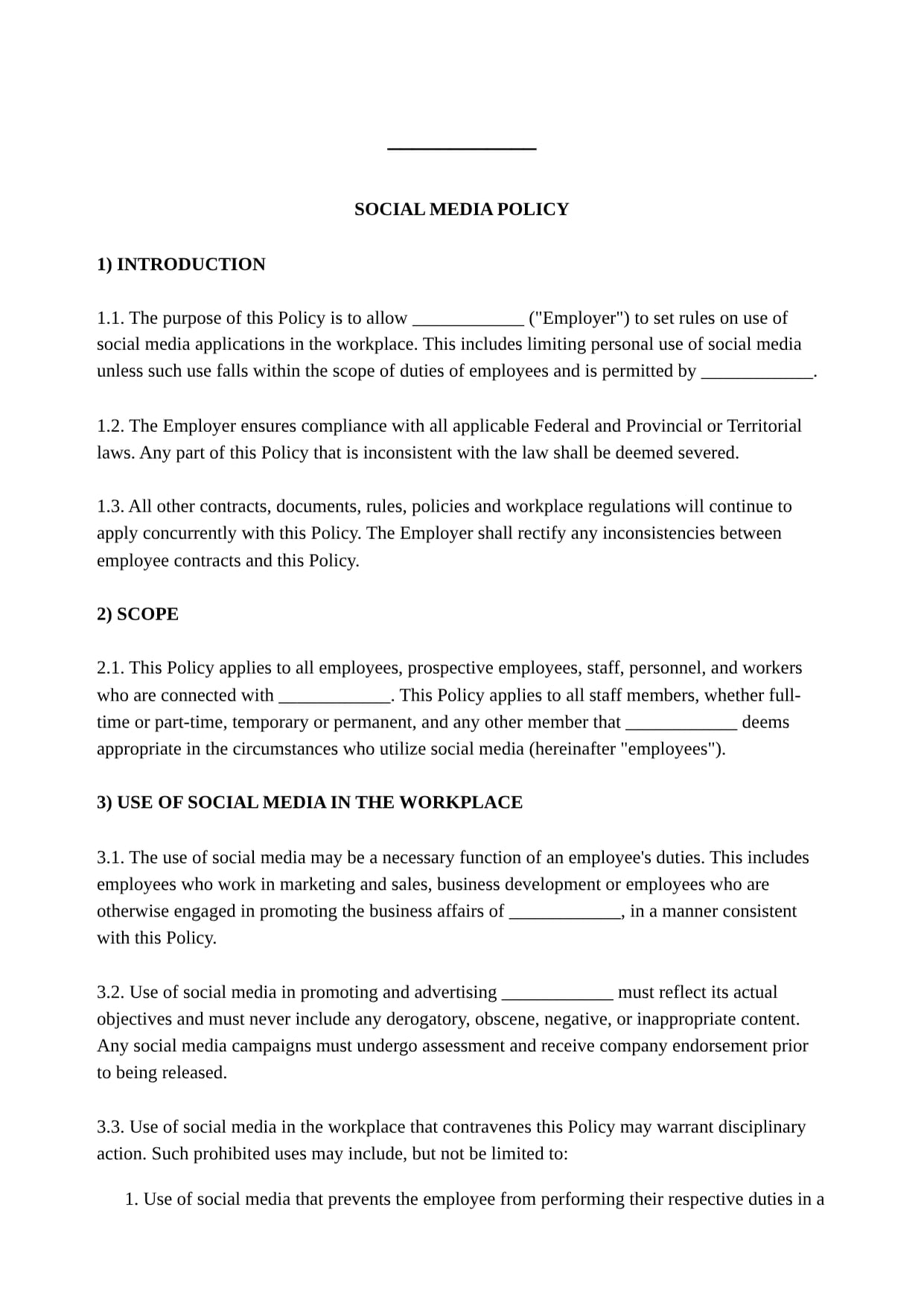
How to write a social media policy?
The question of how to write a social media policy has a predictable structure in Canadian employment law. Read below for the main tips and legal compliance hacks for a solid template.
Scope and definitions
The policy must define the list of employees and workers to whom it applies. Apart from that, the policy must also explicitly define the list of social media or any other online media platforms it applies to. For example, most employees may consider that social media includes only Facebook, LinkedIn, and Instagram, while some employees tend to expand the scope of the policy application towards:
- Review sites, including Glassdoor or Indeed;
- Podcast interviews and platforms;
- Review sites such as Trustpilot and similar.
Canadian arbitrators have consistently held that conduct on a personal account, posted outside working hours, can still attract legitimate employer discipline where it damages the employer’s reputation or the employment relationship (see Lougheed Imports Ltd. (West Coast Mazda) v. UFCW, Local 1518, 2010 CanLII 62482 (BC LRB); Chatham-Kent (Municipality) v. CAW-Canada, Local 127 (Clarke Grievance), 2007 CanLII 5625 (ON LA)).
Business versus personal use
A social media use policy for employees must distinguish between a business account of an employee and a personal account. For example, a solid and well-written policy cannot prohibit employees from using social media for personal use, like chatting with friends and watching reels.
Confidentiality
If there is no separate confidentiality policy for employees within the organization, the employer may wish to include a prohibition of disclosure of confidential information directly in the social media use policy for employee templates.
This includes a strict prohibition on disclosing confidential business information, client lists, trade secrets, financial results, internal communications, or personally identifiable information of colleagues, clients, or patients.
Freedom of expression—the limits. The Canadian Charter of Rights and Freedoms, section 2(b), protects freedom of expression against government action only. It does not directly constrain private-sector employer discipline. However, Canadian labour arbitrators apply a contextual analysis weighing the employee’s expressive interest against the employer’s legitimate interest in reputation, workplace harmony, and operational effectiveness (see Wasaya Airways LP v. ALPA (Wyndels), 2010 CanLII 93333; Kim v. International Triathlon Union, 2014 BCSC 2151). The template is drafted to respect that balance.
Reporting mechanism
The policy must set out how employees report concerns about social media conduct and how the employer will investigate. Investigation procedures should align with the workplace harassment investigation obligations under OHSA and equivalent provincial statutes.
Consequences
The policy must state the list of disciplinary measures an employer can apply to an employee who breaches the policy. The consequences must be clearly stated in the policy; otherwise, their application may not be possible in the future. Usually, the consequences may include issuance of a warning letter, final warning letter, or termination of employment.
Who shall use this social media policy template?
The present document is ideal for various types of Canadian employers and different workplace settings, including:
- Small and mid-size employers without in-house legal or HR.
- HR teams are standardizing policy across multiple provinces.
- Federally regulated employers, including banks, telecoms, airlines, interprovincial transport, etc.
- Regulated professional practices such as law firms, medical and dental practices, etc.
- Not-for-profits, charities, and public-sector organizations.
- Other types of businesses operating in Canada and looking for a reliable template for social media and hr teams.
Is this policy mandatory?
There is no single federal statute that mandates every Canadian employer to have a standalone social media policy. However, several converging obligations make the policy effectively mandatory for any organization of meaningful size.
How to customize this social media policy template with FasterDraft?
To get a fully customizable document template, follow a few easy steps below:
- Click the “Create Document” button.
- Answer simple questions in the form.
- Select a template’s format—social media policy for employees in PDF or Word.
- Make a payment.
The document is ready for instant digital download immediately after the purchase. You can instantly use it in the workplace and distribute it among your employees.