

 United Kingdom
 USA
 Australia


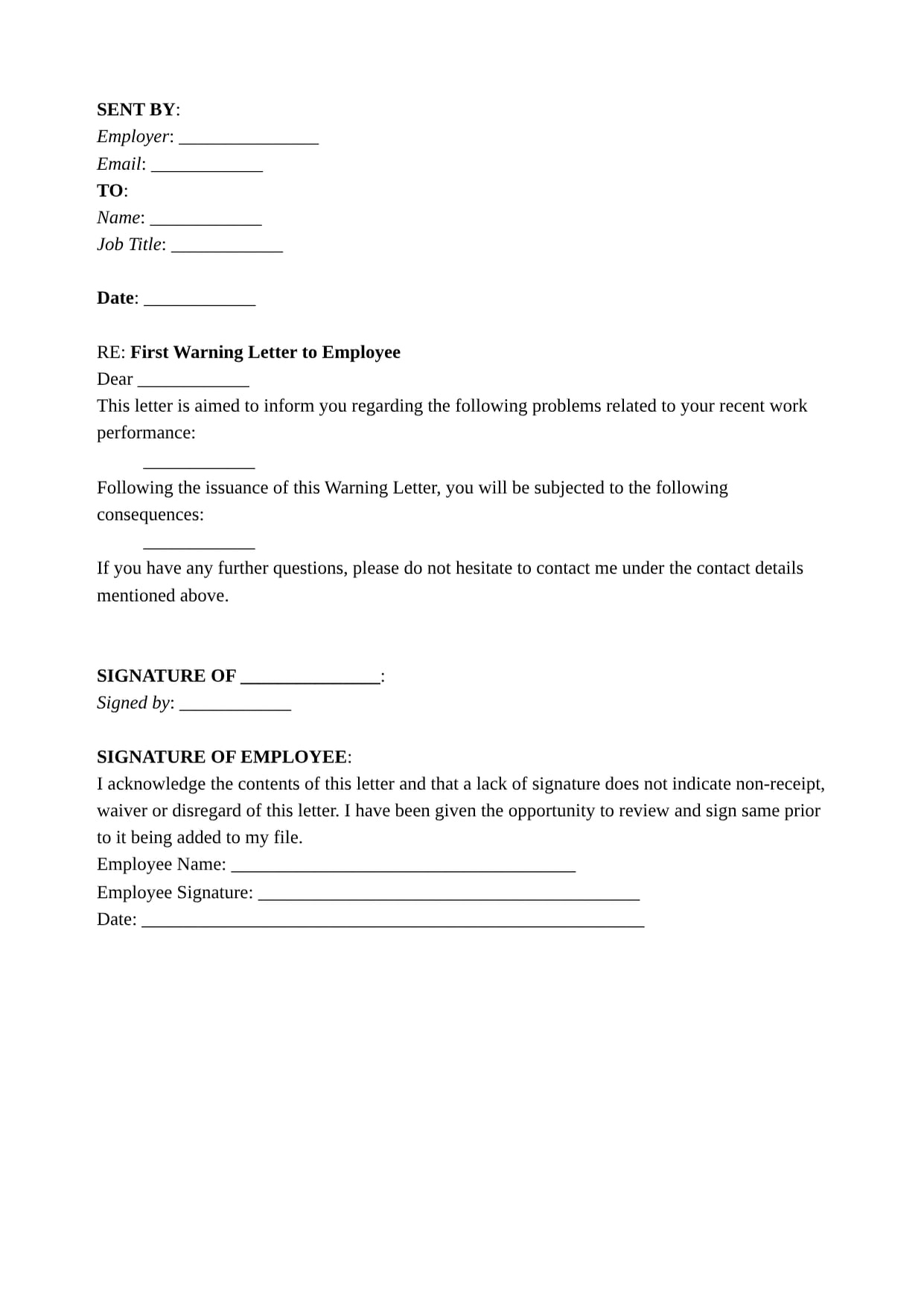
How to send and sign a written warning in Canada?
To issue an employee warning letter in Canada, you must follow a sequence of important consecutive steps. Missing even one of them can significantly affect your business and violate provincial laws.
Preparatory step
The first step is to prepare a solid documentary basis of facts proving an employee’s poor performance and unprofessionalism, including dates, times, what was said, who was present, what was expected, and what actually happened.
When the employer’s concern is mainly about the final deliverables, the best approach is to document all mistakes the employee made at work. Remember one important rule: everything you plan to mention in the text of the employee warning letter template must be supported by relevant documents.
Choose the right moment.
If you plan to issue a verbal warning template, you must still record it in writing on an employee’s internal profile for further record. If you plan to go ahead with a written warning, then the present template is exactly what you need.
The present template allows you to customize the document, including as a first warning or a final warning letter to an employee.
Methods of delivery
The law does not establish strict rules regarding the methods for delivery of the warning letter. The most common options include:
- In-person delivery during a meeting with an employee. It is highly recommended to invite a third party to the meeting, such as a management representative or someone from the HR department.
- Delivery by email (this is the most common option for remote employees or employees on extended leave). In such a case make sure that such an employe is being sent with a request that the employee acknowledge receipt.
Signing
The letter should be signed and dated by the issuing manager, including the company’s director, head of HR or other person within the organisation who is authorised to issue this type of letter,
Ask the employee to sign an acknowledgement that they received the letter. It is important to emphasize that acknowledgement does not mean that the employee agrees with it. We suggest including the following wording at the end of the employee warning letter template: “I acknowledge the contents of this letter and that a lack of signature does not indicate non-receipt, waiver or disregard of this letter. I have been allowed to review and sign the same prior to it being added to my file.”
Who needs this written warning template?
This written warning template is drafted for:
- Small and mid-size Canadian employers and businesses operating without an in-house HR department.
- HR managers searching for a standard document to be used across for discipline management within the orgnaisation.
- HR departments and a company’s CEO looking for a fully customisable warning letter template applicable in Ontario, BC, Alberta or Nova Scotia without rewriting the governing-law and statutory references each time.
- Employment lawyers themselves, as a starting point for client letters, saving the thirty to sixty minutes of drafting that every warning otherwise requires.
Important things Canadian employers often miss when drafting a warning letter
These are the drafting failures I see most often in warning letters that later get torn apart in a wrongful dismissal claim. The template is designed specifically to avoid them.
Vague description of the conduct
The wording of every employee letter template must contain a clear description of the events which triggered the issuance of the warning. The description must include specific incidents, dates and a reference to the employer’s internal policies containing the standards of conduct or performance.
A warning letter to an employee for poor performance that does not quantify the underperformance (missed targets, specific projects, measurable KPIs) will rarely support a later cause termination.
No statement of the standard expected
Many Canadian employers fail to understand the main purpose of the employee warning letter template. In fact, this letter is not about pointing at an employee’smistake. The main purpose is to provide an employee with explicit guidelines on how to improve their performance or discipline.
All in all, the letter should state the standard, the timeframe for improvement, and the support available (training, mentoring, resources).
No clear consequence
Whether it is a first-time warning or a final warning letter to an employee, the document must clearly outline the consequences and what will happen next. For example:
- Issuance of the second warning in case of failure to deliver improvements;
- Issuance of the final warning;
- Termination of employment contract.
Ignoring the just-cause threshold. Canadian common law sets a high bar for just-cause termination. The leading case, McKinley v. BC Tel, 2001 SCC 38, established a contextual approach — a single incident will rarely justify cause unless it fundamentally repudiates the employment relationship. Progressive discipline is how employers build the record that a cumulative cause termination requires. Each warning letter contributes to that record.
Failing to screen for human rights issues
Poor performance or attendance issues often have an underlying cause protected by the applicable provincial Human Rights Code (Ontario Human Rights Code, R.S.O. 1990, c. H.19; BC Human Rights Code, R.S.B.C. 1996, c. 210; Alberta Human Rights Act, R.S.A. 2000, c. A-25.5; and equivalents elsewhere). Disability, family status, addiction (which is treated as a disability), religion and pregnancy are all common triggers. Issuing a warning in response to behaviour that is in fact a protected characteristic — rather than offering accommodation to the point of undue hardship — turns a disciplinary matter into a human rights complaint. The template’s guidance notes flag the questions you need to ask before issuing.
What are the benefits of this template?
This employee warning letter template offers the following benefits:
- Jurisdiction-specific wording. The document is drafted against the Employment Standards Acts of each covered province, including Ontario (ESA, 2000), British Columbia (Employment Standards Act, S.B.C. 1996, c. 113), Alberta (Employment Standards Code, R.S.A. 2000, c. E-9), and other provinces.
- Accommodates different types of warnings. The letter could be easily customised as a first written warning, second written warning, and final warning.
- Covers different workplace situations. This template can be used for various types of workplace misconduct, poor performance, harassment cases, etc.
- Signed acknowledgement built in. The final letter template includes a signature block for the employer, as well as a separate acknowledgment block for an employee.
- Reduces legal spend. By customising this template in several minutes, you not only save a lot of time, but also get a professionally drafted template for the price of a cup of coffee.
- Updated when the law changes. The wording of this employee warning letter template reflects the latest changes in the provincial laws.
How to customise this template?
To get a fully customisable document template, follow the steps below:
- Click the “Create Document” button.
- Answer simple questions in the form.
- Select a template’s format – PDF or Word.
- E-sign the document.
- Make a payment.
- The document is ready for instant digital download immediately after the purchase.