

 United Kingdom
 USA
 Australia


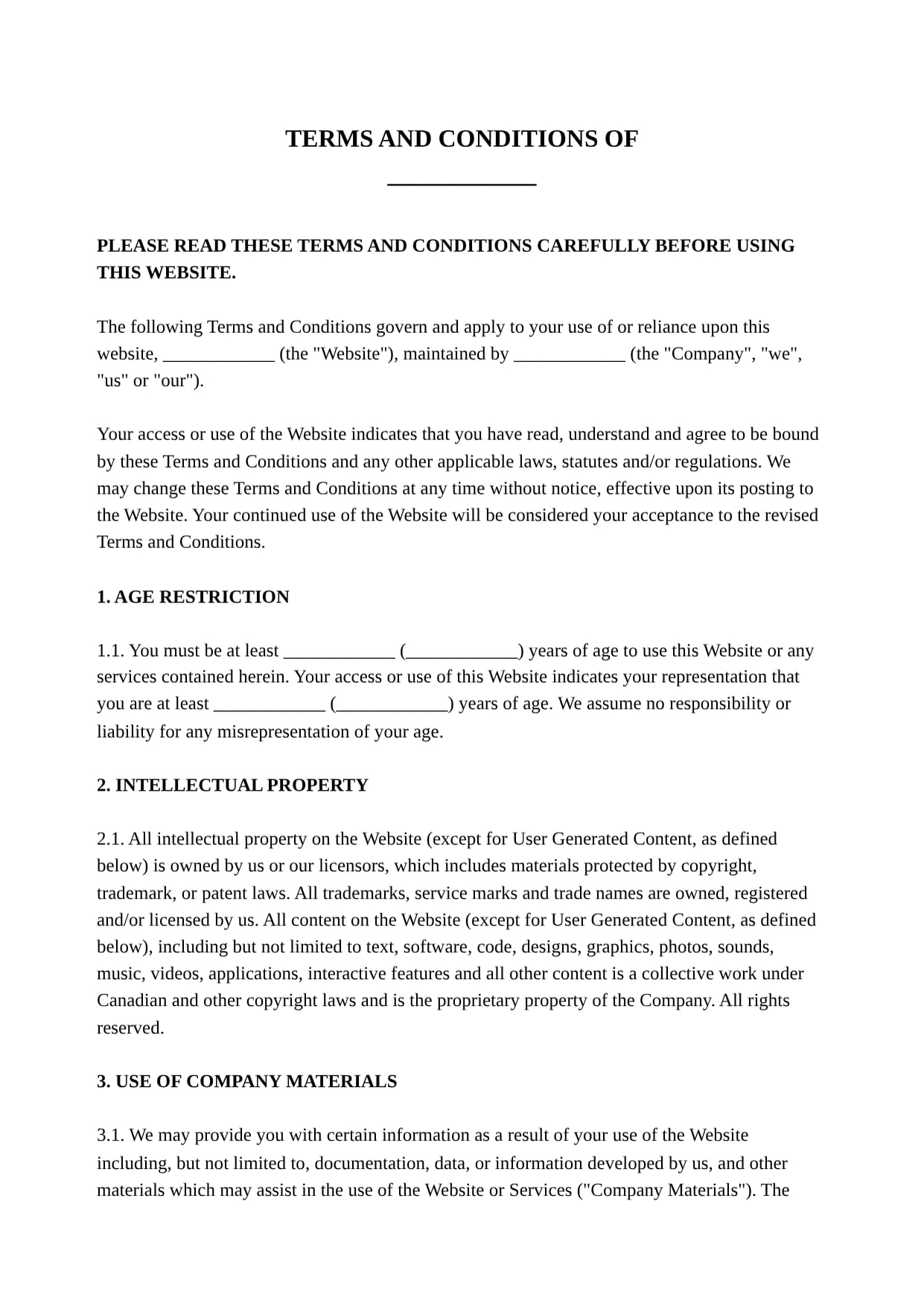
How to draft terms and conditions for an e-commerce website in Canada?
To create professionally drafted terms and conditions for an e-commerce website in Canada, the following essential elements must be present in the document:
Identify the contracting entity and jurisdiction
Every terms and conditions document must disclose the identity information of a legal operator owning the website, including:
- The full legal name;
- Registered address;
- Contact information; and
- Province of registration.
Describe the service precisely
Every terms and conditions for an e-commerce website should outline which goods, services, or both the platform offers, including any information about subscriptions, user-generated content, etc.
Any rules governing the e-sale of physical goods from the website fall within the scope of application of the provincial Sale of Goods Act. Therefore, the final document template must comply with them too.
Build the contract-formation mechanism
Terms and conditions for an e-commerce website are a contract-formation mechanism between the online business and the end-consumer. Therefore, the text of the document should clearly outline how the user is able to consent to the terms.
Under the Uniform Electronic Commerce Act (adopted in substantially all common-law provinces), customers can enforce electronic contracts by taking an affirmative action that demonstrates their assent. The template builds a “clickwrap” acceptance into both account registration and checkout, which is the standard Canadian courts have consistently upheld (Century 21 Canada Ltd. Partnership v. Rogers Communications Inc., 2011 BCSC 1196).
Draft a working refund and cancellation policy
Any website operator across Canada must clarify a working refund and cancellation policy. Ideally, a good example of terms and conditions for a website should incorporate these clauses. However, this is not a mandatory requirement; therefore, businesses may also address such policies in separate documents, including the Refund and Cancellation Policy.
Privacy Terms
Handling of users’ personal information should be done in accordance with PIPEDA (Personal Information Protection and Electronic Documents Act, S.C. 2000, c. 5), including the obtaining of prior written informed consent from users allowing processing of their personal information.
This document template should be used in conjunction with cookies policy which should also be published on the website.
Include the standard protective clauses
This sample terms and conditions for an e-commerce website includes standard clauses covering:
- limitation of liability;
- Indemnification;
- intellectual property ownership; and
- governing law (the law of a selected province where the website operator is registered).
What are the provincial requirements for a website terms and conditions template in Canada?
Apart from federal regulations, lots of provinces establish their own regulations governing consumer protection, online sale of goods, and other requirements, including languages in which policies should be written.
Ontario
By virtue of the Consumer Protection Act, 2002, S.O. 2002, c. 30, provide the following additional rights for end-consumers, including:
- mandatory disclosure requirements for internet agreements over $50 (section 38);
- a right to cancel within seven days of receiving a copy of the agreement if required disclosures were not made (section 40); and
- a 30-day cancellation right if goods or services are not delivered within 30 days of the delivery date specified in the contract.
British Columbia
The Business Practices and Consumer Protection Act, S.B.C. 2004, c. 2, imposes equivalent internet-sales disclosure requirements (Part 4, Division 4), contains strong unfair-practice provisions, and permits chargeback rights against credit card issuers where the merchant fails to deliver. The Electronic Transactions Act, S.B.C. 2001, c. 10, handles contract formation.
Alberta
Similar to Ontario, Alberta’s Consumer Protection Act, R.S.A. 2000, c. C-26.3, imposes internet sales contract disclosure requirements under its Internet Sales Contract Regulation, Alta. Reg. 81/2001, as well as cancellation rights.
Saskatchewan, Manitoba, Nova Scotia, New Brunswick, PEI, and Newfoundland and Labrador
Each has analogous consumer protection legislation imposing substantially similar disclosure, cancellation, and remedy provisions. The template includes a jurisdiction selector for each.
Yukon, Northwest Territories, and Nunavut
Each territory has its own consumer protection framework, included in the template’s territorial variants.
Common legal mistakes to avoid when creating terms and conditions for your website
Before drafting terms and conditions for the e-commerce website template, make sure you never make the most common mistakes as listed below:
Copying US terms
In an attempt to quickly find a free terms and conditions website template, many users use US-drafted templates, which are not suitable for the Canadian legal framework. It does not only apply wrong wording but also fails to comply with PIPEDA, CASL, the Competition Act’s misleading advertising provisions, or the mandatory disclosure requirements of provincial consumer protection statutes.
Blanket limitation of liability clause
The liability of a website’s operator cannot be limited in cases of personal injury, gross negligence, fraud, and willful misconduct. Apart from that, the provincial consumer protection laws establish their threshold when it comes to mandatory consumer guarantees.
A general blanket limitation of liability clause is usually unenforceable in Canadian courts. The template drafts a limitation that is enforceable to the maximum extent the law permits, without voiding itself through overreach.
Attempting to waive mandatory statutory rights
If you draft a terms and conditions for a website template in Canada, it does not mean that you can practically include everything you want. Provincial consumer protection acts state expressly that consumers’ mandatory rights (return, cancellation, and refund) cannot be waived by contract.
Even if they are not incorporated in the text of the policy, every user of your website may invoke them automatically in the court.
No governing law and dispute resolution clause
Without a governing law clause, a Canadian site can find itself defending claims in the plaintiff’s home jurisdiction.
If you have 9 ongoing disputes with different users in different provinces, it will cost you hundreds of thousands of Canadian dollars in attorneys’ fees. To prevent this from happening, this template defaults governing law to the website operator’s home province with an exclusive jurisdiction clause, subject to mandatory consumer protection rules.
No amendment mechanism
Your business model may change in years to come. Once it changes, the respective changes should be properly reflected in the terms and conditions of the website. Therefore, the document’s template should incorporate a clear amendment clause to bind the user without notice.
The present template includes a notice-and-continued-use amendment mechanism that Canadian courts have upheld (Kanitz v. Rogers Cable Inc., 2002 CanLII 49415 (ON SC)).
How to customize this template with FasterDraft?
To get a fully customizable website terms and conditions template in Canada, follow the instructions below:
- Click the “Create Document” button.
- Answer simple questions in the form.
- Select a template’s format—PDF or Word.
- Make a payment.
The document is ready for immediate download right after the purchase is complete.
What are the benefits of these terms and conditions for an e-commerce website template?
This template offers the following benefits:
- Lawyer-drafted document containing jurisdiction-aware clauses;
- Downloadable template—terms and conditions for the website template in Word or PDF.
- Compliant with CASL, PIPEDA, the Competition Act (including 2022 drip pricing amendments), the Copyright Act’s notice-and-notice regime, and provincial consumer protection acts.
- Lifetime access;
- Saves 87% on legal fees for drafting;
- Bespoke legal document written in professional language;
- Immediate download.