

 United Kingdom
 USA
 Australia


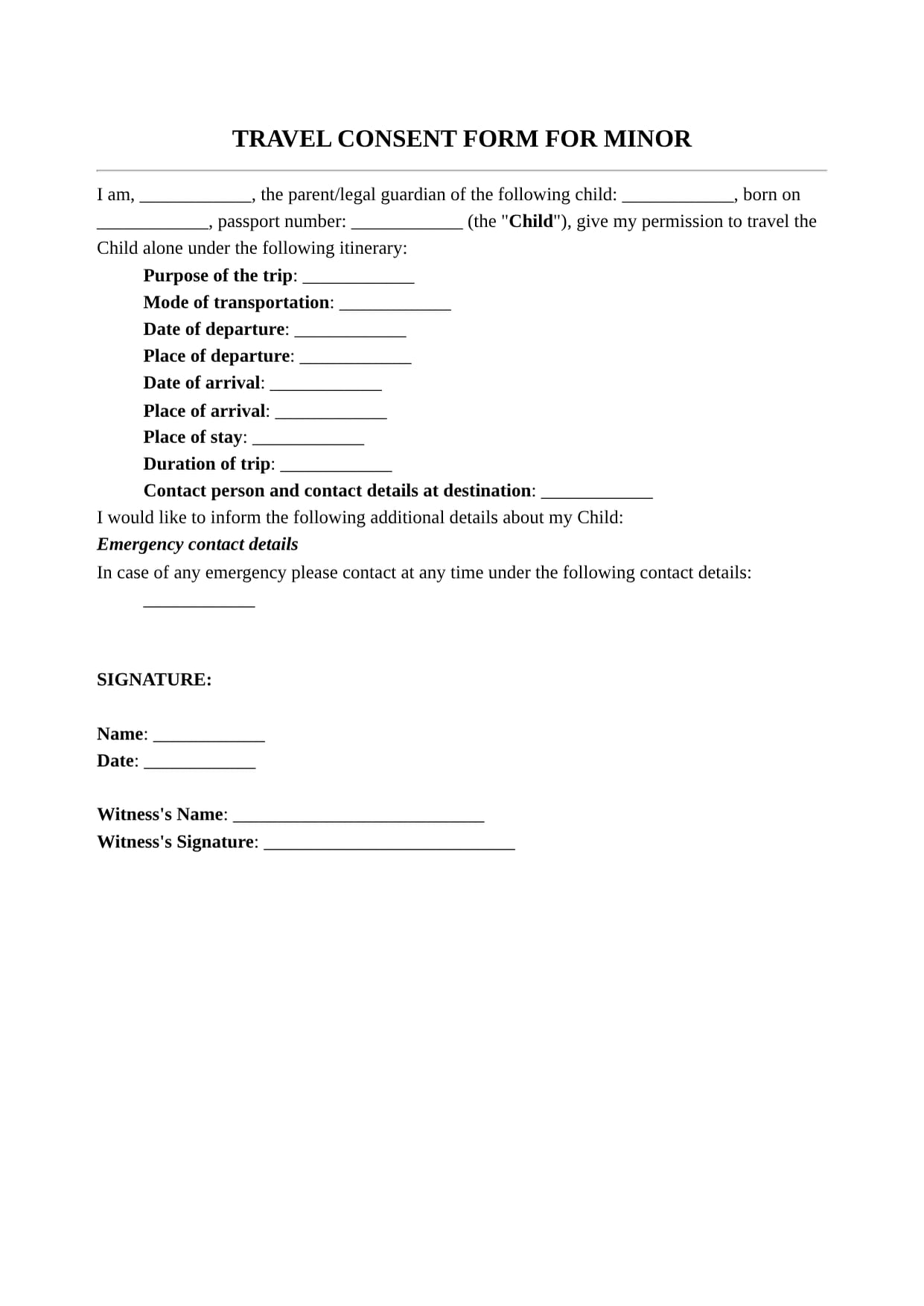
How to draft a travel consent letter for minors?
Drafting a consent letter for travel in Canada requires following a number of important steps, including:
Preparatory Step
First, it is better to check the border and immigration rules of the country your child is travelling to. Second, check any child travel requirements listed on the airline’s website, which you plan to use for your child’s trip. Some countries may require a notarised consent letter for travel (check for more details in the section below), while others accept a simple signed letter.
Identify every party correctly
The letter must name the child in full (including middle names as they appear on the passport), the child’s date and place of birth, passport number, issuing country and expiry date.
Any mismatch between the letter and the travel documents is the single most common reason for a letter being rejected at the border or may cause significant boarding delays.
Trip details
The letter should reveal all the details about the upcoming trip, including:
- Final destination, including date and time;
- Place where the child will be staying;
- Planned duration of the trip;
- Emergency contact details and parents/legal guardians’ contact details.
- Date of signing the letter.
Carry originals, not copies
Border officers routinely ask to see an original signed letter, not a photocopy. If the child is making multiple trips, consider preparing a separate original for each.
A sample letter of consent to travel with one parent PDF produced on this template takes the parent through each of these steps in order, with placeholder text replaced by live fields and guidance notes in the margin.
When do you not need a travel consent form?
A consent letter is not usually required in the following situations:
- The child is travelling with both legal parents or guardians. When both parents are on the trip, no consent letter is needed. In such a case, carrying a child’s birth certificate is enough.
- The travelling parent has sole legal custody by court order. If a child travels with only one parent and such a parent has sole legal custody, in such a case the other parent’s travel consent letter is not mandatory. However, the original sole-custody order itself must be carried in place of the consent letter.
- The other parent is deceased. A notarised copy of the death certificate replaces the consent letter.
- The child has reached the age of majority. The parental consent for travel is no longer required if a child has reached the age of 18 (for Alberta, Manitoba, Ontario, PEI, Quebec and Saskatchewan) or 19 (for British Columbia, New Brunswick, Newfoundland and Labrador, Nova Scotia, Yukon, Northwest Territories and Nunavut).
- Domestic travel within Canada. There is no legal requirement for a consent letter for interprovincial travel.
Is notarisation required?
There is no legal requirement for a travel consent letter to be notarised. However, some border authorities in countries like the United States or Mexico may require an additional notarisation of such a letter. Apart from that, even if the country of the final destination does not require such a notarisation, the airlines may impose additional requirements regarding the format of the letter itself.
To keep you at peace of mind as a parent, we always encourage you to undergo further notarisation of a travel consent letter for minors as an additional precaution. Most notaries public, commissioners of oaths and lawyers will notarise a consent letter for between CAD $25 and $75.
Important things Canadian parents often miss when drafting a travel consent letter
These are the drafting failures I see most often in letters that create problems at the border. The template is designed specifically to avoid them.
Omitting details of custody or parenting orders
Where a separation, divorce or parenting order governs the child’s living arrangements, the letter must reference it. The Divorce Act, R.S.C. 1985, c. 3 (2nd Supp.), as amended in 2021, replaced the language of “custody” and “access” with “decision-making responsibility” and “parenting time”, but the substantive point is unchanged: a travelling parent must have the authority to take the child out of the country, and must be able to demonstrate it.
Failing to appreciate the criminal-law backdrop
Taking a child out of Canada in contravention of a custody or parenting order is an offence under sections 282 and 283 of the Criminal Code of Canada, R.S.C. 1985, c. C-46, carrying a maximum of 10 years’ imprisonment on indictment. The consent letter is, among other things, documentary evidence that the travel was authorised. For a parent travelling alone with a child after separation, that evidence can matter.
Not matching names across documents
The name on the passport, the birth certificate and the letter must be identical. If the child goes by a shortened or alternative name day-to-day, the legal name on the passport is what belongs in the letter.
How to customise this parent travel consent form?
To get a fully customisable document template, follow a few easy steps below:
- Click the “Create document” button.
- Answer the questions in the guide questionnaire.
- Select a template’s format – consent letter Canada PDF or Word.
- E-sign the document online.
- Make a payment.
The document is ready for instant download immediately after the purchase.