

 United Kingdom
 USA
 Australia


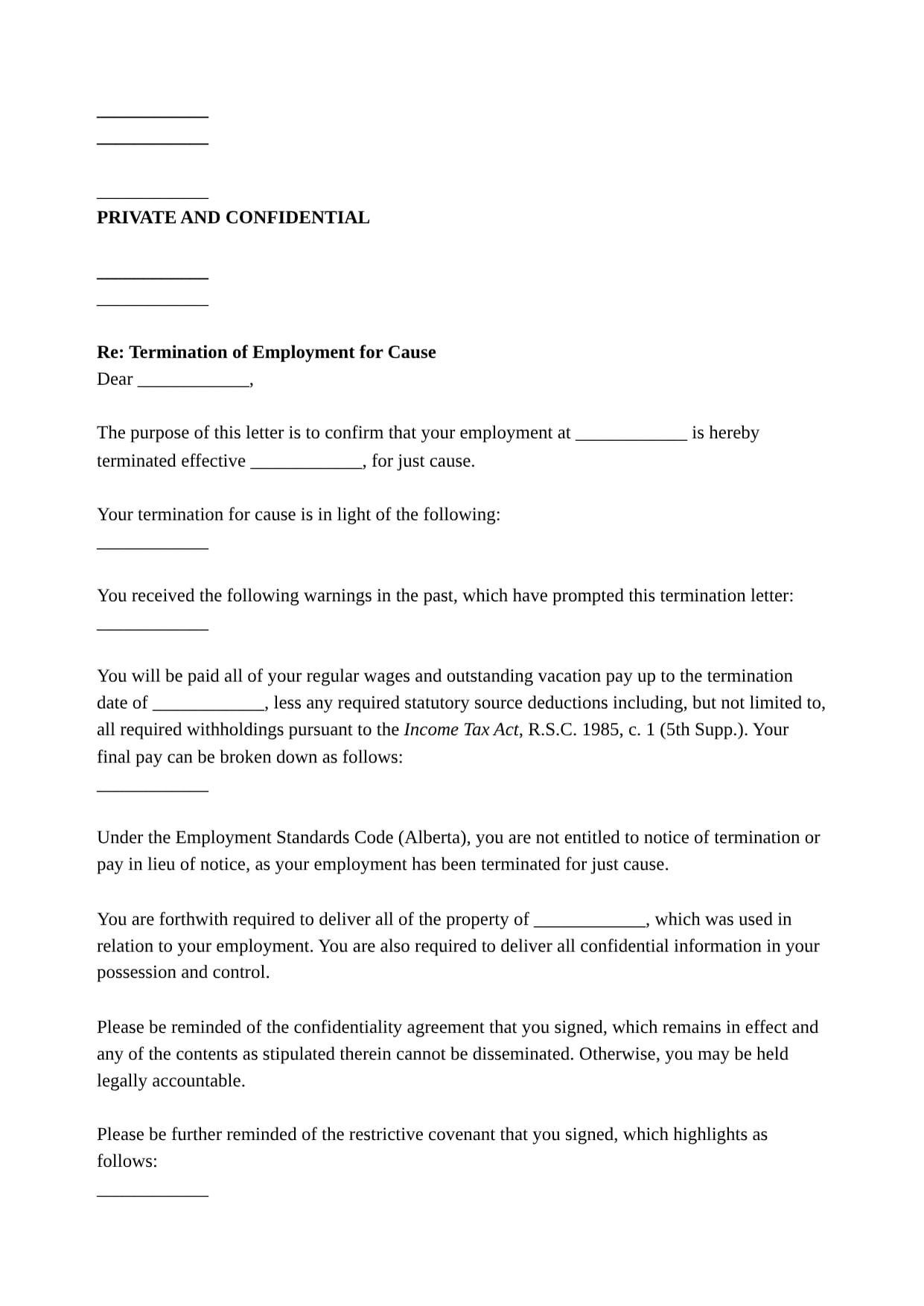
How to send a termination letter to an employee for cause in Canada?
The wording “for cause” means that employment relations are terminated because of certain grounds, including serious misconduct on an employee’s part or a business restructuring or downsizing.
There are also a number of other important legal considerations employers must take into consideration, including:
Provincial Regulation
There is no unified federal employment law that applies universally throughout all provinces. Most employers usually fall under provincial regulation, for example, the Employment Standards Act, 2000, in Ontario; the Employment Standards Act in British Columbia; the Employment Standards Code in Alberta; etc. A minority of workers work in federally regulated sectors (banking, telecommunications, interprovincial transport, and air travel), and those employees are governed by the Canada Labour Code. The template lets you select the right framework before you send anything.
Common law vs. statutory law
The definition and practical application of the wording “for cause” varies significantly between common law and statutory law. At common law, just cause is assessed contextually: the Supreme Court in McKinley v. BC Tel Inc., 2001 SCC 38 held that the misconduct must be weighed against all the circumstances and must be serious enough to strike at the heart of the employment relationship. But clearing that bar does not automatically strip the employee of their statutory minimums.
In Ontario, for example, O. Reg. 288/01 under the Employment Standards Act, 2000, only disentitles an employee from statutory notice and severance where there has been “wilful misconduct, disobedience, or wilful neglect of duty that is not trivial and has not been condoned by the employer.” That is a higher, more demanding test than common-law just cause. An employee can therefore be dismissed for cause at common law and still be owed statutory termination pay. Your letter, and your decision on what to pay out, should reflect which standard you can actually meet.
Written format
When drafting a termination letter for cause template in Canada, employers must always adhere to a written format. Considering the sensitive nature of the letter, it is better to deliver such a letter during a private meeting with an employee or in person rather than by group email or during a group meeting.
What information should be included in a termination letter for an employee template?
A for-cause letter is a legal document that must fulfill minimum requirements to be a complete and legally sound proof of proper notification of an employee. Therefore, the details mentioned below are essential to guarantee the completeness of the final document:
- General information. The letter should clearly outline the topic or purpose as well as the date of its issuance.
- Identifying details. The employee’s full name, position, and the name of the employing entity.
- A clear statement that the dismissal is for cause. Say plainly that the employment is being terminated for cause, and name the standard you are relying on so there is no ambiguity about why no notice or pay in lieu is being offered.
- The factual basis. Set out the specific conduct and circumstances that became the ground for termination of the employment contract. The factual basis must include specific details, references, and descriptions of specific incidents, as well as names of witnesses involved in the reported incidents.
- The breached obligation. Point to the policy, code of conduct, or contractual term the employee violated. A letter that ties the conduct to a written rule is far stronger than one that relies on general displeasure.
- What is and is not being paid. State any outstanding wages, accrued and unpaid vacation pay, and whether any statutory amounts are being paid out. If you have assessed that the misconduct meets the common-law standard but not the higher statutory standard, this is where you account for that.
- Company property and access. If an employee at the time of a termination possesses any company’s property, including a laptop, mobile phone, keys, or cards, in such a case the letter must include a written request to return such property immediately.
- Continuing obligations. If an employee is subject to an ongoing confidentiality or non-compete agreement with an employer, in that case the text of the letter must remind the employee about ongoing post-termination obligations.
- A contact point. Name a person the employee can reach for administrative questions about final pay or benefits.
Common mistakes Canadian businesses make when terminating employment for cause
Many Canadian employers keep making the same mistakes again and again when it comes to termination of employment for cause. The most common of them include the following:
Relying on a single minor incident as a ground for termination
Firing someone for cause over one incident or isolated error almost always fails to win should an employee bring the case to court. The best way to secure the legality of termination for cause is to show the repetitiveness of actions and failure to improve, rather than one isolated act without any prior warnings.
Poor documentation
When terminating an employment contract for cause, an employer should always be ready to defend their legal position in front of a tribunal or a court. Therefore, all practical evidence should be in place to support the cause of termination. Such documentation may include reports, CCTV footage, print screens of internal correspondence, and other files
Administrative failure
Even when employment relations end, an employer still has to fulfill a number of mandatory statutory duties, including paying compensation and benefits accrued by the date of termination.
Termination for cause does not give an employer the right to waive their employment obligations towards an employee.
How to customize this termination with a cause letter with FasterDraft?
To get a fully customizable document template, follow a few easy steps below:
- Click the “Create Document” button.
- Answer simple questions in the form.
- Select a template’s format—PDF or Word.
- E-sign the document online.
- Make a payment.
The document is ready for instant digital download and use immediately after the purchase.