

.svg)
.svg)
Policy for Conflict of Interest
 PDF and
 Word
Word
A Conflict of Interest Policy is an essential Australian workplace document that establishes clear rules for identifying, reporting, and managing actual or potential conflicts of interest to protect business integrity, ensure compliance, and strengthen corporate governance.
Reviews

What is a conflict of interest policy?
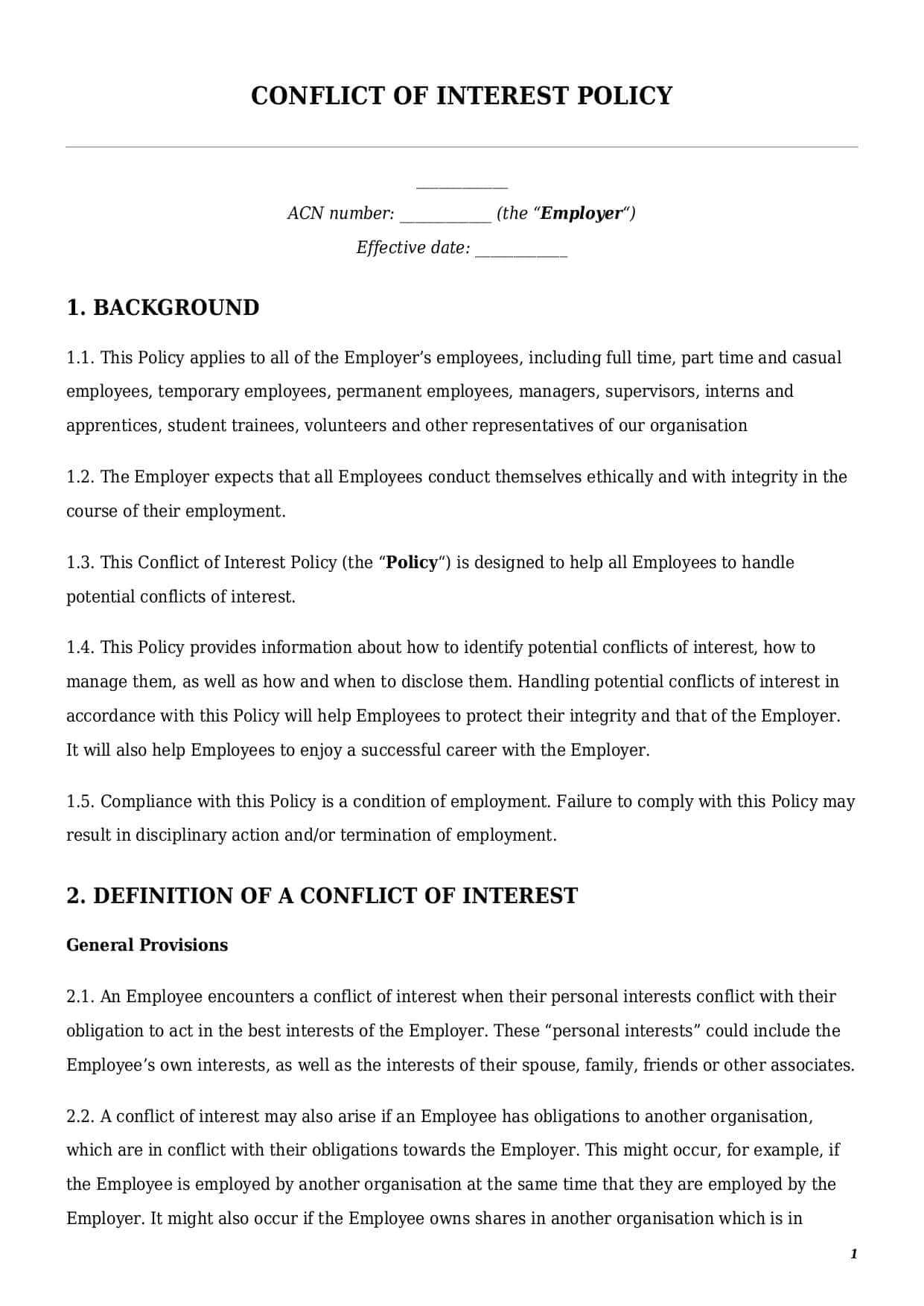
A policy for conflict of interest is an internal corporate document that establishes a clear legal framework for reporting, handling and managing conflicts of interest at the workplace. Once implemented, the policy becomes a mandatory list of guidelines that part-time, full-time and casual employees working within the organisation must follow on a daily basis.
Solid and well-written conflict of interest policy templates help to mitigate employees’ transparency issues and prevent reputation or financial risks for the company, as well as strengthen overall corporate governance within the organisation. This template is being used widely by Australian businesses, SMEs, startups, charities, and other for-profit organisations.
This document is being used in conjunction with the Employee Handbook and Company Whistleblower Policy.
Key Benefits of the Company Conflict of Interest Policy Template
By customising this policy with FasterDraft, you get the policy with the following benefits:
- a document that is available for an affordable price and saves you lots of time and costs;
- a policy that is ready for immediate implementation in your company;
- a document that fully aligns with best Australian business practices;
- a template that complies with the Fair Work Act 2009 and the Corporations Act 2001;
- a document that is created by real legal professionals and never by AI;
- a template that can be customised for businesses of various types or charities operating in Australia.
What should be included in the policy for conflict of interest?
A standard conflict of interest policy must include three core elements:
Definition of Conflict of Interest
Before outlining the measures and procedures on handling the conflict of interest, it is important to make sure that both the employer and the employee understand what a conflict of interest actually means.
Thus, the text of the policy should provide a clear definition along with the most common examples of workplace situations where conflicts may arise. There is a common misconception that a conflict of interest is only relate to money or other financial gains. The policy should emphasise that the conflict of interest does not necessarily involv direct financial benefits.
Employee Disclosure Duties
The policy must outline the list of the employee duties in relation to the policy, including the following:
- comply with all provisions of this policy;
- promptly and immediately report about any potential, actual or perceived conflicts;
- take a proactive approach by reporting the conflict of interest of other employees, etc.
Reporting and Management
Every company conflict of interest policy template must provide the detailed plan of actions the employee shall follow to report the conflict of interest, including:
- full name and job title of a person to whom the reporting should be made;
- means of communication; and
- timeline.
Apart from that, the policy shall explain what will happen after the report is made and how the process is handled in general.
Examples of Usage of Conflict of Interest Policies in Australia
A conflict of interest is not an abstract thing. Thousands of businesses operating in Australia regularly face situations when personal decisions interfere with working duties. Below are the three most typical scenarios that may arise and compromise the company’s integrity.
Hiring Relatives or Family Members
It is common for many organisations to employ family members or relatives. While there is no law that can limit hiring family members or relatives, such relationships may affect an employee’s ability to perform their job duties properly.
For example, let’s imagine a situation where David and Olivia are a married couple working within the same organisation. Olivia is a compliance manager, and David is an accountant. During a regular compliance check, Olivia discovers that David does not follow internal procedures related to onboarding new clients properly. As a compliance manager, Olivia has to report the breach, but she may feel conflicted about putting her husband’s job at risk.
A solid conflict of interest policy template Australia can address such a situation by limiting the appointment of family members or relatives in roles involving direct supervision of one another.
Using Confidential Information
In certain cases employees may use the employer’s confidential information to profit personally.
For example, Mark, who works as an accountant, has unlimited access to the company’s recent financial reports, giving him additional leverage when advising third parties either to invest in the company’s shares or not.
A comprehensive conflict of interest policy template should explicitly prohibit the employee’s trading, sharing or transferring the company’s strategic financial or accounting information to a third party for or without compensation.
Accepting the Gifts
While on duty some employees may closely interact with the employer’s customers, clients, contractors or suppliers. Sometimes third parties may provide the company’s employees with unsolicited gifts or compensation in favour of getting some decisions, guarantees or outcomes. This risk is particularly relevant for employees with decision-making roles.
For example, Victoria is in charge of the company’s tender process. After their unsuccessful bid, a supplier sends Victoria a very expensive gift on the occasion of her birthday. Although Victoria may feel no obligation to reciprocate, the situation creates a perceived conflict of interest.
To avoid situations like that, the solid sample conflict of interest policy template shall limit acceptance by the employees of any gifts from the employer’s direct contractors, clients, or customers.
How to customise a conflicts of interest policy with FasterDraft?
To get a fully customisable policy template, follow a few easy steps below:
- Click the “Create Document” button.
- Answer simple questions in the form.
- Select a template’s format – conflict of interest policy template PDF or Word.
- Make a payment.
The document is ready for instant download immediately after the purchase.
Table of content
Frequently Asked Questions (FAQ)
-
1. Is a conflict of interest policy mandatory in Australia?
No, having a policy for conflict of interest in Australia is not mandatory for either for-profit companies or charitable organisations. At the same time, it is a standard business practice to have one to prevent cases in which personal interests or favouritism interferes with workplace and business decisions.
-
2. Can small businesses use this template?
Yes, conflict of interest policies can be adapted by startups, small businesses, companies with few employees, well-established businesses, as well as charity or non-profit organisations.
-
3. How often should the policy be updated?
A conflict of interest policy template must provide certain basic rules regarding its regular updates and review, including:
- after changes in the company’s internal documents, including company constitutions, charity bylaws, etc.;
- after major organisational changes in the company, including new appointments or staff members;
- once the Fair Work Act 2009 is amended.
It is also highly recommended to review this policy for conflict of interest at least once a year to make sure it aligns with other employers’ policies, such as the Employee Handbook, Anti-Discrimination Policy, etc.
-
4. Is this legally compliant for Australian companies?
Yes, this conflict of interest policy template is created in compliance with the main provisions of the Fair Work Act 2009 dealing with favouritism at work and non-discrimination, as well as the Corporations Act 2001 dealing with corporate duties and obligations of appointed secretaries, directors and other officers within the company.
-
5. What is a board of directors conflict of interest policy?
This is a special type of conflict of interest policy in Australia used to address actual, potential or perceived conflicts within the board of directors managing the daily business of the company or organisation.