
.svg)
 United Kingdom
.svg) USA
USA

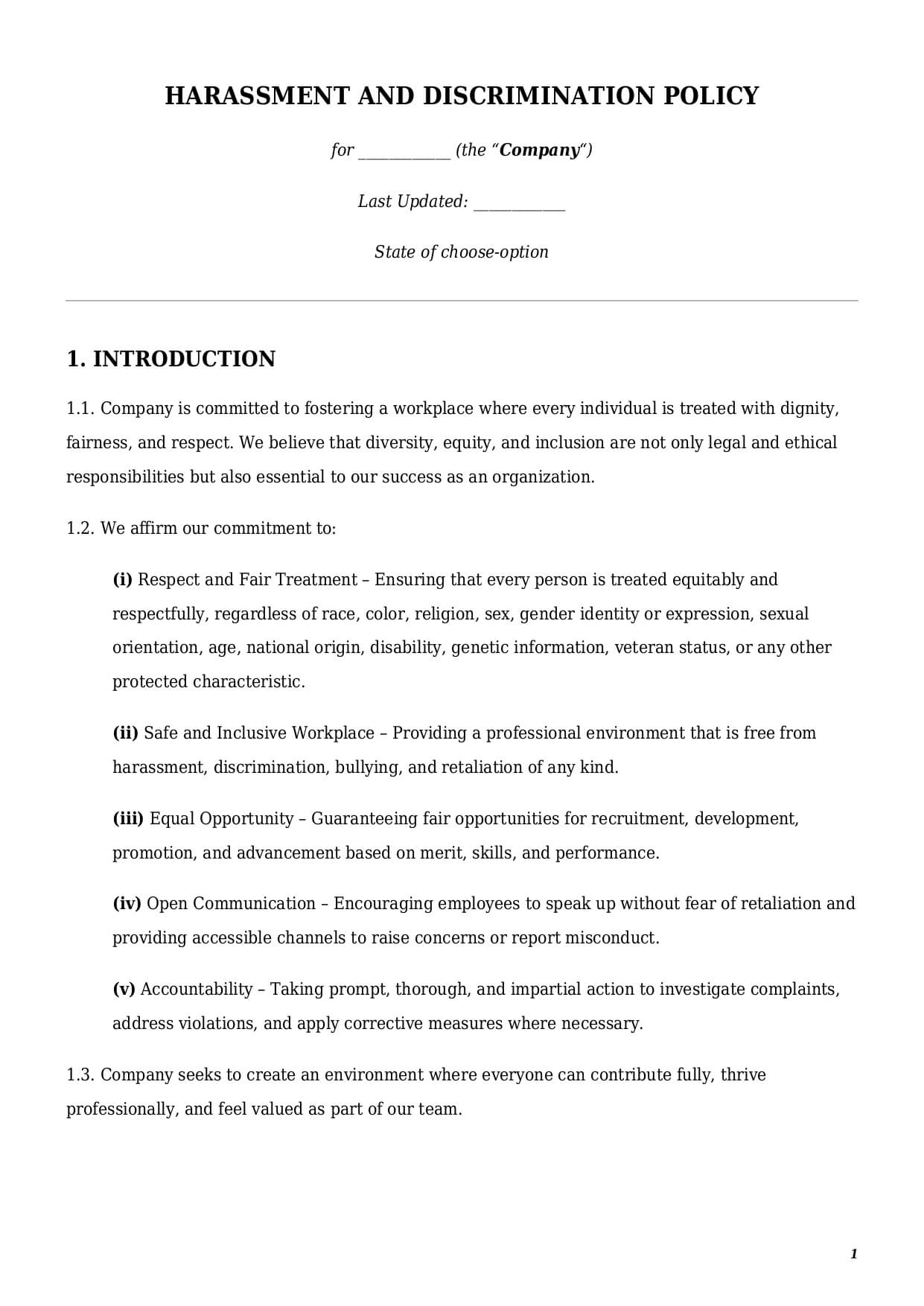
What is an anti-discrimination policy?
An anti-discrimination policy, also known as an equal opportunity discrimination and harassment policy, is an internal corporate document used by Australian employers to prevent any forms of discrimination in the workplace and ensure overall compliance with the National Employment Standards.
This policy for discrimination determines:
- the scope of the policy’s application
- the list of unacceptable behaviour
- the definition of discrimination, harassment and bullying in the workplace
- the detailed list of responsibilities of staff, employees and the company’s management, complaint procedures, and
- the list of disciplinary procedures in case of the policy’s violation.
Anti-discrimination policies help to create an inclusive environment and equal opportunities for all employees at the workplace, despite their religious, political, marital, ethnic, and sexual backgrounds.
Who should use this template?
This bullying and harassment policy template Australia can be used by:
- small businesses without an in-house legal team;
- fast-growing startups hiring employees at a fast scale and willing to ensure compliance with the Australian legal framework;
- established Australian businesses looking for a solid template to update their existing discrimination policies;
- HR managers and directors looking for a comprehensive policy template to use internally;
- employers with a diversified and multicultural environment at the workplace are willing to protect all employees against any forms of discrimination.
What should be included in the anti-discrimination policy template?
A standard discrimination policy must include:
Definitions of discrimination and harassment
Any protection against discrimination starts with its definition. The text of the policy should outline detailed definitions of discrimination, harassment and bullying in the workplace. It is common practice to list common examples of discriminatory actions that usually fall within the scope of discrimination, harassment or bullying, including:
- sarcasm, verbal abuse;
- jokes, and unwanted nicknames;
- threatening language;
- non-constructive criticism
- blaming a person for things that are not their fault;
- unfair work practices, including unfair dismissal, deprivation of workplace benefits, unreasonable refusal of requests, etc.
Employee rights and responsibilities
At the heart of every policy for discrimination is a binding principle that any forms of bullying, harassment, victimisation and discrimination are unlawful in Australia and are not accepted by the employer. In this regard, the policy must outline the detailed list of the employees and the management rights and responsibilities.
Complaint and reporting procedures
The key element for every anti-discrimination policy template Australia is a procedure for reporting a discrimination, harassment or bullying complaint. The policy must include the following information:
- To whom the complaint should be addressed;
- How exactly the complaint should be filed (online submission, in person, by email);
- What is the review process (employees should be given clarity with regard to how long their complaint is being investigated and processed)?
Some businesses in Australia may also offer the list of additional support measures to employees who have suffered from bullying, discrimination or harassment at the workplace. Amongst them, free psychological support, temporary leave from work, etc.
Disciplinary Measures
Anti-discrimination policies should provide the list of disciplinary measures applicable to those who violate the policy. The standard list of measures usually includes the following:
- warning to employee;
- temporary suspension from work;
- termination of employment (in case of continuous violation of this policy).
Some Australian employers may also include measures such as refusal of further promotion, refusal of providing remote work arrangements, etc.
What are the key features of this anti-discrimination policy template?
By customising this policy template you get the following benefits:
- a corporate policy that aligns with the main requirements of the Fair Work Act and the National Employment Standards (NES);
- a professionally drafted policy that saves legal costs;
- an Australian-specific policy template suitable for any type of business operating in Australia;
- a full personalised legal template, and not a generic document created by AI;
- a template that covers all protected characteristics, including gender, sex, age, marital status, etc.;
- a document template that is ready for instant use immediately after the purchase and download;
- a template that significantly reduces compliance risks within your organisation and helps to efficiently manage and prevent workplace discrimination.
Step-by-step guide for anti-discrimination policy template
After the document is customised and downloaded, the employer should ensure execution of three important steps below:
Read the Policy
This bullying and harassment policy template Australia should be carefully read prior to its signing. The employer should double-check the following:
- Scope of employees to whom this policy shall apply. Make sure that you do not forget to include all staff, customers, clients or contractors whom you want to obey the provisions of this policy.
- Other policies. Make sure the final anti-discrimination policy does not contradict other workplace policies such as the employee handbook, company whistleblowing policy, etc.
- Employees in charge. Make sure that an employee who is being appointed as a first point of contact to handle discrimination at the workplace is aware of that appointment and is well instructed about their duties and responsibilities.
Policy Acknowledgement
Once the policy is signed and dated, it shall be communicated to all employees and staff members to whom it shall apply. The policy becomes binding upon employees only after their acknowledgement. The process of acknowledgement of corporate policies in your organisation is usually governed by the employee handbook. Depending on what is said in each business’s employee handbooks, the policy can be acknowledged in either of the following ways:
- by putting an employee’s signature on a document’s copy;
- by distributing hard copies of the policy in the workplace;
- by sending a copy of this policy to each employee’s work email;
- by publishing a copy of this policy in the company’s internal database, etc.
Update the policy
There is no mandatory timeframe within which the policy should be regularly updated. However, this is a good business practice to review this anti-discrimination policy:
- at least once a year (mandatory);
- immediately if major organisational or structural changes happen to the business;
- immediately if federal discriminatory laws change, including the Racial Discrimination Act 1975 (Commonwealth), the Disability Discrimination Act 1992 (Commonwealth), etc.
- immediately if other businesses’ internal corporate policies change significantly.
How to customise this anti-discrimination policy with FasterDraft?
To get a fully customisable document template, follow a few easy steps below:
- Click the “Create Document” button.
- Answer simple questions in the form.
- Select a template’s format – discrimination policy template Australia PDF or Word.
- Make a payment.
The document is ready for instant download immediately after the purchase.