
.svg)
 United Kingdom
.svg) USA
USA

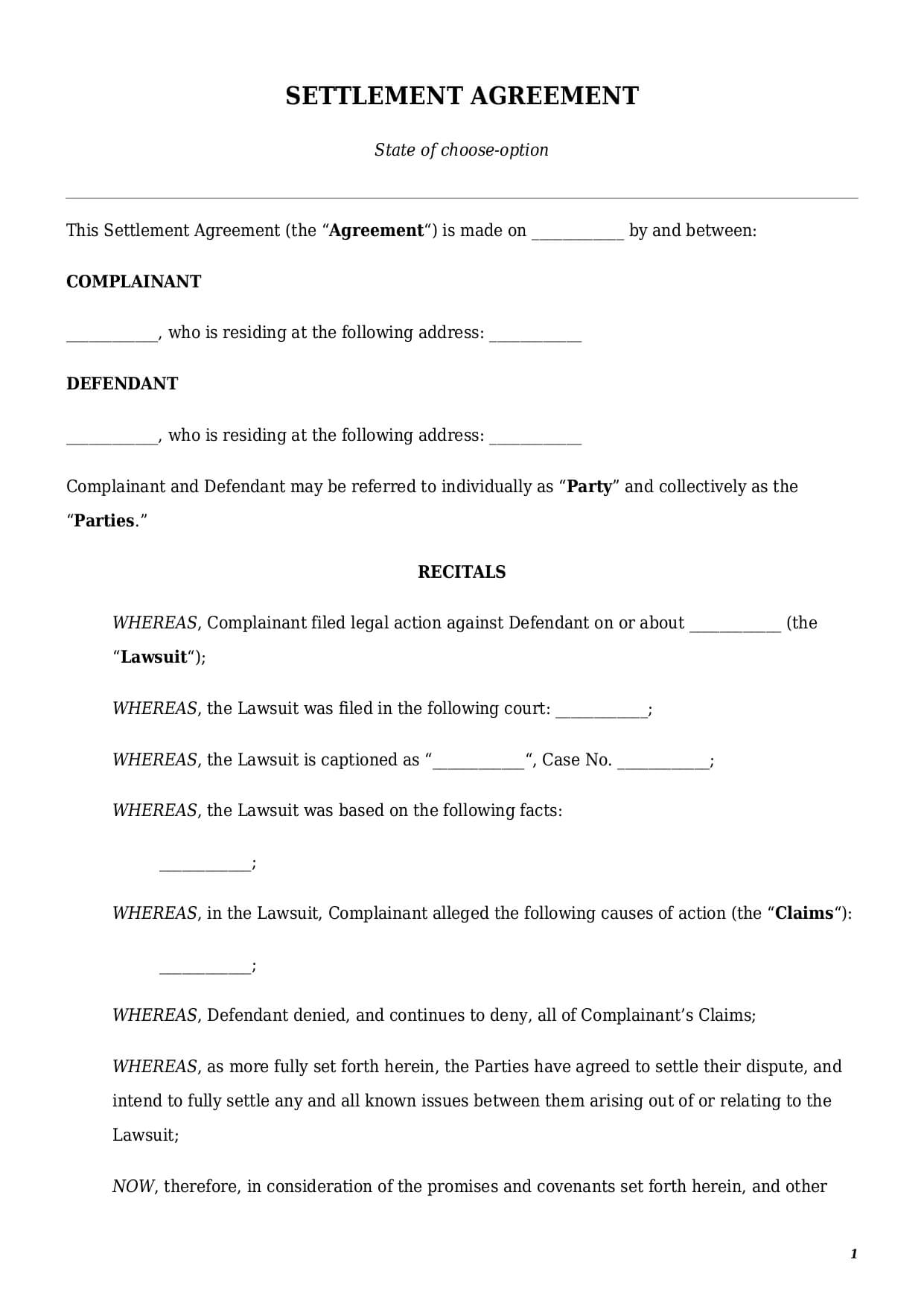
What is a settlement agreement?
A settlement agreement is a legally binding document by which parties stop ongoing administrative or legal proceedings between them in relation to contractual, family, employment, tax or civil matters. A legal settlement agreement template binds both parties to stop the ongoing proceedings, to provide monetary or non-monetary compensation, as well as to perform any other additional actions, including cleaning the credit record or non-disparagement clause.
For the settlement of claims and liabilities before going to the court, parties shall use a separate deed of settlement and release.
This document can be used for mediation of various types of disputes, including the disputes between:
- founders and shareholders;
- contractors;
- employee and employer;
- Australian Taxation Office and individual taxpayers;
- drivers.
A solid deed of settlement template allows one to avoid costly litigation and save costs, to settle disputes in a predictable way, and to protect the interests of both parties involved.
What should be included in this settlement agreement template?
A standard settlement agreement in Australia should have the core clauses listed below:
Dispute Details
The contract should outline the reason for the dispute and its key facts. It is also important to list identification details of both parties signing this agreement, including
- full legal names;
- contact details;
- ACN/ABN number (for a business or company);
- registered business or mailing address.
Settlement Terms
Each deed of settlement shall define the scope of the release, which usually includes:
- bar to further proceedings (both legal and administrative);
- payment of monetary compensation (optional);
- provision of non-monetary compensation, such as public excuses;
- no admission of liability by either party;
- full and final settlement for all claims in connection to the ongoing dispute.
Confidentiality Obligations
A good example of a mediation settlement agreement usually includes a simple confidentiality clause that requires both parties to keep confidential the details of the settlement arrangement. Parties can either add this clause directly in the document or sign a separate confidentiality agreement.
Non-Disparagement
Inclusion of this clause is common for all Australian settlement agreements. Under this clause each party undertakes not to disparage, denigrate or harm the reputation of the other Party or any officers, employees, directors, agents, contractors, assignees, successors or other representatives of the other Party. By this clause are also covered cases of gossiping, spreading rumours or false information about each other.
Who shall use this settlement agreement template in Australia?
A deed of settlement template has a wide application within Australia and can be used by:
- employers willing to reduce reputation risks and settle workplace disputes quietly;
- small business owners searching for a legal tool to reach a settlement regarding unpaid invoices;
- private parties looking to settle individual disputes out of the court;
- legal professionals looking for a simple settlement agreement to be used on a daily basis.
Step-by-step Process of Settling Legal Disputes in Australia
Make the Offer
Not all court disputes in Australia can be settled. Among them are criminal cases, child custody, bankruptcy cases, cases involving state interest, etc. Therefore, first it is important to make sure that the ongoing dispute you are willing to settle is eligible for the settlement in Australia.
Any settlement process in Australia starts with sending a settlement offer from one party to a dispute to another. The text of the offer shall briefly suggest terms and conditions of the proposed settlement, as well as the deadline for its acceptance.
Sign the Settlement Agreement
If the other party to a dispute accepts the offer, parties can proceed immediately to signing an out-of-court settlement agreement Australia. The document should be signed in the presence of witnesses.
Submit to the Court
Once the settlement agreement is dated and signed, it should be sent to the court to stop the legal proceeding.
Why choose this legal settlement agreement template?
By customising this out-of-court settlement agreement Australia, you get the template with the following benefits:
- a document that is suitable for your particular type of the dispute, such as property, injury, unpaid invoice, or car accident;
- a document with clear wording and professional structure aligned with Australian contract law;
- a customisable template suitable for monetary and non-monetary settlements;
- a document that offers a balanced legal protection for both parties involved.
How to customise this settlement agreement template for Australia?
To get a fully customisable document that can be used across all Australian states and territories, follow a few easy steps below:
- Click the “Create Document” button.
- Answer simple questions in the form.
- Select the template’s format – PDF or Word.
- Make a payment.
The document is ready for instant download immediately after the purchase.