

.svg)
.svg)
Deed of Settlement and Release
 PDF and
 Word
Word
This deed of release template Australia helps parties resolve disputes and release liabilities before going to the court. Ideal for businesses, partners, shareholders, and service providers dealing with the release of commercial, contractual, and civil claims in Australia.
Reviews

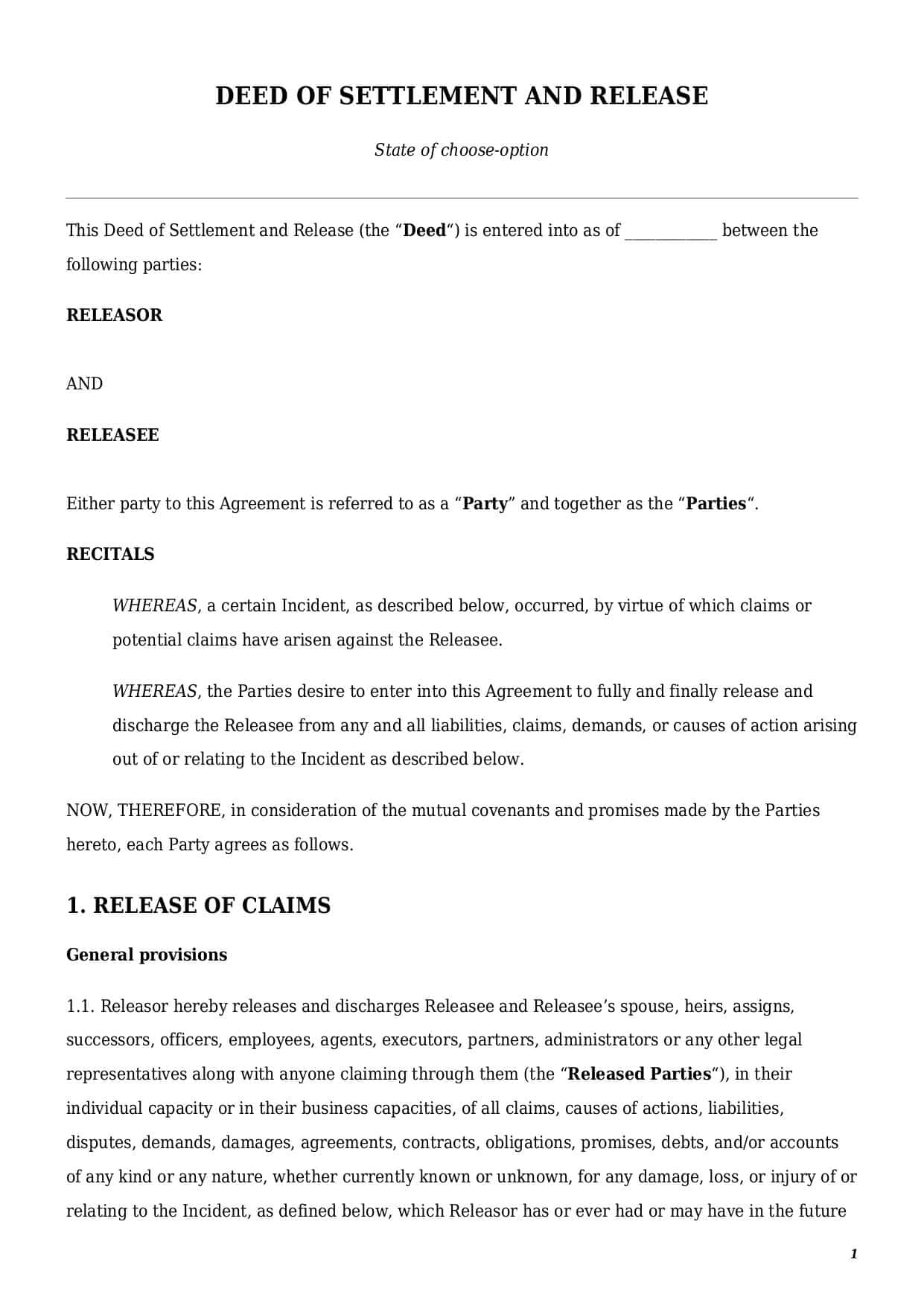
What is the deed of settlement and release in Australia?
A deed of settlement and release, also known as a release agreement, is a legally binding document used by parties to resolve a dispute and release each other from liabilities and claims arising from contractual or non-contractual relationships. The document is commonly used to mitigate existing or potential disputes before they escalate to the court proceedings.
Entering into a deed of settlement and release in Australia is not mandatory. Though lots of businesses and individuals choose this option to minimise potential conflicts and to resolve disputes at early stages. Once signed, the document becomes legally binding and enforceable for the parties involved.
This deed of release and indemnity template records the main terms and conditions of the release, including the scope of the release, important legal disclaimers, compensation, confidentiality and mutual obligations of the parties. This template is suitable for the release of commercial disputes, partnerships or shareholder conflicts, civil claims arising out of incidents or non-contractual relations, provision of services and works, and similar matters.
However, this deed of release and indemnity template cannot be used in situations when:
- There is an ongoing legal proceeding between the parties.
- The release concerns the criminal liability.
- The release attempts to override certain statutory rights that cannot be compromised (for example, certain consumer rights, employment rights, whistleblower rights, etc.); and
- other circumstances specifically outlined in applicable state or territory laws.
What should be included in this deed of settlement and release template?
A simple deed of release template Australia normally includes the following key components:
- Details of the Parties. Full identification details of a releasing party and released party should be outlined in the document, including full legal name, ACN and ABN number (for companies), and contact mailing address.
- Details of Relationship. This section of the document should outline details of existing contractual or non-contractual relations giving rise to the claim, debt, liability or dispute. It is important to state also the date, if known, on which such relations or incidents occurred.
- Type of Release. The document can be of two different types – a one-way or mutual release agreement. In a one-way release, one party releases another from claims, debts and demands arising from their relations. In a mutual release, both parties release each other.
- Scope of Release. Another key element for every deed of release sample is the definition of the scope of the release or which claims should be covered. It is common to release against all existing claims, debts, demands, suits, actions, proceedings or other liabilities. Thought parties may also add such future claims if needed.
- Compensation. In consideration of the release, the released party is entitled to the recipient of non-monetary or cash compensation. Thus, the deed of release and indemnity template should stipulate the amount of such compensation and the timeframe within which it should be paid.
- Bar to Further Proceedings. A solid deed of release often includes an additional clause under which both parties mutually agree to not pursue any further proceedings to any claims, debts or demands arising from the relevant contract or incident.
- No admission of liability. Signing a deed of release does constitute an admission of liability in full or in part by either party. The settlement reached by both parties in the present agreement should be considered full and final.
- Confidentiality clause. It is common to include a simple confidentiality clause that may prevent both parties from disclosing any provisions of the deed of release to third parties. A confidentiality obligation becomes effective upon signing the deed and remains in force usually between 1 and 3 years. If parties want to, they can also sign a separate confidentiality agreement instead.
- Date and Signature. Once the document is ready, both parties must sign and date it. Without either party’s signature, a document cannot become legally valid.
Why choose this deed of release and indemnity template from FasterDraft?
By customising this document template with us, you get the following benefits:
- a document 100% tailored for your specific needs;
- a template that is created by real lawyers and never by AI;
- a document that is fully compliant with relevant Australian laws;
- a fully customisable template in PDF and Word.
How to customise this deed of release template with FasterDraft?
To get a fully customisable document template, follow a few easy steps below:
- Click the “Create Document” button.
- Answer simple questions in the form.
- Select a template’s format – deed of release template PDF or Word.
- Make a payment.
Your deed of release and indemnity template is ready for instant download immediately after the purchase.
Table of content
Frequently Asked Questions (FAQ)
-
1. What is a mutual release agreement in Australia?
A mutual release agreement, known also as a deed of mutual release, is a legally binding document between two parties who release each other from a legal liability arising out of a certain incident or contract.
In other words, under the mutual release, both parties get a monetary or non-cash compensation.
-
2. Should I use free deed of release templates available on the Internet?
Using any free legal template from the Internet can be risky for different reasons, including:
- a document is not suitable for your specific case;
- a document may include errors.
- a document generated by AI, and not by real lawyers;
- a document that is not suitable for usage in Australia.
It’s safer to customise legal documents via reputable online platforms such as FasterDraft. We provide lawyer-prepared legal document templates at an affordable price.
-
3. Do I need a lawyer to customise this deed of settlement and release template?
No. You do not need a lawyer to answer questions in the form or for customisation of the template. Even though we ask questions in the form, we do it in such a way so that questions are easy to understand.
However, you may wish to seek legal advice to understand the broader legal and financial consequences of signing a deed of release in Australia.
-
4. Which laws apply to an Australian deed of release?
There is no uniform law that applies to deeds of release in Australia. In general, the basic principles of contract law shall apply along with the relevant state and territory legislation related to civil liability.
-
5. Can this deed be used for business disputes?
Yes, the present deed of release template can be customised to release one or both parties from a contractual liability arising from independent contractor agreements, joint venture agreements, service agreements, sale of goods agreements and other business-related contracts.