

.svg)
.svg)
Employment Deed of Release
 PDF and
 Word
Word
This employment deed of release is commonly used in Australia when employment ends due to termination, redundancy, or mutual separation, or when the parties wish to resolve a workplace dispute without litigation.
Reviews

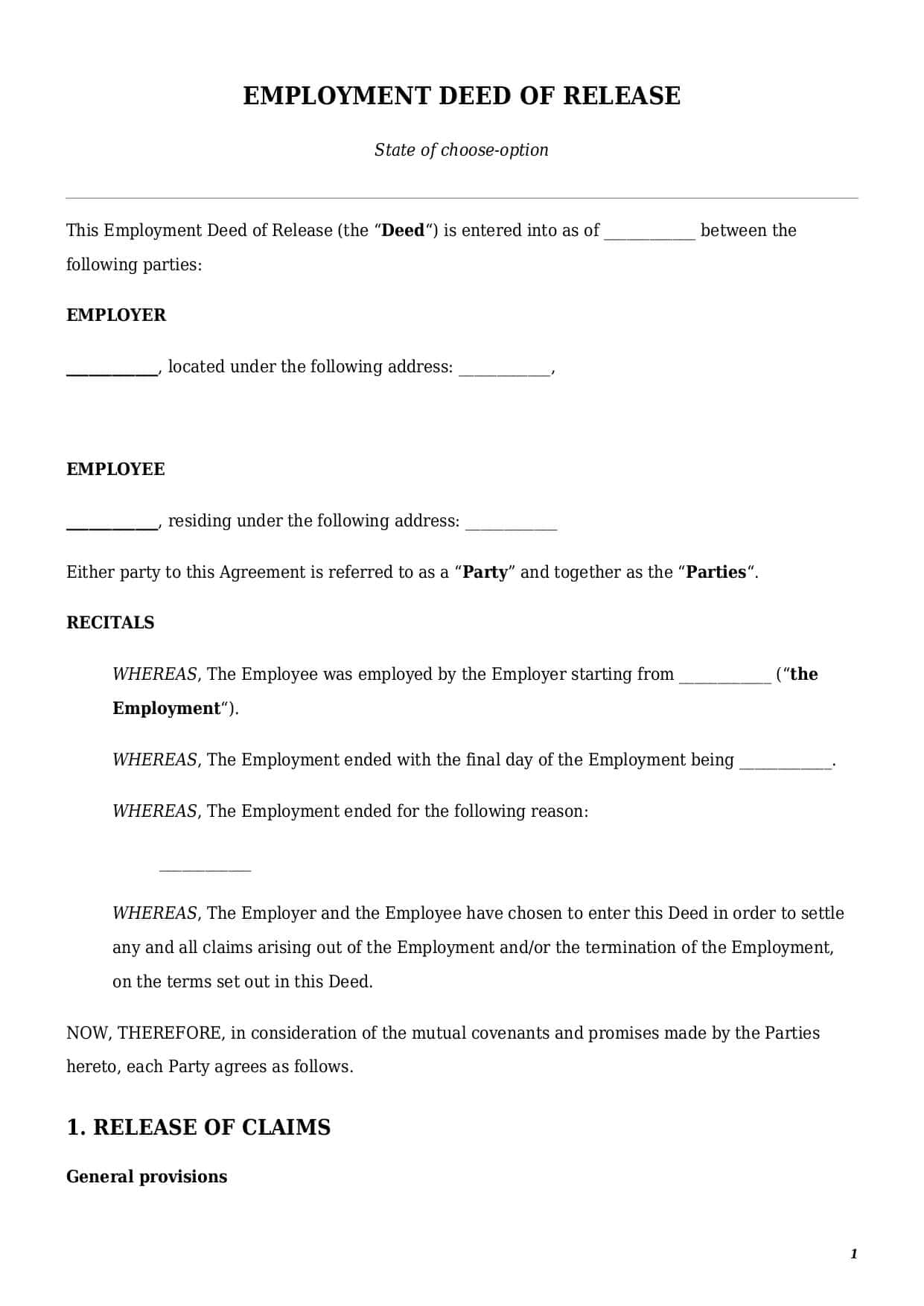
What is a deed of release of employment?
An employment deed of release is a legally binding agreement used in Australia to formally settle and finalise matters arising from the end of an employment relationship, including claims, demands or disputes. The main purpose of this document is to record the termination of employment and confirm that both parties release each other from future legal claims connected with the employment or its termination.
A deed of release employment sample is widely used in Australia by startups, established businesses, online companies and sole traders to terminate employment in a compliant way. In most cases, the employee agrees to release the employer from existing or potential claims arising from the employment or its termination, usually in exchange for a settlement payment or other benefits.
A compliant Fair Work Deed of Release defines the conditions under which the employer is being released from any claims, demands or disputes related to the employment or its termination, including:
- scope of release;
- amount of compensation;
- confidentiality obligation s;
- details of the parties involved; and
- applicable law.
When should this employment deed of release be used?
A solid deed of release employment sample is a practical legal solution when:
- ending employment relations in the case of a redundancy;
- termination of a fixed-term employment contract;
- ending the employment contract due to failure to pass the probation period;
- termination of employment because the employee failed to comply with internal policies, etc.
What should be included in the deed of release employment template?
The full and complete deed of release of employment must include a number of important elements:
Details of the Parties
This is one of the most important sections of the document since it defines the party who is being released, such as an employer, and the party who provides the release, such as an employee. The document must include their full legal names, ABN and ACN numbers (for the employer), registered business address or mailing address, contact email and phone number.
Scope of Release
It is not sufficient to simply state that the employer is being released from all claims. The scope of release is more detailed in nature, thus the following components should be addressed:
- Who is released? It is evident that the employer is the one who is being released under this deed of release employment. However, parties may also include a wider scope, such as the employer’s successors, officers, employees, partners, contractors or agents, who could also be covered by such a release.
- Which claims are being covered? The concept of a claim is a broad, therefore the document should give some clarity on which types of claims are covered. The parties may cover claims for loss, damage or injury that relates to employment or its termination, claims that are currently known and claims that may be unknown, any demands, damages and disputes.
Compensation
To make a deed of release Fair Work Act 2009 compliant, an employer is required to pay compensation to an employee. Such compensation is not the same as an employee’s entitlements associated with their work and employment, including wages, salaries, bonuses and other entitlements. The compensation under the employment deed of release is the other type of compensation that should be paid on top of such entitlements. Besides, Australian law does not prescribe a specific threshold or amount for such compensation.
Obligations of the Parties
In Australia, the employment deed of release template usually includes the list of additional obligations parties should additionally follow:
- Confidentiality Obligations. Parties are usually required to keep matters discussed and agreed upon in the text of this deed confidential, including the amount and nature of any consideration and the circumstances of the employment.
- Employment Reference. Parties may agree that the employer is required to provide an employment reference letter following termination of employment. This is optional, though lots of employment deeds of release in Australia tend to have that clause.
- Job Placement Assistance. An employer can agree to provide assistance to a former employee in seeking new employment opportunities elsewhere.
- Non-disparagement. This is a mutual obligation for both parties not to disparage, denigrate or harm each other’s reputation.
Australian Deed of Release Employment Checklist
After this deed is ready, parties have to complete a few additional steps to finalise the document.
Read the Document
Both parties must carefully read the document to make sure it correctly reflects their initial intentions. For an employee, it is highly recommended to take additional legal advice to ensure that they, as the weaker party in employment relations, understand the consequences of signing this deed.
Sign and Date the Document
After that, parties must sign this deed of release employment Australia to make it legally binding. Without either party’s signature, the document is not enforceable in the court. It is advisable to sign the document in two identical copies, one copy per person.
There is generally no requirement to register or notarise the document. However, each party’s signature should be additionally witnessed by at least one witness. A suitable witness should be at least 18 years old, of sound mind, and not directly interested in the outcome of the transaction.
Comply with the Document
Once this deed of release termination of employment template has been signed, parties must comply with its provisions. Therefore, it is important to periodically review the document to remain aware of any ongoing limitations and restrictions.
Since an employer is required to pay compensation to an employee for such a release, the payment should be made in full within the timeline stipulated in the document.
How to customise this employment deed of release with FasterDraft?
To get a fully customisable document template, follow a few easy steps below:
- Click the “Create Document” button.
- Answer simple questions in the form.
- Select a template’s format – deed of release employment template PDF or Word.
- E-sign online.
- Make a payment.
The document is ready for instant download immediately after the purchase.
Table of content
Frequently Asked Questions (FAQ)
-
1. Is an Employment Deed of Release legally binding in Australia?
Yes, the deed of release employment becomes a legally binding document once it is signed by both the employer and the employee.
-
2. Does a deed of release prevent unfair dismissal claims?
Yes, the main purpose of an employment deed of release is to protect the employer against potential and future claims from employees related to unfair dismissal, failure to pay entitlements and compensation, including any damage, loss or injury in relation to the employment or its termination, and so on.
-
3. Do I need a lawyer to use this template?
No, you do not need a lawyer to complete the questionnaire and download the document from the website. However, you may need a lawyer to understand the general consequences of signing this deed of release employment template. On top of that, if you are an employer, it is important to make sure that the termination of employment itself is compliant with the provisions of the Fair Work Act 2009 and the National Employment Standard (NES).
-
4. Can this employment deed of release be used for redundancy?
Yes, you can customise the present template for various situations, including when employment is being terminated due to the employee’s low performance, failure of the probation period, harassment or discriminatory behaviour at the workplace, including redundancy.
-
5. What is the deed of release redundancy?
This is a special type of deed that is being signed between employer and employee whose employment is being terminated due to redundancy.
-
6. What is the difference between the employment deed of release and the general deed of release?
The present document is suitable only for employers and employees who are willing to terminate existing employment contracts. By virtue of the employment deed of release template, an employer is being released against all existing or future claims an employee may have in relation to their employment in general, termination, etc.
By contrast, a general deed of release is being used for the release of claims in any other situations where claims arise out of existing contractual relations between the parties, such as a service agreement or work contract, or accidents like a car crash, etc. The general deed of release has a broader scope of application. Apart from that, the general deed allows both one-way and mutual release of claims, while the employment deed of release relates only to one-way release by the employee.