

.svg)
.svg)
Roommate Lease Agreement
 PDF and
 Word
Word
Roommate Lease Agreement, also widely known as a roomshare agreement, is a private contract between individuals sharing a common residential space such as house or apartment and who are willing to define mutual rights and obligations of co-habitation, including cleaning rules for common space, quiet time, weekly chores, pet permission accommodation etc.
Reviews

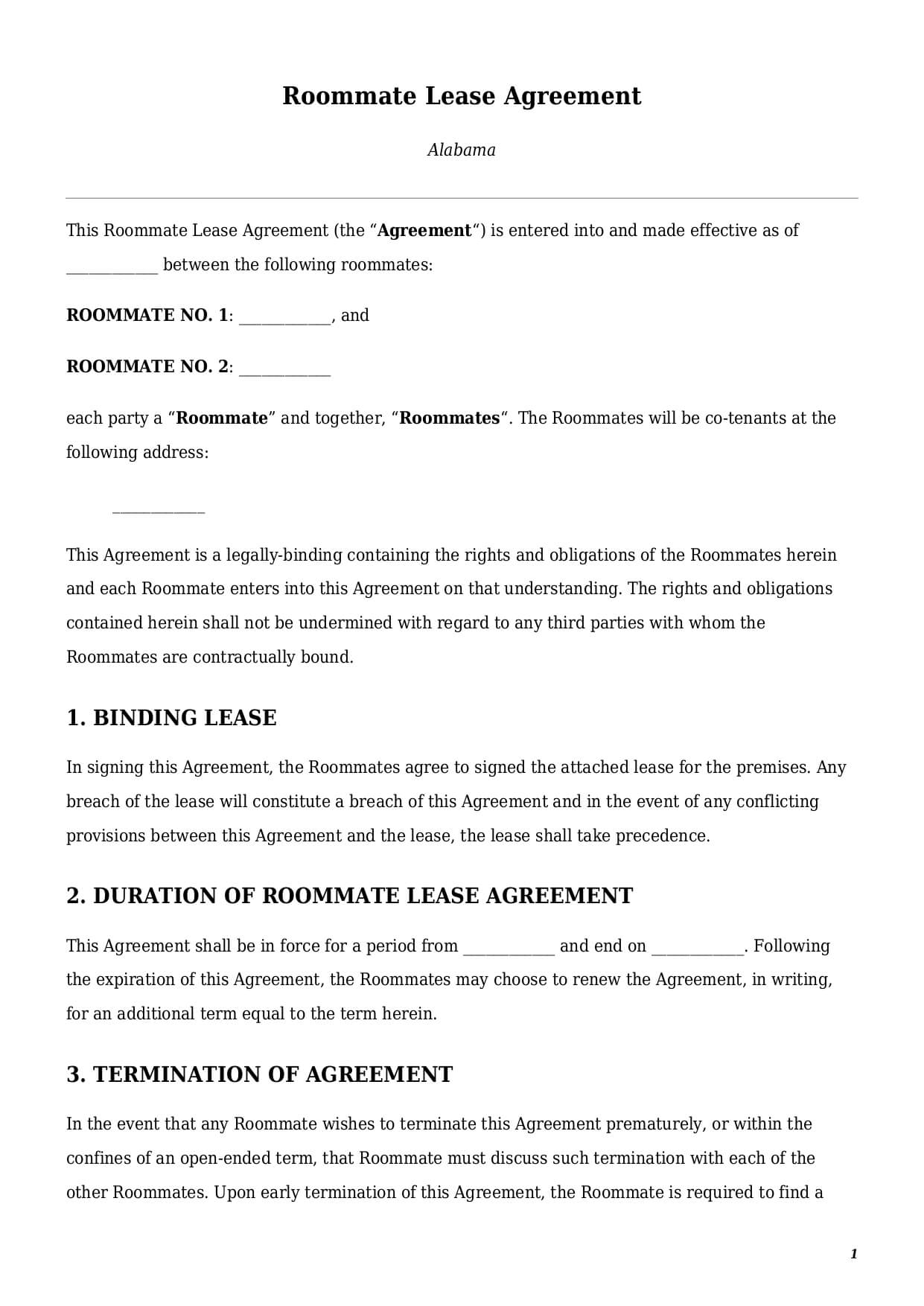
What Is a Roommate Rental Agreement?
A roommate rental agreement is a contract between two or more individuals who are planning to rent a living space together or already residing in it and are willing to set up rules of co-living, including rent payment obligations, cleaning schedule, and usage of common areas. This document template is widely used across the U.S. between co-tenants residing in houses, apartments, or other residential premises together, and who are not a couple of family members.
Room sharing is particularly popular in expensive cities such as New York, San Jose, San Francisco, or Boston, as it allows you to save housing costs significantly. For example, in New York a studio apartment will cost you roughly $2,500-4,000 per month depending on the area, excluding monthly utilities, which add up to $150-200 on top of the monthly rent. If you choose to share an apartment with a roommate, you can get a decent place to live for about $1,200-1,800 per month and divide additional utilities costs by two or three times depending on the number of roommates.
When should I use a roommate lease agreement?
You may need a roommate lease template in various situations:
- Setting up Common House Rules: Liam and Ethan are the best friends. They plan to move to another state together for work. To split the costs, they decide to rent a two-bedroom apartment together. A few months later, Ethan loses his job and can’t pay his part of a rent payment. On top of that, he invites his friends all the time, which creates a constant noise. Liam suggests preparing a sample roommate agreement to define the rules of co-living.
- Finding a College Accommodation: Peter has recently received a college enrollment letter. He did not apply for a student’s accommodation on time. Now, there are no free spaces in a student’s residency. Peter offers John, his new classmate, to find an apartment somewhere in the city. They start discussing together future terms of the roommate rental agreement contract.
- Relocating for Work: Jessica has got an internship in a high-profile law firm in a big city. If she passes the training well, she might get a job offer. Jessica’s salary is low and can’t afford to rent the whole apartment. She is seeking roommates to sign a roommate rental agreement to share accommodation costs.
- Reducing Accommodation Costs: Sarah has moved to New York. The renting prices are high, so she decided to look for someone with whom she can split up lease payments. At the same time Sarah values her privacy and comfort. She plans to sign a simple roommate lease form to set up some basic rules about cleaning and quiet time.
- Finding a New Roommate: John split up with his girlfriend last month, and she moved out. He can’t afford to rent out the whole place on his own. Moving out is also not an option, as his current place of living is close to his job. John values his privacy the most. He may need to have a basic roommate rental agreement to define the rules about the usage of common areas, as well as quiet time.
Choosing the right agreement—know the difference between a roommate agreement, a room rental agreement, and a sublease agreement
Whether you are moving in with your friend or co-worker for the first time, or you have done it numerous times, choosing the right legal foundation for room-sharing relations is vital to protect yourself against potential disputes in the future. You might have already stuck in understanding the difference between roommate agreement, room rental contract, and sublease agreement. While all of them can be potentially used for the lease, they have a different purpose.
| Sublease Agreement | Roommate Agreement | Room Rental Agreement | |
|---|---|---|---|
| What is all about? | An existing tenant rents all or part of the leased property to another person (subtenant). The tenant becomes a “landlord” for such a subtenant. | Co-tenants (roommates) set out the rights and responsibilities for sharing the same home. | A property owner rents out a single room in a house/apartment to a third party (tenant). |
| Parties | Original tenant and subtenant. Landlord may also consent if required. | All roommates. | Property owner and room renter. |
| Landlord’s role | Does not create lease relationships between the subtenant and landlord directly. Depending on the original lease agreement, the landlord’s prior written consent for sublease may be required. | Does not create a landlord-tenant relationship. Landlord is not obliged by the provisions of this agreement. | Creates a landlord-tenant relationship between the parties. |
| Who remains liable before the landlord | The original tenant under the main lease agreement. | Each roommate (if all roommates are co-tenants under the original lease), or the original tenant (if only one tenant signed the agreement and rents rooms to additional occupants under separate sublease agreements). | Tenant. |
| Property covered | Entire property or a portion of the leased premises. | Shared living arrangements within the same property. | One private room, with shared access to common areas if applicable. |
| Common use | Tenant temporarily moves out or does not need the whole space to occupy during the lease term. | Friends, students, or unrelated individuals sharing a home to split the costs or on a low budget. | Students, single individuals, fresh graduates willing to save the costs or not needing lots of space. |
| Rent payments | Subtenant usually pays rent to the original tenant unless otherwise agreed. | The agreement may assign one roommate to be responsible for paying rent. It can also specify how roommates divide rent and household expenses. | Tenant pays rent to the landlord. |
To sum up: If you are planning to rent out a separate room directly from the landlord, a room rental agreement template can be a good choice, as it defines the main conditions of the rent, the amount of the security deposit, the duration, and the termination. When, however, you are moving into the property that is being sub-leased to you by a tenant, a sublease agreement template should be used instead.
Having a roommate agreement is suitable for a situation when two or more co-tenants reside in the same apartment or house and are willing to clarify mutual obligations regarding the maintenance of the property, daily chores, and usage of common space. This document does not create any landlord-tenant relations between the parties, but rather focuses on defining terms and conditions of co-residing in the same property.
Why Choose FasterDraft Over Free Templates Found Online?
Using a free template of a legal document that is being advertised in the Internet can be risky and here is why:
| FasterDraft | Free Template Websites | |
|---|---|---|
| AI-generation | All legal templates created by real legal professionals and never by AI. | Documents are partially AI-generated, or include 2-page simple standard template. |
| US-specific | Templates are drafted for all 50 U.S. states and comply with applicable federal and state laws. | Most free templates are suitable for multijurisdictional usage without understanding U.S. legal context. |
| Annual review | Our templates are revised regularly to accommodate the most recent changes in state or federal regulation. | No review or update. Usually the last review date is not known. |
| Guarantee | Legal Guarantee and 100% refund if a legal mistake is found in the template. | The template is offered “as is” without any guarantee for legal accuracy. |
| Customization | Guided questionnaire automatically generates a personalized document in minutes. | Users usually edit the template manually. The template never takes into account your specific case (for example, location of the property, amount of deposit, condition of the property) |
What Should Be Included in the Basic Roommate Rental Agreement?
Every roommate contract template has to contain the following essential elements.
Parties’ Details and Signatures
People who plan to live together in the same apartment or house, have to be listed as roommates in the text of a roommate agreement. Roommate Agreement can become legally binding only upon being signed by all roommates.
At the same time, a signed roommate lease agreement is not binding for a landlord. Mutual rights and obligations of tenants and landlords are defined in a residential rental agreement. We will discuss this difference below.
House Rules
Even if you plan to rent out together with your close friend, having an agreed set of basic rules of cohabitation is a must. Lack of clarity may cause conflict along the road and even lead to major conflicts. Having clear house rules helps to define
- Cleaning schedule: TJ and Reese rent out a two-bedroom apartment. Friends have different daily habits and schedules of the day. Reese loves to clean on Sunday morning, while TJ prefers to sleep longer on the weekends. To avoid any conflicts, they decide to create a simple roommate agreement template defining a cleaning schedule. As per the new schedule, now Reese cleans only when TJ is away for work.
- Usage of Common Areas: Roommates may set up exact timing for using the kitchen, bathrooms, living space, fridge, balcony, or terrace. Having clear rules in this regard helps to protect everyone’s privacy and guarantee some personal space. John and Peter are roommates. John adores singing for hours in a bathroom in the evening. As there is only one bathroom within the apartment, Peter is not happy about that. John and Peter may need a sample roommate agreement to limit the maximum time either of them can spend in common areas.
- Having Pets: Most residential rental agreements prohibit having pets. If, however, your landlord allows you to have a pet, having them might still be a problem for your roommates. Imagine if either of your roommates is allergic to any type of fur, including cats and dogs. It also makes sense to specify which exact types of pets are allowed. For instance, some roommates agree on a parrot, though they are scared of a snake or a spider.
- Quiet Hours: Everyone needs a time for a good sleep and rest. Even if roommates have different working schedules and habits, there is always a way to find a compromise. A typical roomshare agreement template may define:
- If roommates can invite their friends;
- How many times per month friends and third parties may come to your place;
- If your friends can stay over a night or not;
- If roommates can host parties;
- When does a quiet time start, and when does it end?
- Privacy vs. Sharing Items with Others: Most of the conflicts between roommates arise because of the absence of rules on sharing items. John and Reese rent out a house together. John loves to cook and leave lots of tasty things in the fridge. Reese loves to eat and constantly picks up John’s food without asking. To avoid conflicts, friends decide to draft a roommate rental agreement template. In this template they agreed to split shelves in the fridge, as well as penalize each other for stealing food.
Regular Payments
The financial part of roommates’ relationships is vital. When either of the roommates breaks the lease agreement, it always creates tension and uncertainty.
As a rule of thumb, a rent payment should always be paid on time. Depending on an agreed arrangement with your landlord, rent payments could be made in either of the following ways:
- Jointly by all roommates (in other words, every roommate pays a part of a rent payment);
- By a selected roommate on behalf of others.
In the case of a joint payment, failure to pay a part of a rent payment on time by one roommate does not affect another roommate.
However, if one roommate handles all payments, this is where troubles may start. A landlord may apply late fees towards a selected roommate or even end the whole lease. To avoid this, a lease contract for roommates may define exact deadlines by which a payment should be made. A deadline for making a payment to a selected roommate should be at least 5 days earlier than the main deadline for a landlord.
Early Termination
Parties may define in their rental lease agreement roommate rules for early termination. Those rules might be different.
For instance, a contract may obligate giving an extra-long notice to move out to other roommates. This is usually done to make sure other roommates have plenty of time to find another suitable roommate. In underpopulated areas, for instance, it might be hard to find a roommate quickly. Thus, some roommate contract templates may oblige you to find a replacement by yourself before moving out.
There is one more important thing to keep in mind. Rules on early termination in a roommate agreement document should not change the same rules in the original lease agreement. For example, if a notice period in the original lease agreement is 40 days, then a roommate agreement should have the same notice period. Of course, roommates can define a longer notice period if they want to.
Mandatory preparatory steps before signing a rental agreement for a roommate
There are certain important considerations roommates should discuss well in advance before signing a roommate lease agreement.
Step 1. Landlord’s Consent
Check the original residential lease agreement to find out if you must obtain prior written consent from the landlord for inviting roommates into your apartment or house. Failure to get such consent may be treated as a serious material breach of the original lease, causing a potential early termination. Sometimes, the wording of the original lease agreement may simply require the provision of notification to the landlord about the identification details of the new roommate.
Step 2. No Contradictions
The provisions of the roomshare agreement may not contradict or override the provisions of the original lease agreement between the landlord and the tenant(s). A typical mistake we encounter with roommate agreements in the U.S. is that parties are trying to change rules applicable to:
- accommodation of pets within the apartment or house (if original lease agreement allows pets only upon a landlord’s prior consent, a pet permission letter should be sent first);
- allowing overnight or long stays for third parties, who are not the tenants or roommates;
- smoking or organizing parties inside a shared apartment or house, etc.
Step 3. Make Background Checks
Before jumping into drafting a roommate rental lease agreement, check your future roommate’s background. Where do they work? Where do they study? Do they have references from previous roommates? Do they have a stable financial income? What are the hobbies? All this may help you to understand better a person you plan to move in with.
Common Mistakes Roommates Make Without an Agreement and how FasterDraft’s template can protect you
While a room-sharing agreement is a flexible contractual arrangement, it is still subject to a number of mandatory federal and state local requirements that failure to comply with may have negative legal consequences.
Federal occupancy recommendations
According to the U.S. Department of Housing and Urban Development Policy 1998, it has been suggested that a maximum acceptable occupancy rate for one room shall not exceed two persons. While this rule is not a strict legal requirement, most real estate agents and landlords across the U.S. tend to comply with it as a standard good practice.
Additional deposits
If, in the course of signing the roommate agreement, the parties exchange deposits between each other to additionally enforce their mutual obligations under the agreement, such a deposit does not enjoy the same level of protection as a deposit granted under the residential lease agreement signed between the landlord and tenant. While the original deposit is protected under the applicable state laws that define the maximum amount of deposit and the timeline within which the deposit should be returned, these rules are not applicable for private deposits between the roommates.
Any internal roommate deposit split is enforceable only as an ordinary contract claim, not under the state’s deposit statute.
State caps
Depending on the state laws, the maximum occupancy standards may apply independently to what is being sent in the original roommate agreement. For example, according to the New York Real Property Law § 235-f(2), no more than 2 non-related tenants, including their immediate family members. If one of the tenants leaves, the remaining tenant can get a replacement. However, in states like California or New Mexico, there is no specific regulation regarding the maximum rate of occupancy for non-related tenants.
Lead-based paint disclosure rule
If the house or apartment where roommates are planning to reside together is pre-1978 housing, all roommates must have been provided with a respective lead-based disclosure. This is especially relevant when the new roommate does not have a direct agreement with a landlord and is being subsequently added to the lease after the previous co-tenant departs. While this agreement template does not contain such a lead paint disclosure statement, it could be attached as a separate addendum later.
Table of content
Frequently Asked Questions (FAQ)
-
1. Should I use free Roommate Agreement Templates available online?
No, it is not recommended. An online template means that it has been used by someone and is customized for someone’s needs. If a template in question worked for one person, it does not necessarily mean it will work for your case.
The best solution is to find a customized roommate lease agreement template. FasterDraft allows you to create a customized template in a few seconds. Simply click the button “Create Document” above.
-
2. What is a roommate agreement, and how can it help when creating a shared budget?
This type of legal contract can be very helpful for individuals living together. It helps to define the cleaning schedule, general house rules, and usage of common areas, as well as paying the bills and buying groceries. A rental agreement template for roommates can accommodate any arrangement between individuals.
-
3. Which things can I include in a roommate rental agreement?
A sample roommate rental agreement can include:
- cleaning schedule;
- usage of living space and common areas;
- splitting up bills for groceries;
- party time and quiet time and many more.
-
4. Does a roommate agreement need to be notarized?
As a general rule, a roommate rental agreement does not need to be notarized. The main rule is that it should be signed by all roommates, who are part of it.
If the parties wish, they can invite witnesses to witness them signing a roommate rental agreement. But this is optional and does not affect the general legal validity of a document.
-
5. Can a roommate agreement be changed later?
Yes, a roommate agreement can be changed anytime by signing a separate amendment to lease agreement in writing. Change of a roommate agreement by one party only is not possible and is not legally valid.

Looking for something Different?
Start typing to find out our collection of legal documents and contract templates