

.svg)
.svg)
General Indemnity Agreement
 PDF and
 Word
Word
The indemnity agreement protects against financial losses, lawsuits, claims, damages, settlements and other legal fees arising from certain activities or services.
Reviews

What is a general indemnity agreement?
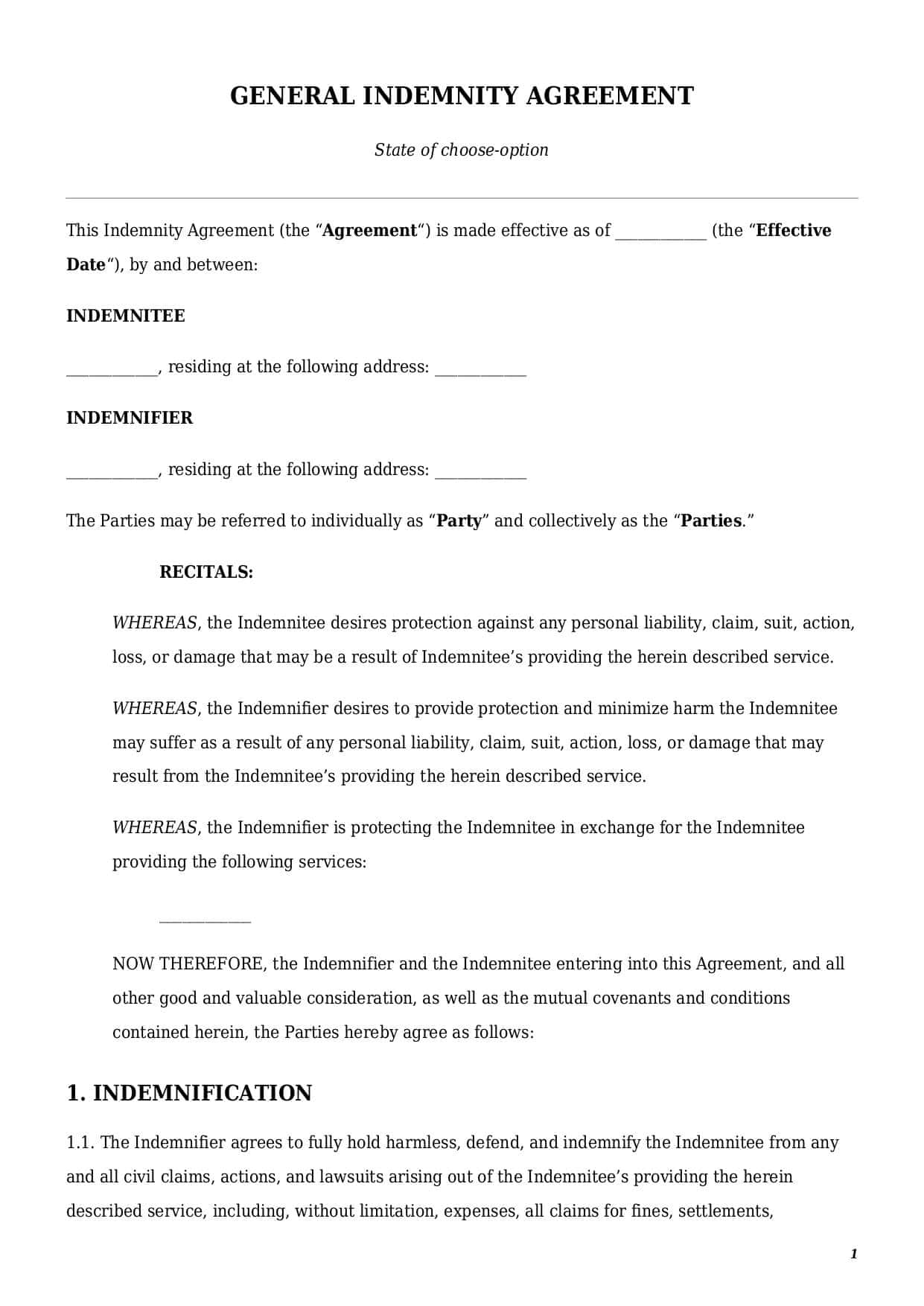
A general indemnity agreement is a legally binding contract in which one party agrees to protect and compensate another party against specific losses, claims, damages, or legal liabilities arising out of certain transactions, events, or activities. This agreement is commonly used by U.S. businesses, contractors, and freelancers and aims to prevent costly disputes by defining a person responsible for losses well in advance. Sample indemnity agreements and clauses are widely used in the U.S. for various types of contracts and transactions.
A good indemnity agreement example usually includes the following:
- parties’ details;
- statement of indemnification and its scope;
- exception from indemnification;
- indemnification procedure;
- grounds for termination of the agreement; and
- applicable law and dispute resolution.
The parties involved in this indemnity contract sample are:
- An indemnitee. This is a person or an organization who wants to receive protection and to be held harmless against all claims, lawsuits, and demands. An indemnitee could also be referred to as a protected party.
- An indemnifier. This is a person or organization that undertakes to provide protection and indemnify the protected party.
Who should use this indemnity agreement?
This general indemnity agreement is suitable for:
- Small business owners who participate in various daily transactions and want to protect themselves against possible risks;
- Independent contractors and freelancers who provide professional services and wish to be released from liability for possible financial losses or damages;
- Event organizers who aim to fully hold themselves harmless and to defend against any civil claims, actions, and lawsuits brought by events’ participants;
- Startups and entrepreneurs who have limited financial resources and thus want to be protected against any additional potential losses, etc.
What shall be included in an indemnity agreement template?
Drafting an indemnity agreement template is a challenging task for a number of reasons. First, an indemnity agreement is a sensitive document, as it significantly affects the rights and obligations of the parties involved. Once you release another party from any claims and losses, it is almost impossible to legally reverse that decision. Second, inclusion of certain clauses and provisions is essential to ensure the final document is complete and legally valid.
Below we made a summary of the most important tips you have to keep in mind when creating your indemnity contract template.
Details of the Parties
The text of every indemnity agreement contract defines full identification details of the parties involved. Those details shall include:
- full name and business or mailing address;
- contact information;
- full name of the company’s representative (only if either party is an organization or legal entity); and
- both parties’ signatures.
Contract’s Purpose
Another essential pillar of every contract of indemnity is the definition of a contract’s purpose. Normally, this purpose includes three important components: (1) hold harmless; (2) defend; and (3) indemnify another from any and all civil claims, actions, or lawsuits that may arise from certain events, transactions, or activities an indemnitee participates in.
The coverage provided under a contract of indemnity normally covers:
- fines;
- settlements;
- court and legal expenses; or
- any other reimbursements.
In case an indemnifier wishes to indemnify against all possible criminal proceedings, this should be separately stated in the text of a final contract.
Indemnification Details
In this section of a release and indemnity agreement, parties must define the following core elements:
- Grounds for indemnification. Under the present contract an indemnifier desires to provide protection and minimize harm incurred by an indemnitee due to participation in certain events, activities, or transactions. For instance, parties may wish to sign this release and indemnity agreement when entering into a sale-purchase agreement of shares, various service contracts, partnership agreements, etc.
- Indemnification cap. Parties could define a maximum amount that an indemnifier undertakes to reimburse or compensate to a protected party. Neither federal nor state laws require inclusion of an indemnification cap into indemnity contracts. However, this is a good practice to limit an indemnifier’s liability to a certain extent.
- Exceptions. Even if an indemnifier promises to provide protection and reimbursement, there are potential exceptions in which the contract of indemnity is not being “activated.” Those exceptions include, for instance, cases of an indemnitee’s negligence or willful misconduct, when the protected party has already received proper compensation under the insurance, etc.
Termination Clause
An indemnification is limited in time, thus, parties to every indemnity agreement sample shall define the period of its validity. The duration of indemnification could last:
- till a specific date in the future;
- until the occurrence of certain specific events in the future;
- until mutual written agreement of both parties; or
- for a defined period of time (in months or years).
How to customize a document template at FasterDraft?
To get a fully customized legal document, follow the instructions given below:
- Click the “Create Document” button.
- Answer simple questions in the indemnity agreement form.
- Select a template’s format—indemnity agreement sample PDF or Word.
- Make a payment.
- Download, print out, and make both parties sign the document.
Table of content
Frequently Asked Questions (FAQ)
-
1. What is the difference between an indemnifier and an indemnitee?
The parties involved in an indemnity agreement contract are an indemnifier and an indemnitee. An indemnifier is a person that undertakes to cover all expenses associated with legal claims or damages incurred by another party under certain circumstances.
For example, John and Erika enter into an accounting services agreement under which Erika undertakes to provide professional accounting services to John. Erika wants to sign an additional indemnity agreement by which John agrees to indemnify her against all possible financial losses, claims, or damages arising out of the provision of accounting services.
An indemnitee is a person that is being released from liability and receives protection under an indemnity agreement. To take an example provided above, Erika is an indemnitee.
-
2. What does a general indemnity agreement protect against?
It protects against financial losses, lawsuits, claims, damages, settlements, and legal fees arising from specified activities or services.
-
3. What is the difference between an indemnity contract and a release of liability agreement?
The main purpose of an indemnity contract is to protect a person (i.e., an indemnitee) from any future liabilities arising from entering a certain contract or transaction. If any claims or losses occur in the future, an indemnitee’s liability is fully excluded.
A release of liability agreement is when a person’s liability is confirmed (i.e., a guilty person), and a releasing party adopts the decision to waive all claims against a guilty person in full or partially.
-
4. Does an indemnity agreement cover legal defense costs?
The typical wording of an indemnity agreement contract uses the wording that covers all civil claims, actions, and lawsuits. The coverage of legal defense costs is mutually being included into “all civil claims” and does not require inclusion of separate wording to emphasize the coverage for those particular expenses.

Looking for something Different?
Start typing to find out our collection of legal documents and contract templates