
.svg)
 United Kingdom
.svg) Australia
Australia

What is a release of liability agreement?
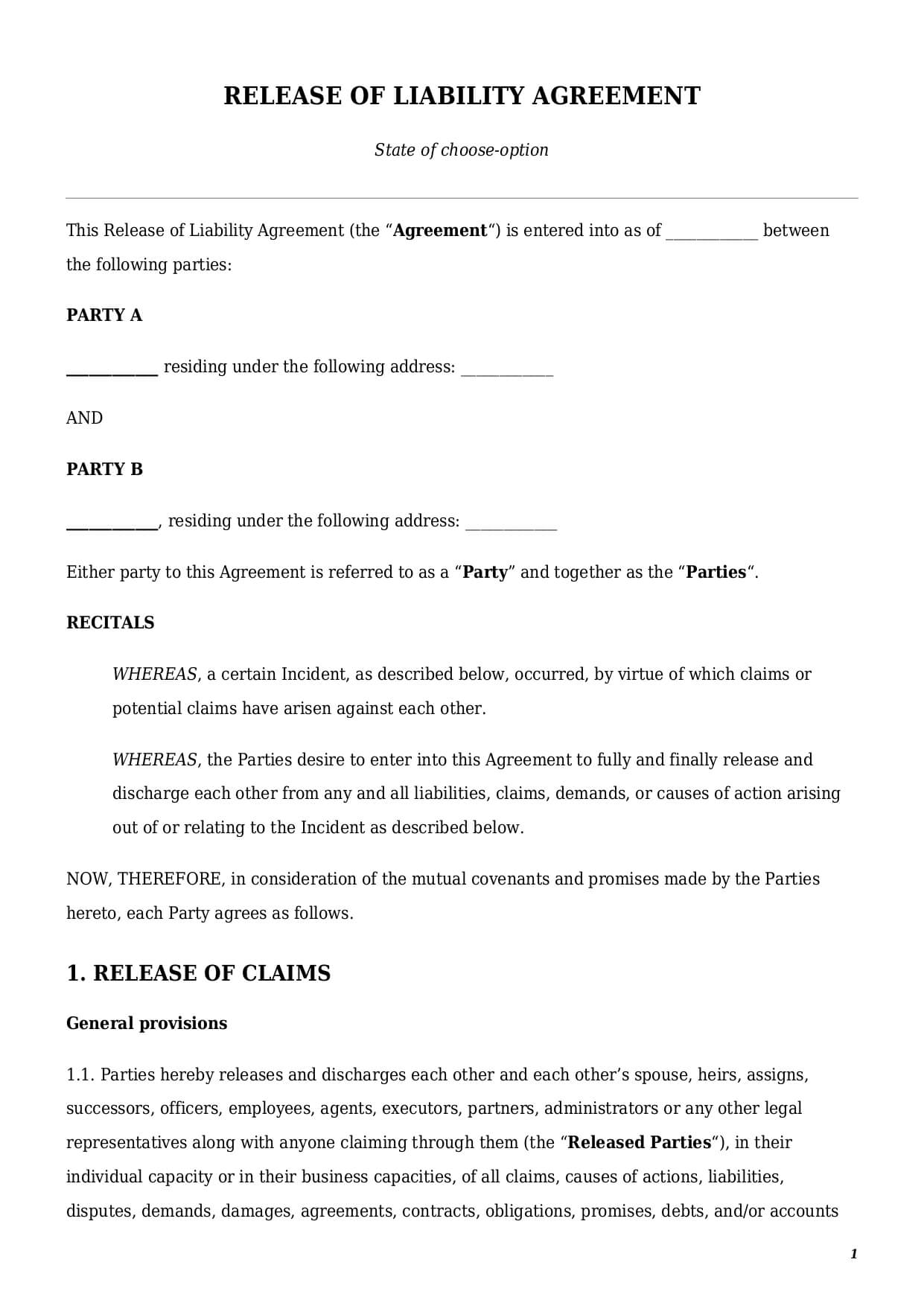
A release of liability agreement, or a release agreement, is a legally binding document where one party agrees to waive their legal claims against another party, typically in exchange for compensation.
A simple release of liability form allows the party to settle the dispute without going to the court. The present template can be used for the following situations:
- car accidents;
- personal injuries;
- contract settlement (e.g., service agreements);
- debt settlement;
- other general claims, etc.
The parties involved in a release of liability agreement are a releasor and a releasee. A releasor is a person who waives their legal claims to the party, while a releasee is a person who is being released from such claims.
How to draft a release waiver agreement?
A well-drafted release waiver agreement shall include a number of key components to be a legally sound document. Below we made a breakdown of the most essential elements every release waiver agreement shall have:
General Information
Every release agreement sample shall include basic information such as:
- full party details (names, addresses, and signatures);
- the date of signing the release agreement; and
- governing law clause.
Type of Release
There are several forms of release that may be used in a release agreement sample:
- one-way or single release contract (i.e., when one party releases the other from all liabilities);
- mutual release agreement (i.e., when both parties release each other from all liabilities).
Depending on the chosen type, the final wording of a release agreement sample shall differ dramatically.
It is also common to release from liability in full for all claims and partially for certain claims only.
Compensation
Despite if it is a one-way release or a mutual release agreement sample, a party that releases another from a liability has a right to compensation.
The law does not define the exact form in which such compensation should be paid. Therefore the parties may select either of the following:
- a monetary or cash compensation;
- compensation with securities or shares;
- compensation with other non-material benefits (e.g., free membership);
- compensation with goods or property.
The exact value of a compensation shall be stated directly in the text of a contract as well.
Confidentiality Clause
A comprehensive agreement releasing from liability may also include a confidentiality clause. This clause helps to prevent either party from disclosing the terms of the settlement to the third parties, including:
- details of the incident;
- details of the compensation;
- other important considerations, if any.
Usually, a contract template to release from a liability does not limit a confidentiality obligation in time.
How to customize an agreement template at Faster Draft?
To personalize your document template, follow a few easy steps below:
- Click the button “Create Document.”
- Answer simple questions online.
- Select a document’s format—release liability agreement PDF or Word.
- Make a payment.
- Download, print, sign and use customized document in seconds.