

.svg)
.svg)
Founders Agreement
 PDF and
 Word
Word
A founders agreement template sets up a formal framework for how the business is owned, managed, and operated from its early stages.
Reviews

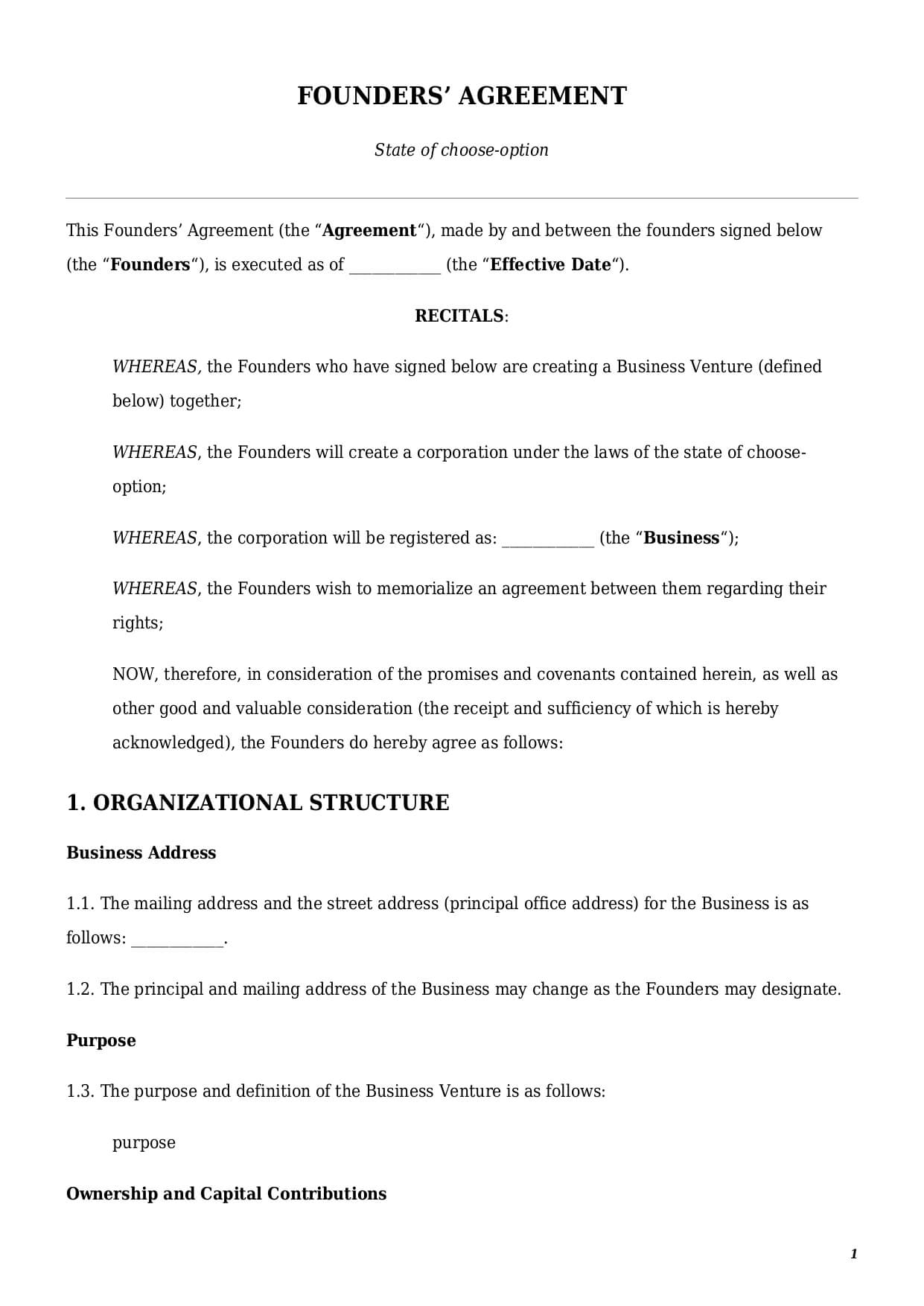
What is a founders agreement?
A founders agreement, also known as a co-founders agreement, is a legal document that outlines the rights, responsibilities, and relationships between the founders of a business that is already created or in the process of creation. While having this type of contract is not mandatory, most small businesses and startups across the U.S. tend to sign at least a simple company founders agreement.
This contract could be used for various types of companies, including corporations, partnerships, or limited liability companies. A good founders agreement example usually includes:
- detailed description of the founders;
- name, address, and purpose of the company;
- list of founders, their duties, contributions, and interest percentage;
- intellectual property rights;
- confidentiality obligation;
- dissolution clause; and
- dispute resolution clause.
The parties involved in a startup founders agreement are individuals, businesses, or organizations that wish to start their joint business venture. A founders agreement shall not be confused with a joint venture agreement. The latter allows parties to achieve common business goals and needs on a temporary basis without forming a company. While a founders agreement aims to start a company.
Who can use a founders agreement?
Having a solid company founders agreement is ideal for:
- early-stage startups that have to define terms and conditions for cooperation at early stages;
- small- and medium-sized businesses that plan to grow and look for a reliable founders agreement sample to start with;
- business partners and investors who want to create a new business venture in a compliant way.
What to include in a founders agreement sample?
Neither federal nor state laws define the exact structure of a founders agreement. All depends on the type of business venture parties want to create, the composition of the founders, the management of the company, etc.
All those and other elements significantly affect the text of a founders contract. At the same time, inclusion of certain elements is essential to make sure the final document is complete. Below we made a short list of all essential sections a solid founders agreement must have.
Purpose of Business Venture
Parties enter into a founders contract not just for the purpose of incorporating a company but to accomplish certain business needs, including commercial, scientific, etc. Thus, the text of a template shall clearly reflect the reason and purpose of signing this agreement and forming a company.
Besides that, all founders’ agreements must include:
- name of the business venture;
- registered business address;
- mailing address;
- state of the business’s incorporation/registration; and
- type of the business (e.g., limited liability company, incorporation).
Founders’ Details
Another essential element for all founders’ agreement samples is the inclusion of identification details of the founders. Those details must include the following information:
- Full Name. This block is necessary to identify all the parties involved in the company’s formation and registration. Besides that, the signatures of all founders should be added at the end of the document.
- Type of a Contribution. In simple words, this is what a founder does or contributes to the business. Contributions could be made in various forms—cash, services, goods, etc. All in all, a founders contract shall reflect each founder’s contribution, including description and cash equivalent in U.S. dollars.
- List of Duties. This is a list of responsibilities each founder has with regard to the business formation.
- Percentage of Business Interest. This is the share in a future company, a business a founder owns. Depending on the type of company, the amount of shares will define the percentage of profit and losses received by a founder in the future, as well as the scope of voting rights. The amount of share could have a different size. It may depend on the amount of a contribution, be equal for all founders, or have other proportions.
Intellectual Property Rights
In the course of the business venture formation, founders could create certain IP rights, including trademarks, copyrights, know-how, etc. A well-drafted startup founders agreement must define to whom shall belong all the rights for creating IP rights. Founders could select from either of the following scenarios:
- all rights shall belong to one founder only;
- all rights shall belong to all founders in equal parts; or
- all rights shall belong to all founders in proportion to their business interest in the company.
Dispute Resolution
A dispute resolution clause is by far the most essential clause for every startup founder’s agreement template. Disputes are very common between founders in the course of the company’s formation and registration.
Therefore, inclusion of a solid dispute resolution clause in a founders contract is a must for two reasons. First, it ensures clarity for a procedure of a dispute resolution when it is hard to reach an agreement on anything. Second, it provides a mandatory framework for a dispute resolution. In other words, if the contract provides arbitration, another party cannot file a lawsuit.
A co-founders agreement could provide for mandatory mediation, arbitration, or simple litigation, depending on the founders’ needs. Usually litigation shall take place in the courts of a state, the laws of which apply to the provisions of this agreement.
How to customize a founders agreement at FasterDraft?
To get a fully customized legal document template, follow a few easy steps given below:
- Click the “Create Document” button.
- Answer simple questions in the form.
- Select a template’s format—founders agreement PDF or Word.
- Make a payment.
- Download, print, and sign the document.
Table of content
Frequently Asked Questions (FAQ)
-
1. What is the difference between articles of incorporation and a founders agreement?
Articles of incorporation are a mandatory legal document without which registration of a corporation is not possible in the U.S. A founders agreement is a private document signed between future shareholders of incorporation to define:
- parties’ mutual obligations and responsibilities related to the incorporation;
- membership interest in the future company;
- basic voting rights, etc.
-
2. What is the difference between an LLC operating agreement and a founders contract?
An LLC operating agreement is used to record terms and conditions of how the LLC will be run. Contrary to that, a founders contract could be used for LLCs, partnerships, and corporations.
Besides, a founders contract focuses more on the process of the company’s formation and its early stages of operation. It does not define relations between the company’s governing or managing bodies, voting procedures, distribution of dividends, etc.

Looking for something Different?
Start typing to find out our collection of legal documents and contract templates