

.svg)
.svg)
Performance Contract
 PDF and
 Word
Word
A performance contract is the agreement between a performer, including a musician, band, DJ, comedian, speaker, or other entertainer, and the client engaging them, whether a venue, event organiser, or private individual.
Reviews

What is a performance contract?
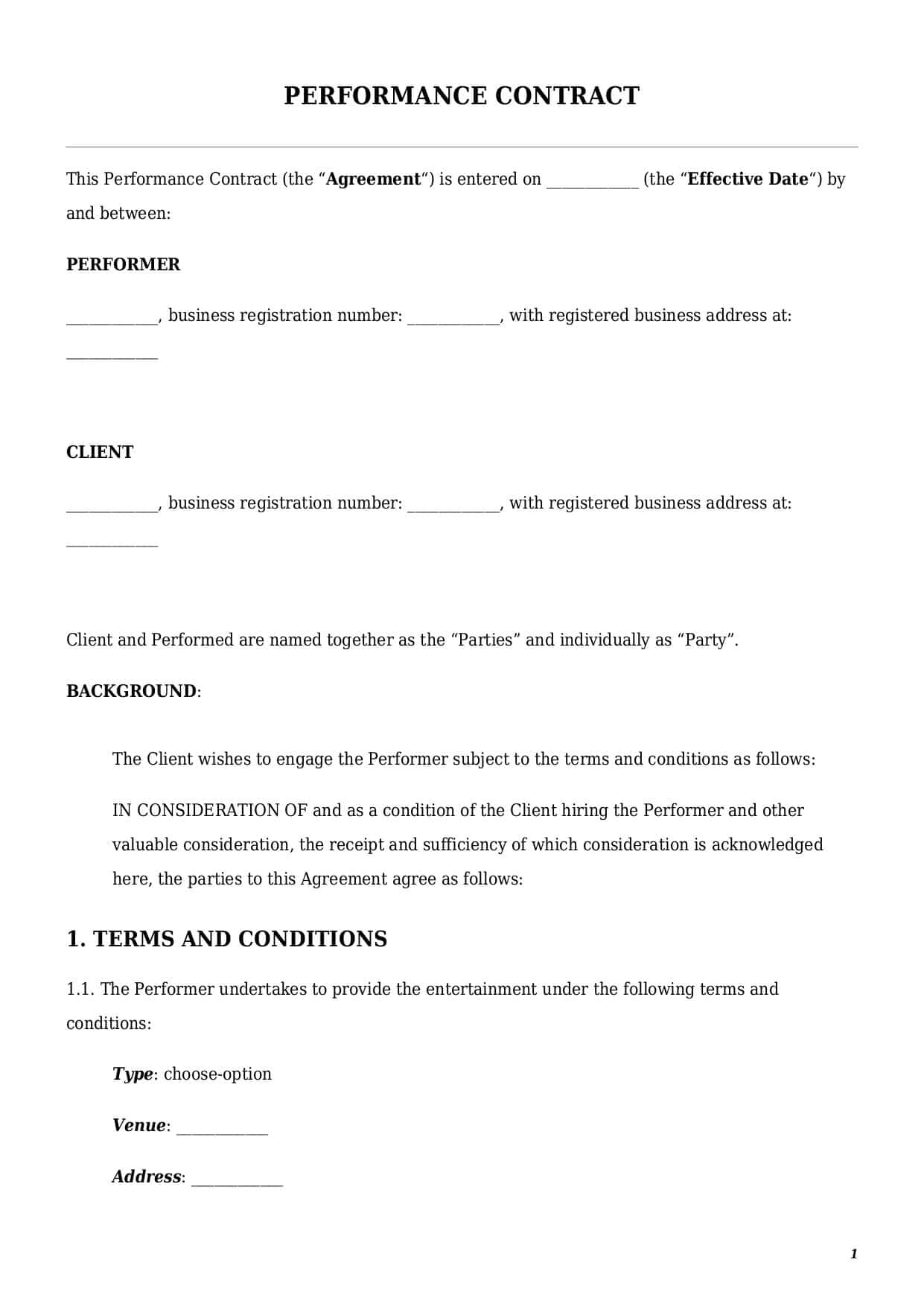
A performance contract is a written agreement between a performer and the party engaging them for a specific engagement, such as poetry, stand-up, music performance, or a festival slot, covering the details of the performance, the fee and how it’s paid, and the mutual rights and obligations of both parties related to cancellation and termination.
A performance contract is a special type of services contract used in the UK for the terms and conditions governing the provision of a show by a service provider, known as a performer, to the client.
Performance Contract vs. Booking Agreement vs. Artist-Agent Agreement — Which Do You Need?
It’s a distinct document from an ongoing management or representation arrangement — see below — and it’s worth getting the distinction right before you draft anything, because the wrong document leaves real gaps.
| Term | What it governs | Typical use | Key features |
|---|---|---|---|
| Performance Contract | The relationship between a performer and a client for one specific engagement. | An individual gig or performance. | The venue, date, fee, technical requirements, and what happens on the night. |
| Booking Agreement | Often the same relationship as a performance contract, but may also involve an intermediary such as a booker or promoter. | A specific booking or arrangement involving an artist, venue, and potentially an intermediary. | Its meaning depends on who the parties actually are, rather than the label used for the document. |
| Artist-Agent Agreement | An ongoing representation relationship between an artist and an agent. | An agent securing bookings for an artist over time. | Typically covers representation and commission. It is not intended to cover specific performance details such as soundcheck times, technical riders, or cancellation terms for a particular date. |
Why do musicians and artists need a written performance contract?
Having a solid and professional written contract helps:
- To protect against a fee dispute. For example, in a verbal contract, a client could later claim a different, lower fee was agreed. With a written contract, a client does not have such room for manoeuvre and must pay exactly what has been agreed.
- To describe consequences of a no-show. In a situation when the show or event is cancelled due to either party’s decision or force majeure, a verbal contract does not define what happens next. A written agreement addresses how a deposit should be returned, who is responsible for paying the fees, etc.
- To define how disputes should be resolved between the parties. A professionally drafted performance contract defines applicable laws and jurisdiction, the courts of which should have an exclusive right to resolve disputes arising from the present contract.
What does a standard performance contract in the UK cover?
A complete performance contract must include the following important clauses:
- Details of the parties. This clause shall cover full legal names, contact email addresses for the exchange of notices, and registered business or mailing addresses.
- Show and venue details. The contract should define the type of performance, where, when and at what time the show should start and end, including a detailed description of the venue.
- Equipment and sound check. Any performance contract must address which party will be responsible for the provision of music and sound equipment, its installation and usage during the performance.
- Fee and deposit structure. Usually a performance contract in the UK applies one of three payment models, including a fixed fee, an hourly rate, or a combination of both. It is also common to charge an additional non-refundable retainer fee. All fees must be stated in pounds.
- Cancellation policy. The contract must outline what happens with paid fees in case an event or show is cancelled by either party due to force majeure events. For example, a standard clause for the cancellation of the show by a client may provide the following: “The Client reserves the right to cancel this Agreement without obligation upon written notice to the Performer prior to XX/XX/XXXX. In the event of said cancellation, the Performer will promptly return the Deposit to the Client. Cancellation by the client for any reason later than XX/XX/XXXX will result in forfeiture of the Deposit. Cancellation by the client later than XX/XX/XXXX will also require payment of any outstanding balance of the full fee.“
- Force majeure. This clause defines what happens if the performance can’t go ahead due to circumstances outside either party’s control.
- The technical and hospitality rider includes details about the equipment, staging, and any hospitality requirements and is usually attached as a schedule.
- Recording restrictions. If the client plans to perform audio or video recording of the performance or show, prior written consent should be obtained from the performer. It is also possible to incorporate a default consent as a separate clause in the performance contract.
- Independent contractor status. To prevent the creation of the risk of employment relations, a standard performance contract in the UK must explicitly confirm the performer’s independent contractor status and exclude any employment or partnership relations.
- Confidentiality clause. If the performance is required for a private event, parties may include a confidentiality clause into the performance contact or sign a separate non-disclosure agreement.
- Governing law. The parties to this agreement can select the laws of England, Wales, Scotland or Northern Ireland to apply to the provisions of this agreement.
Common legal pitfalls with UK performance contracts, which can save you from disputes
Either you are an entertainer or musician who signs your first contract, or you provide professional services regularly. Knowing these common legal mistakes can save you from court disputes, administrative fines and negative client feedback:
Employee or Self-Employed
Normally, a performance contract includes a client and a performer who is an independent contractor, same as a service provider performing works under the freelance contract. It is rarely the parties’ wish to create any sort of partnership or employment contract relations between them while entering the performance contract. Therefore, almost all performance contracts in the UK contain a standard clause stating that “a performer is not an employee, partner or member of a joint venture and acts independently”.
However, having proper contractual wording is not enough. As the Supreme Court rightfully pointed out in Uber BV v Aslam [2021] UKSC 5, the necessity is to look through contractual wording entirely to the substance of how the relationship actually operates in practice. All in all, it is not just enough to claim that the performer is not your employee. The other provisions of the contract must confirm the same. In the court case Ready Mixed Concrete (South East) Ltd v Minister of Pensions and National Insurance [1968] 2 QB 497, the court suggested looking at the following:
- degree of control the client exercises over the provider;
- list of mutual obligations;
- whether substitution is required.
Check below the comparison table suggesting which type of clause in your performance contract can create a risk of the performance contract being considered as an employment contract.
| Criteria | High Risk of Employee Status | Low Risk of Employee Status |
|---|---|---|
| Payment | regular fixed weekly or monthly remuneration. | hourly rate, fixed fee per show/performance |
| Duration | fixed-term contract, indefinite contract | on demand, one-time performance, short-term contract |
| Control | client dictates how the performance should be made and organised | client simply accepts the performance |
| Cancellation | no cancellation policy or warning for no-show | clear cancellation rules including return of the fee and/or deposit |
| Subcontractors | the show must be performed exclusively by the performer, no subcontractors or substitutes are allowed | if the show allows, the performer can engage additional personnel for substitution |
| Competition | strict non-compete clause or separate non-compete agreement prohibiting the performer from performing for third parties | the performer is free to perform for other clients |
Requirements under the Copyright, Designs and Patents Act 1988
A recording clause in the performance contract is something the parties must discuss in any case before the performance takes place. By virtue of Section 182 of the Copyright, Designs and Patents Act 1988, the performer’s consent is required before their live performance can be recorded or broadcast. Failure to obtain such consent constitutes an IP infringement as defined by Section 183 of the same Act.
Music Licensing at the Venue
If the performance includes the play or performance of copyrighted musical works, any UK venue generally needs its own PRS for Music licence to legally play or perform such music on its premises.
This obligation sits with the venue or client, not the performer. However, failure to discuss this obligation directly in the text of the performance contract may cause a real legal dispute in the future.
Important tips on how to write a professional performance contract in the UK
Keep in mind these important rules when drafting a performance contract:
Cancellation Fee vs Penalty Clause
In a situation where the event or show is cancelled by the client closer to the show date, usually the client loses the entire deposit. This is a common clause most performance contracts in the UK would include. However, enforceability of such a clause has been re-evaluated in the Supreme Court’s decision in Cavendish Square Holdings BV v Talal El Makdessi [2015] UKSC 67. In particular, a cancellation fee is genuinely needed to compensate the performer for lost income and lost opportunity to book another engagement on that date, rather than simply punishing the client for cancelling. For example, if the cancellation clause in your performance contract forfeits the whole amount of the deposit if the event is cancelled by the client one day prior to the show date, such a clause is likely to be enforceable and will survive the scrutiny of the UK courts. However, if the cancellation clause forfeits the deposit in full even if the client cancels 2 months before the date, in such a case the court may not enforce such a clause in its entirety.
Missing technical rider
The parties have to discuss in advance the type of equipment that is required for the performance, installation guidelines, who shall be responsible for that and the technical fit of the venue to accommodate the required technical and sound equipment.
Vague performance descriptions
The text of the performance contract must clearly specify the type of performance, the details of the programme itself (for example, number of songs), its length, number of sets, any breaks and their duration, any third-party artists being invited to support the performance, and so on.
How to use and customise this template with FasterDraft?
To get a fully customised performance contract template, follow the steps below:
- Click “Create Document” to open the questionnaire.
- Answer the questions to customise the document to your engagement.
- Select your preferred format — PDF or Word.
- E-sign the document for free as part of the questionnaire.
- Complete your payment.
- Download your customised template instantly once the purchase is complete.
- Print the contract in two copies.
- Make both parties sign it.
- Each party must keep a copy of the signed document for their own record.
This article is reviewed by Daria Turanska, a lawyer with 15 years’ contract drafting experience
Table of content
Frequently Asked Questions (FAQ)
-
1. Is a performer an employee or self-employed under UK law?
Almost always a performer is a self-employed, but the wording in the contract alone doesn’t decide it. Courts look at the reality of the relationship, including control, whether substitution is genuinely permitted, and mutuality of obligation, following Ready Mixed Concrete v Minister of Pensions [1968] and Uber BV v Aslam [2021] UKSC 5.
-
2. Who is responsible for music licensing at the venue?
Generally the venue or client, through a PRS for Music licence and, where recorded music is also played, a PPL licence. A well-drafted contract should say this explicitly rather than leave it assumed.
-
3. Can I cancel a performance contract and get my deposit back?
It depends entirely on the agreed cancellation terms in the contract. Any deposit forfeiture or cancellation fee must be proportionate to the other party’s actual loss to avoid being struck down as an unenforceable penalty clause under Cavendish Square v Makdessi [2015] UKSC 67.
-
4. Does a performer have legal rights over recordings of their performance?
Yes. Under Part II of the Copyright, Designs and Patents Act 1988, a performer’s consent is required before their live performance can be recorded or broadcast.
-
5. What should a technical rider include?
Sound, lighting, staging, and any equipment or setup requirements specific to the performance, typically attached as a schedule to the main contract.

Looking for something Different?
Start typing to find out our collection of legal documents and contract templates