

.svg)
.svg)
Articles of Association
 PDF and
 Word
Word
Reviews

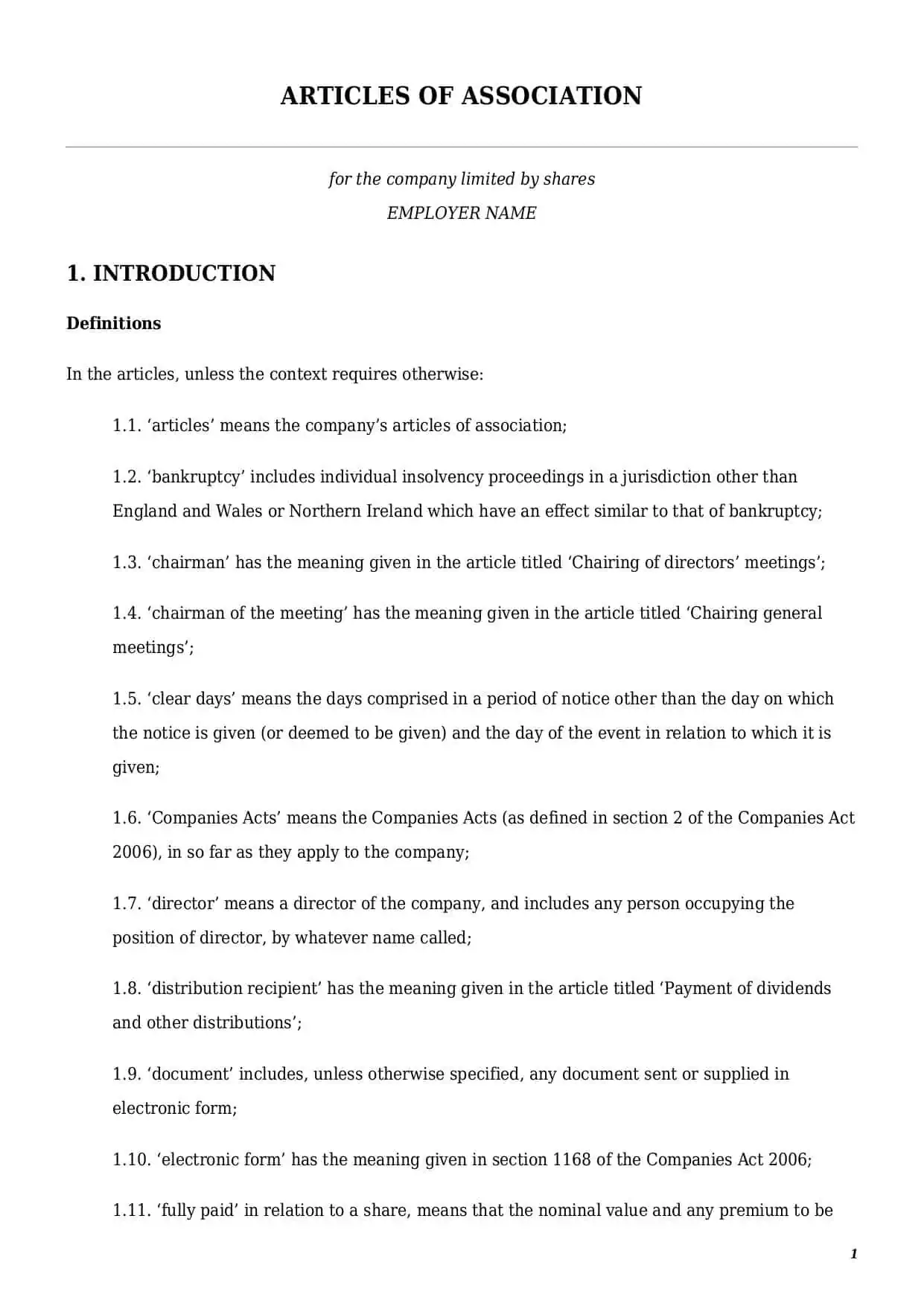
What is an articles of association template?
An article of association is a mandatory document that constitutes the legal framework for the operation of a company limited by shares in the UK, and that defines core provisions related to corporate governance, appointment of directors, transfer of shares, dissolution of the company, etc. This company articles of association template is the first document you need to incorporate the company limited by shares with the Companies House. This template aligns with all mandatory requirements of the Companies Act 2006 and Companies House filing requirements set for the incorporation of a limited company in 2026.
What are the benefits of this articles of association template?
By customising this document template with FasterDraft, you get the following benefits:
- Save time on incorporation. Skip drafting from a blank page. Use this template with a lawyer-informed structure that adapts the clauses necessary to pass the rigorous registration checks at Companies House.
- Complete template. A 30-page solicitor-drafted legal document covering all essential aspects of corporate governance and daily management of the company limited by shares in the UK.
- Avoid common drafting errors. Each clause is built to align with the Companies Act 2006 and Companies House filing requirements. This template helps you to bypass the most common mistakes users usually make when drafting the document from scratch.
- Instant download after purchase. Your customised document is generated and available to download immediately in the following formats: articles of association template Word and PDF.
- No AI generation. While AI is a helpful tool for work and studies, it cannot replace a classy legal drafting aimed at creating a bespoke, tailored document. Our template is created and regularly reviewed by qualified UK solicitors who research and implement jurisdiction-specific clause in the document. No AI nonsense is guaranteed.
Companies House Filing & Company Details
Once the company’s articles of association template is ready, the next step is to prepare for the incorporation of the company in the Companies House. This template is structured to align with what Companies House expects to see, and with the information you’ll need to provide on form IN01 when you incorporate.
Before submitting your documents for registration, prepare the following important information:
The proposed company name.
The applicant must ensure that the proposed company’s name is unique, not offensice to the general public and is not being misleading. For example, in the court case [] the company was refused registration due to a misleading name. The case began in 1914 when promoters tried to incorporate a private company limited by shares under the name “United Dental Service Ltd,” but all the subscribers to the memorandum were dental practitioners who were not registered under the Dentists Act. The Registrar of Companies refused to register the company unless the memorandum was altered or the name changed, fearing it would mislead the public into thinking the men behind it were registered dentists — prompting the applicant, Bowen, to bring the matter before the King’s Bench Division seeking a writ of mandamus to force registration.
The registered office address.
Both virtual and residential addresses are acceptable. You should not necessary own the premises where the company’s business address is being registered. You can lease or sublease them based on the respective commercial lease agreement.
Details of the first director.
These details must include their full name, copy of identification document (usually passport or ID card), and contact details such as email and telephone number.
Details of each initial shareholder.
Provide their full name, registered business address (for a corporate member) or mailing address (for an individual) as well as the amount of shares indicated in percentage from the total share capital.
The company’s statement of capital.
In simple terms, the amount of a share capital that should be stated in pounds and cannot be lower than 0.01 pound per share. There is no statutory maximum for the share capital of a company limited by shares in the UK.
A statement of prescribed particulars for each class of share.
The statement of capital records the total number of shares, their aggregate nominal value, and the amount paid up on them. The prescribed particulars set out the rights attached to each class of share — voting rights, dividend rights, and rights on a return of capital. This template is drafted so that your share rights clauses stay consistent with what you declare in these filings, reducing the risk of a mismatch that Companies House or a future investor might flag.
What Goes Into Your Company’s Articles (Clause Guide)
A solid and well-written article of association template must include the following key clauses:
Director appointment and removal.
Clauses covering how directors are appointed (by the existing directors or by ordinary resolution of shareholders), the minimum and maximum number of directors, and the circumstances in which a director can be removed — including alignment with the statutory removal right under section 168 of the Companies Act 2006, which operates independently of anything the Articles say.
On top of that, a solid legal template for articles of association should also address if the appointment of alternative directors is allowed, as well as if the chairman or managing director should have a casting vote at the directors’ meeting.
Shareholder decision-making.
The document should also define how shareholders make decisions on the company’s key decisions. There are two possible ways founders may choose:
- decision can be made through general meetings, or
- through written resolutions.
Voting through the meeting should also be discussed in terms of the quorum required. Typically, depending on the complexity of the matter discussed, the minimum required quorum to pass the resolution may vary between a simple majority and a qualified majority (i.e. 75% or 3/4 of all votes). Simple majority of votes can be required to change the registered address, to issue the new class of shares, to consent for the major transaction. A qualified majority goes for major decisions like liquidation, winding up, merger and acquisition etc.
Share rights, classes, and transfers.
The articles of association template must also define which classes of shares are being issued and what rights attach to each class of share (voting, dividend, and capital rights). This does not apply if the company has only one class of shares.
Dividend and distribution mechanics.
Clauses setting out how dividends are declared and paid — distinguishing between final dividends (requiring shareholder approval by ordinary resolution) and interim dividends (which directors can typically declare without shareholder approval, subject to the company having sufficient distributable profits) — along with how dividends are apportioned across different share classes if you have more than one.
Shares, Transfers, and Voting
All articles of association templates in the UK typically include a separate block governing share transfer and voting rights in the company.
Cumulative voting.
Cumulative voting is an optional mechanism, not part of the standard Model Articles, that some companies choose to include when electing directors. Rather than each shareholder casting one vote per share for each director position individually, cumulative voting allows a shareholder to pool their total votes (shares × number of director positions being filled) and allocate them however they choose — including casting all of them for a single candidate. Its effect is to give minority shareholders a realistic chance of securing a board seat, since they can concentrate their voting power rather than being consistently outvoted across every individual appointment. It’s more commonly seen in US corporate practice, but it can be drafted into UK Articles where minority representation on the board is a priority for shareholders. The template includes optional wording you can activate if this suits your company’s structure.
Pre-emption rights and rights of first refusal.
These clauses give existing shareholders the first opportunity to buy shares before they’re offered to an outside buyer — either on a new share issue (aligning with the statutory pre-emption rights on allotment under section 561 of the Companies Act 2006, which the Articles can restrict or disapply within statutory limits) or on a transfer of existing shares (a contractual right of first refusal, which operates independently of the statutory provisions and is entirely a matter of what your Articles say).
Pre-emption right is especially significant for founders who built their business on personal relations. if the transfer to a third party occurs, it can significantly impede internal relations within the company.
The template sets out the offer mechanism, the pricing basis, the timeframe within which existing shareholders must respond, and what happens if the pre-emption right isn’t taken up.
Permitted transfers.
If the pre-emption right is being established in the company, founders may wish to limit application of that clause by outlining the list of permitted transfers to which such a right of first refusal will not apply. A permitted transfer is a transfer of shares in the purchase of a donation or sale to a limited number of third parties, including wives, widows, children, civil partners etc. In most of the cases, a permitted transfer allows a succession of shares within the family.
Difference between bespoke articles and model articles
To incorporate a company limited by shares in the UK, founders may use either the model articles of association provided by the Companies Regulations 2008 or draft a fully customisable document for their needs.
Model Articles.
Model articles are the default constitution set out in the Companies (Model Articles) Regulations 2008. If you don’t file bespoke Articles at incorporation, the Model Articles for private companies limited by shares apply automatically. They’re a solid, legally sound starting point. However, this is a generi document that does not aim to protect the rights of investors, to address potential disputes in the future, or to care for dispute-free transfer of shares or rights of minor shareholders. A model document gives a company a simple tool to start the business, but it does not help that business to last longer.
Customisable template of articles of association.
Bespoke articles amend or replace the Model Articles to reflect how your company will actually be run and owned. They’re generally the better choice once your company has:
- More than one shareholder, particularly where shareholdings aren’t equal;
- Different classes of shares with different rights;
- Outside investors who expect protective provisions;
- A need for restrictions on who shares can be transferred to.
All in all, a customisable template gives you control of your company in your hands, especially for companies with third-party investors.
Corporate Governance, Directors, and Company Secretary
Every articles of association template should address the company’s daily management and corporate governance, including:
Director powers and board decision-making.
The Articles must set out the scope of authority delegated to the board, including:
- whether directors are allowed to sell the company’s property or shares;
- whether directors are permitted to acquire new property on behalf of the company;
- whether directors are allowed to provide guarantees, lend or borrow money on behalf of the company etc.
The directors manage the company on a daily basis. However, the articles of association shall outline the limits of such management and a set legal framework within which such a mangement being performed, including:
- how board meetings are called and conducted;
- quorum requirements; and
- how board decisions are made (usually by majority vote, with a casting vote for the chair in some structures).
Company secretary.
Private companies are not legally required to appoint a company secretary under section 270 of the Companies Act 2006, though many still choose to for administrative support with statutory filings and record-keeping. The template includes an optional clause for appointing a company secretary, so you can include or omit this role depending on your company’s needs.
Indemnity and director liability.
The template includes indemnity provisions permitted under the Companies Act 2006 — for example, cover for liability to third parties and provision for the company to pay for directors’ and officers’ (D&O) insurance. Note that the Act restricts what a company can indemnify a director against: sections 232 to 234 make void any provision that purports to exempt or indemnify a director against liability for their own negligence, default, breach of duty, or breach of trust in relation to the company, subject to limited statutory exceptions. The template is drafted to stay within these limits.
How to customise this template with FasterDraft?
To get a fully customisable articles of association template UK, follow a few easy steps below:
- Click the “Create Document” button.
- Answer simple questions in the form.
- Select a template’s format – articles of association template words or PDF.
- E-sign the document online for free.
- Make a payment.
The document is ready for instant digital download immediately after the purchase.
Table of content
Frequently Asked Questions (FAQ)
-
1. How long does Companies House take to process my filing?
Standard online incorporation through Companies House is typically processed within 24 hours, though this can vary. Paper filings generally take longer — often 8 to 10 working days. Your Articles form part of that filing, so having them finalised and consistent with your other incorporation documents in advance will help avoid delays.
-
2. Does this template replace legal advice?
No. This template is a drafting starting point designed to reflect the Companies Act 2006 and current Companies House practice, but it isn’t a substitute for advice from a qualified solicitor on your company’s specific circumstances — particularly if you have multiple shareholders with different bargaining positions, outside investors, complex share structures, or anticipate disputes. We’d recommend having a solicitor review your finalised Articles before filing, especially for anything beyond a straightforward single-shareholder or founder-only company.
-
3. How do I revoke or amend a bespoke clause after incorporation?
Once your Articles are filed, amending them requires a special resolution passed by shareholders holding at least 75% of the voting rights exercised on the resolution (unless your Articles include stricter entrenchment provisions for specific clauses, in which case those higher thresholds apply instead). The amended Articles must then be filed with Companies House within 15 days of the resolution being passed. If you purchased custom clauses through FasterDraft, contact us and we can help you draft the amending resolution and updated Articles.

Looking for something Different?
Start typing to find out our collection of legal documents and contract templates