

.svg)
.svg)
Shareholders Agreement
 PDF and
 Word
Word
A solid shareholder agreement template helps to protect your business in the UK by covering how decisions get made, what happens when someone wants to leave, and who has the power to do what.
Reviews

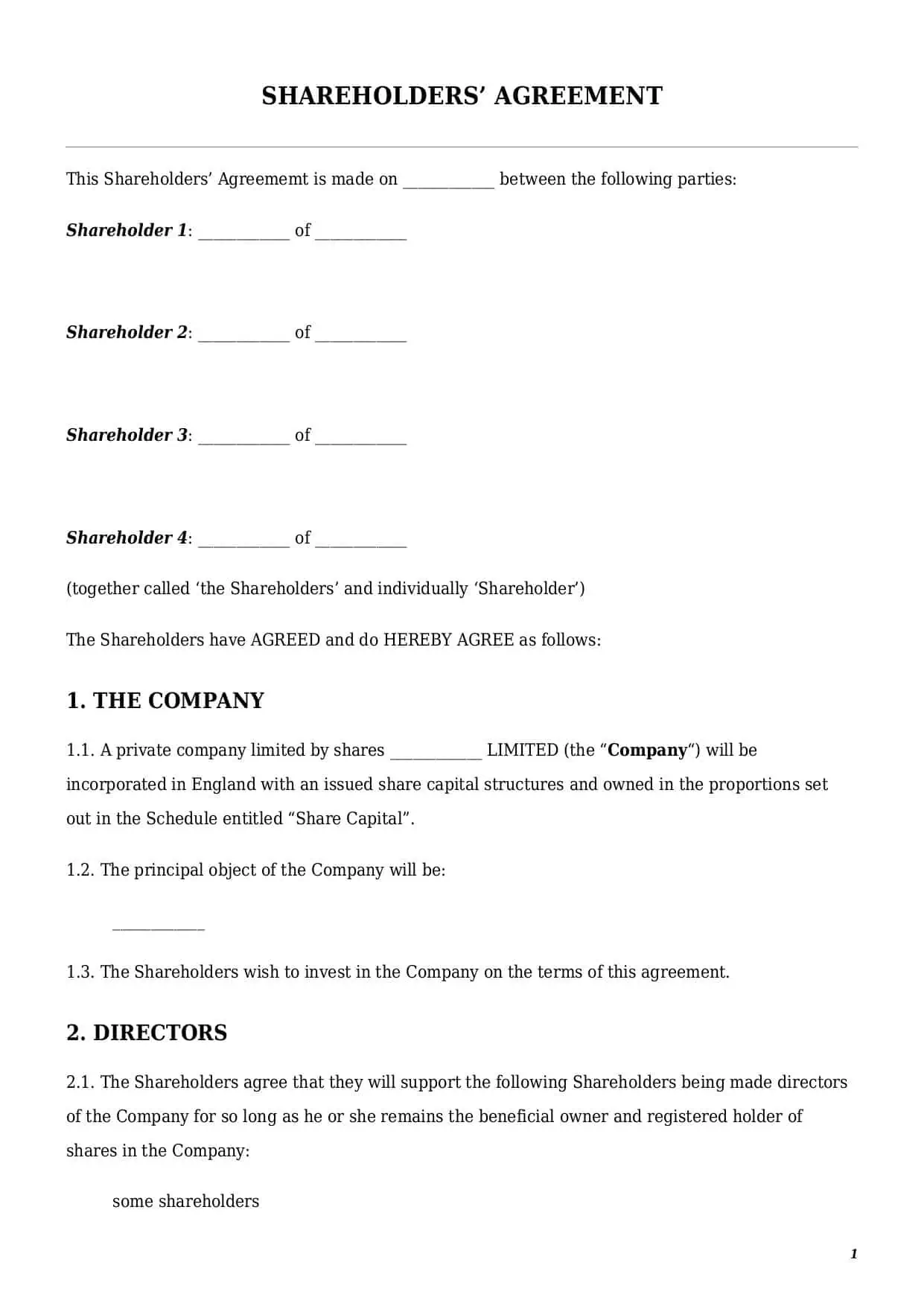
What is a shareholders’ agreement?
A shareholders’ agreement is a private contract between a company’s shareholders of the company limited by shares that governs how shares are owned and transferred, how key decisions are made, and what happens if relationships break down or circumstances change. Keep in mind that a template of shareholders agreement is not legally required by the Companies Act 2006. That means a company limited by shares in the UK can operate without it using only a company’s articles of association. However, articles of association do not provide the tailored protections many founders, directors, and investors need to avoid disputes and ensure fair treatment. That’s why you need a shareholders’ agreement template to protect your financial and investment interest in the company.
A shareholders’ agreement supplements and works alongside the articles of association. This document does not replace articles of association but rather covers unregulated or poorly regulated aspects in favour of investors and shareholders. A shareholders’ agreement is a private document that does not need to be registered or published for the general public.
Why do you need this shareholders agreement template for the UK company?
Having a fully customisable shareholders agreement for your business helps you as follows:
- Prevents Partnership Disputes. Most shareholder disputes are caused by the lack of clarity in the decision-making process, the transfer of shares between the parties or the dividend’s distribution. This template includes clear provisions for decision-making authority, share transfers, reserved matters, and exit scenarios — so the rules are agreed upon in writing before anyone needs to rely on them.
- Saves Thousands in Legal Fees. A standard rate for creating a template of a shareholders’ agreement limited by shares in the UK is around £3,000 to £10,000 depending on the complexity. This professional template gives you the same essential protections at a fraction of that cost. FasterDraft offers fully customisable templates at a very affordable price.
- Protects Your Investment. The Companies Act 2006 offers very limited statutory protection for shareholders’ rights and investments. A well-drafted shareholders’ agreement is the gold standard for protection that allows all shareholders to agree up front on all sensitive matters before conflicts arise.
- UK Companies Act 2006 Compliant. This shareholders’ agreement template UK is fully compliant with the main statutory requirements set up in the Companies Act 2006 and could be easily used in conjunction with the company’s articles of association.
- Ready in Minutes, Not Weeks. The customisation process of your shareholders’ agreement template is done in minutes, not weeks. That means you get a downloadable PDF or Word template instantly and do not spend months on unnecessary paperwork.
5 steps to draft a solid Shareholders Agreement
Drafting a shareholders agreement involves working through each of the key areas of the shareholder relationship and documenting what the parties have actually agreed to. Usually the whole process can be divided into six simple steps as follows:
Step 1: Identify the parties.
Signing a shareholder agreement template UK is a shareholder’s right and not an obligation. For example, if your company has 5 shareholders, it does not necessarily mean that all of them want to sign a shareholders agreement. Therefore, the first step is to identify the list of shareholders willing to enter this agreement. It does not matter if a shareholder is an individual or a corporate entity such as a company, general or limited partnership.
Another important step is to clearly identify each shareholder’s share in the share capital. This includes specifying in the text of a shareholder agreement how many shares, which class of shares and a share’s value are being owned by each shareholder.
Step 2: Agree the financial provisions.
A solid template of shareholder agreement must outline the basis for how the profits will be distributed between the parties. The distribution provisions shall cover the following:
- frequency of distribution;
- proportion of distribution (for example, equally, in proportion to each shareholder’s share); and
- additional limitations (for example, a lock-in period for the distribution within one year after signing the contract).
If shareholders can be appointed as directors or will be additionally hired as employees by virtue of an employment contract, the shareholders’ agreement must outline how such employees should be paid. It can also include warranties to assure investors about the company’s state.
Step 3: Define decision-making authority.
What decisions can the board of directors take without shareholder approval? What decisions require a simple majority of shareholders? What decisions require unanimous consent — and are these “reserved matters” documented clearly? Directors’ and board meetings should also set clear governance expectations for both directors and shareholders.
Step 4: Plan for difficult scenarios.
It is important to plan for different scenarios and certain events by outlining what happens if the shares and the company in general when:
- either the shareholder dies or retires or the founder leaves.
- if there is a deadlock between shareholders; or
- if either shareholder violates provisions of the shareholders’ agreement.
Vesting provisions can also be included to protect equity over time when a founder leaves or other trigger events occur.
Step 5: Agree on dispute resolution.
Parties to the shareholders’ agreement template shall discuss the dispute resolution process in case of a deadlock. For example, in 2025, 21% of all court proceedings in the Chancery Division (Commercial Court) were dedicated to the shareholders’ disputes, 50% of which arose due to the absence of dispute resolution settlement in the original shareholders’ agreement. Therefore, to save legal costs and to avoid the headache of legal proceedings, it is better to address the dispute resolution clause in advance. Our template suggests a standard, though effective, legal clause covering the dispute resolution between shareholders.
This template walks through each of these steps with plain English guidance and customisable provisions at every stage.
What Are the Standard Clauses in a Shareholders Agreement?
A well-drafted UK shareholders agreement typically includes the following core provisions.
List of Reserved Matters
Reserved matters are decisions so significant that they cannot be taken by the board or a simple majority of shareholders alone. Typically these decisions require a unanimous vote of all shareholders or, at least, a special majority (e.g., 3/4). The reserved matters usually entail a protective mechanism for minority shareholders to ensure that they are not being excluded from ‘important decisions’. These approval thresholds are often measured by voting shares. Common reserved matters in a UK shareholders agreement include the following:
Changing the company’s articles of association;
Issuing new shares or altering the share capital;
Entering into borrowings or guarantees above a specified limit;
Selling or disposing of significant assets;
Acquiring another business or entering a joint venture etc.
Conflict of Interest Clauses
Shareholders who are also directors owe duties to the company under Sections 171–177 of the Companies Act 2006, including the duty to avoid conflicts of interest (Section 175) and the duty not to accept benefits from third parties (Section 176). A well-drafted shareholder agreement template can help protect the company”s business interests alongside investor and shareholder protections by adding the following clauses:
- Non-compete obligations. This clause prohibits shareholders from competing with the company after its exit. To be legal and valid, such a prohibition should be limited in time and apply only within the specific geographic region (normally in the city or jurisdiction where the company currently operates).
- Non-solicitation obligations. Preventing departing shareholders from poaching the company’s clients or employees. This clause normally establishes the following limitations – no hiring, no contracting, no contacting, etc.
- Confidentiality obligations are also commonly included to protect company information, especially on shareholder exits.
- Good leaver / bad leaver provisions. This clause usually defines what happens to a departing shareholder’s shares depending on the circumstances of their departure (resignation, misconduct, death, or disability), with different economic consequences for each. For example, if a shareholder is a good leaver, their share can be repaid according to the market price of shares. Such provisions often address what happens when a new shareholder joins or when a founder leaves.
Dispute Resolution Clauses
Including dispute resolution mechanisms in the shareholders’ agreement is essential to prevent costly court battles. Typically, a standard shareholders’ agreement template includes a set of the following techniques:
- Negotiation. Friendly and informal negotiations between the parties shall commonly last between 15 and 30 days. Usually no specific requirements such as the place of negotiation or means of communication are being set out in the document.
- Deadlock provisions. Deadlock provisions are being used in shareholders agreement with two shareholders whose shares are equally divided. These may include a “Russian roulette” clause (one party offers to buy the other’s shares at a specified price; the other party must either sell at that price or buy on the same terms), a “Texas shootout” (sealed bid auction for the shares), or referral to an independent expert or mediator. Usually a shareholders agreement template shall offer a set of solutions by defining if parties can pick up either of them or apply them in a specific order. The agreement should also state what happens if certain events occur, and the parties agree on an escalation path before court proceedings.
- Arbitration or litigation. As a final and most costly resort. Shareholders may only switch to arbitration or litigation if they run out of any other means provided in the shareholders agreement. Many shareholders agreements specify London Court of International Arbitration (LCIA) arbitration or the jurisdiction of the English courts, both of which are regarded internationally as sophisticated and reliable dispute resolution forums.
What’s the Difference Between a Shareholders Agreement and Articles of Association?
This is one of the most important questions for any business owner or investor to understand before either document is signed.
Public visability
A shareholders agreement is a completely private document in the UK. On the other hand, articles of association are a public document that must be filed at the Companies House upon the company’s registration and kept publicly available at all times during the whole period of the company’s existence.
Legal powers
A shareholders’ agreement template remains legally binding only upon the shareholders who signed it. If new shareholders join the company, they may be bound by such an agreement only if signing it directly. This includes signing an adherence document so they are bound by the entire agreement on the same terms as the existing shareholders.
In case of the articles of association, this document is strictly mandatory for all current and future shareholders. In case of any contradiction between these two documents, the articles of association shall always prevail.
Amendment process
The amendment of the shareholder agreement can be done only by the consent of all shareholders who signed this agreement. The amendment process for the articles of association is slightly different. Depending on the provisions of the original document, the articles of association can be amended by:
- special resolution (75% majority); or
- unanimous vote.
Scope of application
Shareholders’ agreement templates only govern the relationship between shareholders and private governance arrangements, including the transfer of shares, distribution of dividends, succession of shares, etc. On the other hand, the articles of association are the company’s constitution that tackles all aspects of the company’s governance and management.
A shareholders’ agreement can provide stronger protection in practice: an agreement cannot fetter statutory powers of the company, but it binds the contracting shareholders inter se. A breach of contract allows damages or specific performance and sometimes injunctive relief.
Who shall use this shareholders agreement template?
This UK shareholders agreement template is suitable for:
- Business co-founders establishing ownership and control structures from the outset;
- Existing shareholders adding new investors or co-owners;
- Small business owners bringing in key employees as shareholders;
- Any shareholders willing to add additional protection for the investor’s rights;
- Family businesses formalising ownership — documenting succession arrangements, dividend policies, and what happens if a family member wants to exit
Important Legal Considerations When Drafting a Shareholders Agreement
This section draws on real cases and established legal principles and the UK laws to highlight the provisions that matter most in practice.
The unfair prejudice remedy
Under Section 994 of the Companies Act 2006, any shareholder can apply to court where the company’s affairs are being conducted in a manner that is unfairly prejudicial to their interests. In a 2024 High Court case, the court concluded that a respondent who deliberately delayed the company’s exit strategy had caused unfair prejudice to the petitioner by using his position as a director to cause the company to act in breach of the shareholders’ agreement. Our shareholders agreement template prevents the underlying dispute from reaching that point by outlining a clear and fair buyout process of the shares.
The non-reflective loss principle
A shareholder cannot personally claim for a loss that is merely a reflection of the company’s loss — their claim is barred by the non-reflective loss principle. In Marex Financial Ltd v Sevilleja [2020] UKSC 31, the Supreme Court confirmed and clarified this principle. In practice, this means that if a majority shareholder causes the company to be devalued, the minority shareholder may have to bring a derivative claim on behalf of the company rather than a personal claim for the diminution in share value. A shareholders’ agreement can address this by including specific buyout obligations that arise independently of the company’s value.
Competition law
It is a standard business practice to include a non-compete clause in shareholders agreement prevent former or current shareholders from competing with the company’s business. However, insertion of such a clause may raise issues under the Competition Act 1998 and retained EU competition law. Provisions restricting the ability of shareholders to compete, enter certain markets, or deal with certain customers should be reviewed for competition law compliance. Non-compete clauses that are excessive in scope or duration may be void and unenforceable and may expose the parties to regulatory scrutiny. The examples may include:
- worldwide limitation to perform the same business activity as the company;
- lifetime prohibition to perform the same business activity as the company within the UK, etc.
Common Mistakes When Drafting a Shareholders Agreement
These are the errors most frequently seen in practice with shareholders agreement in the UK that may result in expensive disputes.
Mistake 1: Having no shareholders agreement at all.
Having no shareholders’ agreement or a very basic shareholders agreement is the same thing. According to the recent statistics, roughly 26% of all cases filed by the UK SMEs last year were related to a formal shareholders’a agreement in place and the basic rules that never were written down. Therefore, creating a bespoke and fully tailored document to the needs of your business is the most important step.
Using generic templates for free from the Internet or templates generated by AI cannot offer a solid legal protection against any legal dispute.
Mistake 2: Inconsistency between the shareholders agreement and the articles of association.
A shareholders’ agreement cannot contradict the articles of association. Such a contradiction is always being ruled out by the articles of association put there in the first place. If there is a dispute between a shareholder and a third party, such a third party can always rely on the articles of association as the standalone document to rely on.
In this regard there is a very interesting case known as the Bond v Unwin case (Norton Rose Fulbright commentary). The fabula of the case states that it was an 80%/20% shareholder joint venture where the minority shareholder (also an employee) was dismissed. Under the company’s articles of association, the dismissed shareholder was obliged to sell his shares for a nominal amount as a “bad leaver”, even though his dismissal was later found unfair. The present case illustrates that a third party enforces a strict articles-based obligation despite another contractual arrangement in the shareholders agreement.
Mistake 3: Vague or missing share transfer provisions.
One of the most common sources of shareholder disputes is uncertainty about what happens when a shareholder wants to leave. Therefore, all shareholders agreement templates must include the following:
- pre-emptive right mechanism;
- drag along or tag along option (in a situation when there is a significant difference in share owning by minor and majority shareholders);
- lock-in period, etc.
Mistake 4: Ignoring deadlock provisions for equal shareholdings.
A 50/50 company — two founders with equal shares — is inherently vulnerable to deadlock. Many shareholders typically rely on personal relations, friendship and other things that should potentially help them to resolve the dispute in the future. However, the reality is harsh, and 90% of all disputes in this particular case end up in the court.
One of the famous and foundational examples of such a situation is Re Yenidje Tobacco Co Ltd [1916] 2 Ch 426 (Court of Appeal). Two equal (50/50) shareholders and directors, who were also close business partners, fell into such bitter personal and business disagreement that they stopped speaking to each other entirely and communicated only through the company secretary. There was no deadlock-breaking mechanism in the articles. The Court of Appeal held that the company should be wound up on the “just and equitable” ground.
Without a deadlock mechanism (Russian roulette, Texas shootout, mediation escalation, or an independent casting vote), the only resolution may be a winding-up petition under Section 122(1)(g) of the Insolvency Act 1986 or dissolution of the company, as in the court case above. FasterDraft offers a template with a solid dispute resolution clause suitable for a 50/50 company structure.
Mistake 5: Using a generic template.
A shareholders’ agreement that has not been properly adapted to the company’s sector, shareholders’ business needs, and commercial objectives provides weaker protection. It is better not to have such a shareholder agreement at all rather than to have one. It might also be tempting to generate a template with AI. However, the AI cannot consider jurisdiction-specific regulation, cannot draft solid legal clauses and cannot put up the whole document together.
Our template was created by qualified UK solicitors and can be customised in minutes using a document automation tool.
How to use this template?
To get a fully customisable document template, follow a few easy steps below:
- Click the “Create Document” button.
- Answer simple questions in the form.
- Select a template’s format – a free shareholders’ agreement template Word or PDF.
- Make a payment.
- Download the document in seconds.
- Sign the document and use it.
Table of content
Frequently Asked Questions (FAQ)
-
1. Can I write my own shareholders agreement?
Yes. In the UK everyone can draft a shareholders agreement template without the help of a solicitor. However, the key factor is that the document must be carefully drafted to reflect the latest requirements of the effective legislation, including the Companies Act 2006. A quality template — like this one — provides the professional-grade structure and the correct legal language, while the plain English guidance helps you customise it accurately.
-
2. How do I write a shareholders agreement?
A template of shareholders agreement is basically a set of questions on which you and your business partner must answer. These questions typically include the following:
- who owns what shares?
- how decisions are made?
- what happens to dividends?
- how shares can be transferred?
- how to resolve the deadlock?
- what exit mechanisms apply?
Before the document is finalised, the parties agree the key commercial and governance terms.
-
3. Is it a legal requirement to have a shareholders agreement?
No. The Companies Act 2006 does not require companies to have a shareholders agreement. A company in the UK can operate without a shareholder agreement. However, many investors and shareholders choose to have a sharreholders agreemetn to get extra legal protection for minority shareholders and to resolve difficult situations in advance.
-
4. What rights does a 20% shareholder have?
Under the Companies Act 2006 alone, a 20% shareholder can vote on all shareholder resolutions and can bring an unfair prejudice petition if their interests are being prejudiced. They cannot alone block a special resolution (which requires more than 25% of votes to block). However, a well-drafted shareholders agreement can give a 20% shareholder significantly enhanced protections — including board representation, reserved matter vetoes, information rights, tag-along rights, and anti-dilution protection — negotiated and documented at the outset.
-
5. How is this different from free templates online?
Most free shareholder agreement templates are generic, jurisdiction-neutral documents or generated by AI. It is also common that free shareholder agreement templates do not reflect the specific requirements of the Companies Act 2006 and are not tailored to UK company law.
This template is drafted specifically for UK private companies limited by shares, includes plain English guidance in every section, and is created by UK solicitors.
-
6. Will this work with my existing Articles of Association?
Yes. This template of shareholders agreement can be used in conjunction with your company’s articles of association. It includes a built-in alignment checklist that identifies the key interaction points between the two documents, so you can review any provisions that need to be consistent between them before you sign. If there are significant inconsistencies, the guidance notes will flag them and suggest how to resolve them. The final version should be reviewed as a comprehensive agreement and checked for consistency before signing.

Looking for something Different?
Start typing to find out our collection of legal documents and contract templates