

.svg)
.svg)
Influencer Agreement
 PDF and
 Word
Word
Whether you’re a brand engaging a creator for a sponsored campaign or an influencer being asked to sign a brand’s contract for the first time, an influencer agreement helps to define what content gets made, who owns it afterwards, how it can be reused, what needs disclosing to the audience, and what happens if either side doesn’t deliver.
Reviews

What is an influencer agreement?
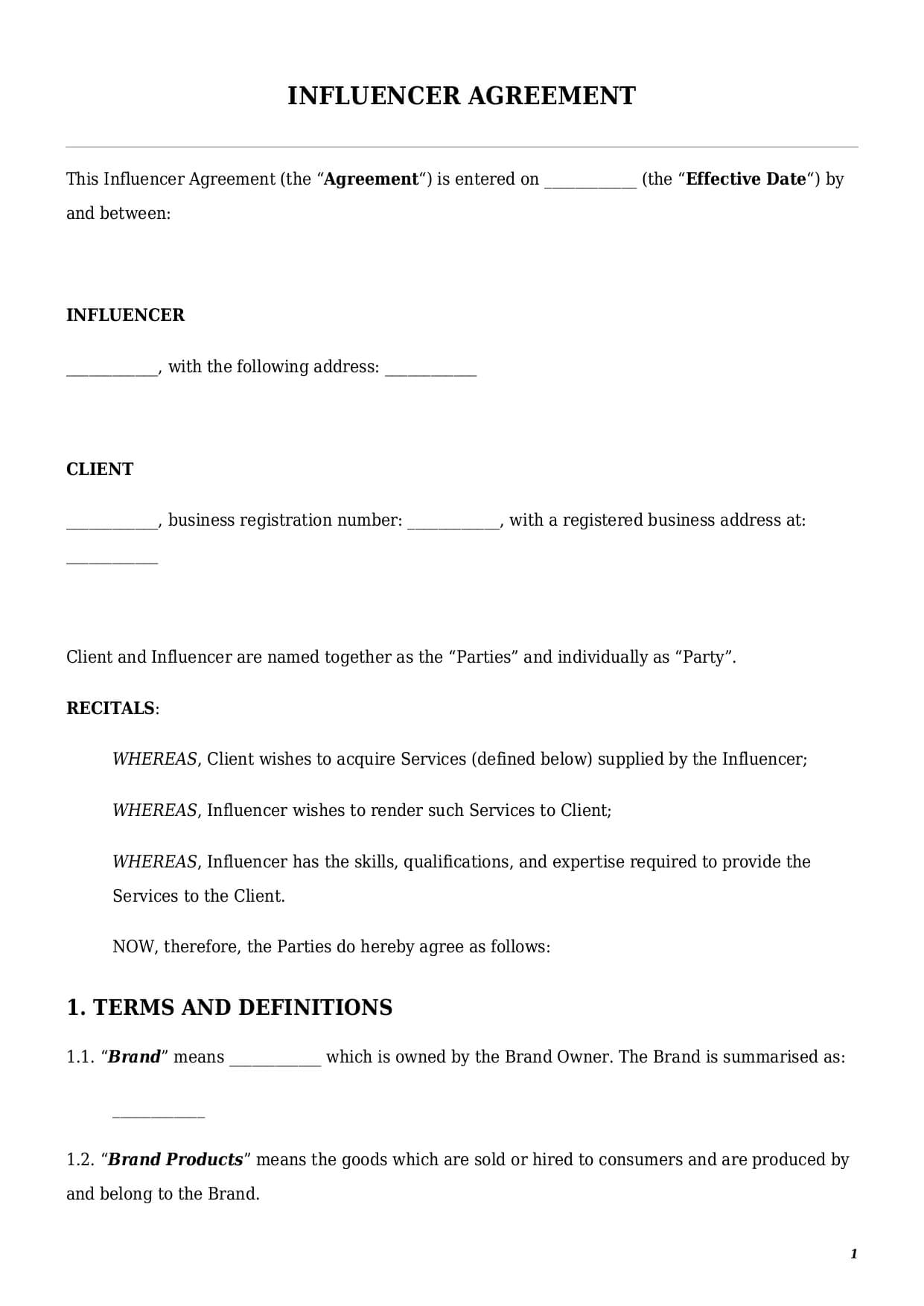
An influencer agreement, also known as an influencer marketing agreement, is a legal contract between a brand and a content creator (influencer), setting out the terms on which the creator will produce and publish promotional content. A well-written influencer agreement example covers what’s being promoted, on which platforms, for what fee or benefit in kind, and critically, who owns the resulting content and what can be done with it afterwards.
This influencer agreement template fully aligns with the provisions of the Digital Market, Competition and Consumers Act (DMCCA) 2024, Data Protection Act (DPA) 2018, UK GDPR, Copyright, Designs and Patents Act (CDPA) 1988, and UK Code of Non-broadcast Advertising and Direct & Promotional Marketing (CAP code) to ensure that the promotional and advertising services performed under the contract meet minimum compliance standards.
This document can be used in conjunction with a non-disclosure agreement to ensure that any confidential information exchanged between the parties in the course of the collaboration remains undisclosed.
Why is this influencer agreement template right for you?
This template of an influencer marketing agreement is a helpful legal solution if you are:
- UK brand willing to advertise products on social media. This template protects your investment in a campaign by clearly defining your usage rights over the content, timeline of the campaign, format of final deliverables and clear recourse if a creator doesn’t deliver.
- Influencer with UK audience. This document template protects your content from misuse by the brand and your work from going unpaid. It makes clear exactly what you’re being paid for and what rights you’re giving up.
- UK startups and entrepreneurs are willing to have a fully compliant legal tool for doing business in the UK. After the introduction of the DMCCA 2024 in 2025, influencer marketing in the UK has moved from an informal handshake industry to a heavily regulated one. Any business that is willing to promote goods and services on social media in the UK needs this template to ensure full compliance with basic requirements established by the Advertising Standards Authority (ASA) and the Committee of Advertising Practice (CAP).
What is covered by this influencer agreement template?
Our template covers the list of the following essential clauses:
- Scope of the campaign. This section defines the specific content to be created, platforms, posting dates, and number of deliverables, so “one Instagram post” doesn’t quietly become an open-ended obligation. If the brand owner wants to order any additional services, including SEO or other content creation, an SEO services contract or general service agreement templates should be used instead.
- Fee and payment terms. The template can be customised for various payment models, including a one-time fee, payment schedule, cash fee or compensation in kind.
- Content ownership and licence. This template allows users to outline whether the brand is licensed to use the content, for how long, and on which platforms, or whether full copyright is being assigned outright. If the parties choose to have a full ownership assignment, the document offers explicit wording in full compliance with Section 90 of the CDPA 1988.
- Approval and revision rights. The document also provides parties with an opportunity to review content before it’s posted and how many rounds of revision are included.
- Advertising disclosure obligations. This is mandatory wording ensuring every piece of sponsored content is correctly labelled under UK advertising law.
- Exclusivity and competitor restrictions — whether the influencer is restricted from working with competing brands, for how long, and in what category.
- Moral rights waiver. This template also addresses the creator’s right to be identified as the author and to object to derogatory treatment of their work and whether these rights are waived to allow the brand to edit or repurpose content freely.
- Termination rights. By customising this template with FasterDraft, parties can define what happens if either party breaches the agreement, including non-delivery, late posting, or a brand reputational issue; a notice period for early termination; as well as post-termination obligations. For example, parties may enter, additionally, a non-disclosure agreement to ensure that the exchanged information remains confidential even after the end of cooperation.
- Indemnities and warranties. In our template, the users can find a pre-default of standard contractual indemnities and warranties clauses that are typical for a solid influencer agreement template. For example, the influencer should confirm the content is original and doesn’t infringe anyone else’s rights, and the brand should confirm that any product claims it wants promoted are accurate and substantiated. In case of a dispute with third parties, either party should be able to rely on the contractual indemnities and warranties as true statements.
- Governing law. The parties can select the laws of which jurisdiction (England and Wales, Scotland or Northern Ireland) should apply to the provisions of this agreement. Once the law is selected, the court of the chosen jurisdiction will have an exclusive right to review the dispute between the parties.
What are the risks of not having a written influencer marketing agreement?
Many businesses and brands in the UK do not take the collaboration on social media seriously, thinking that the agreement made on a ‘handshake’ is enough to proceed further. However, a proper written agreement is essential, as it can shield you from the following risks:
Regulatory compliance risks
Failure to comply with the requirements of the DMCCA 2024 and CAP code may result in severe fines. All this can create uncertainty between the parties when deciding who shall be responsible for paying the fine. To prevent this, our template clearly divides compliance obligations between the parties to ensure both parties are well aware of their compliance obligations and legal consequences for their violation.
Losing usage rights you thought you had
Without a clear licence or assignment of intellectual property rights, the brand may not have sufficient rights to subsequently publish and reuse the created content. To prevent this, our template explicitly addresses which rights are being transferred under the agreement, including a moral rights waiver.
No recourse for non-delivery
Without clear deliverables and timelines, a brand paying upfront (or supplying free product) with no enforceable delivery obligation has very little leverage if content never materialises. Our template allows parties to define the exact completion date when the content must be finalised and delivered to the brand.
Employment status risk
Longer-term, exclusive influencer arrangements that start to resemble ongoing employment (fixed hours, significant control over how work is done, and no ability to work for others) can be considered an employment contract by HM Revenue & Customs. To prevent this, our template includes a special clause to ensure that any partnership or employment relations are being excluded.
What are the common mistakes people make when signing an influencer agreement template in the UK?
If you are a business owner willing to advertise or promote your services, products or goods on social media, or an influencer offering promotion of goods online, you should be aware of the following common legal pitfalls when signing an influencer agreement:
Mistake 1: Assuming payment automatically transfers ownership of the content
The content created under the influencer agreement belongs automatically to the influencer by virtue of a default clause in Section 11 of the CDPA 1988. This is because an influencer is the author of the content, which automatically triggers ownership rights, unless parties agree on something else in the text of the contract. Therefore, if the client makes a payment for the content created, it does not automatically trigger the transfer of ownership. This surprises a lot of brands. If a brand wants to actually own the content outright, that requires an assignment, which under Section 90 of the CDPA 1988 must be in writing and signed by the influencer to be effective — a licence to use content (which can be broad or narrow, exclusive or non-exclusive) is a materially different, lesser right than full ownership, and your agreement needs to say clearly which one is actually being granted.
Our template allows a party to define well in advance who shall own all intellectual property rights created in the course of provision of services under this agreement.
Mistake 2: Child influencer complications
Where content features a minor under the age of 18 years old, a family vlogging channel, or a young creator, it should comply with the UK performance licensing rules (administered by local authorities). For example, any featuring of a minor in any collaboration related to advertising or promotion of goods or services should be done upon the prior written consent from a child’s parents or legal guardian.
Mistake 3: No automatic waiver of moral rights
The CDPA 1988 distinguishes between the moral rights of the author for the created content and ownership rights. Even if the ownership rights are being explicitly transferred to the brand under the agreement, it does not trigger an automatic transfer of the influencer’s moral rights for the created content. Moral rights are the foundation of every piece of content and recognise who is the first to create the content, not the brand. Therefore, if the brand is planning to subsequently reuse, edit, crop or remix influencer content, they either should request a written waiver of moral rights from the influencer (Section 87 of the CDPA 1988) or request a prior written authorisation from the influencer every time they want to introduce any changes to such content.
Mistake 4: GDPR Compliance
In some campaigns, the brand owner and the influencer may need to additionally comply with the requirements of the UK GDPR and DPA 2018. This is the case when, in the course of the campaign, the user’s personal data or information is being collected, processed or shared between third parties, for example:
- Free samples are being shared/delivered to the users’ postal addresses.
- Bonus or promo codes are being shared with the users’ personal email addresses.
- Users are requested to provide certain entries in the quiz to compete for the prize.
- Any other actions involving email captures, competition entries, or analytics shared between influencer and brand.
Mistake 5: DMCCA 2024 mandatory compliance requirement
All influencers in the UK who are making a paid partnership with brands or parties for the purpose of the promotion of goods or services on social media must comply with the set of requirements established by the DMCCA 2024. Failure to comply with its basic requirements now constitutes an unfair commercial practice which is being strictly penalised. For example, the CMA has direct enforcement powers, including fines of up to £300,000 or 10% of a business’s global annual turnover, whichever is higher from the brand and influencer. If the content is fully or partially paid, financed or promoted by the brand, the influencer must always disclose it clearly in the text of the created content.
Mistake 6: Industry conduct requirements.
When promoting goods and services on social media to UK users, influencers and brands must also comply with the CAP Code, administered by CAP and enforced by the ASA, which is the detailed rulebook sitting alongside the statutory framework. Rule 2.1 requires marketing communications to be obviously identifiable as such; Rule 2.3 prohibits falsely presenting a marketing communication as coming from a consumer rather than a trader. The CAP Code specifies acceptable labels for sponsored content — “Ad”, “Advert”, “Advertising”, “Advertisement Feature”, or “Ad Feature” — and current ASA guidance is clear that a label buried at the end of a long string of hashtags doesn’t meet the standard; it needs to be upfront and unmissable.
These requirements also apply to so-called “gifted” collaborations, when the influencer does not receive any compensation for the promotion from the brand.
Mistake 7: Disclosure of AI-generated content
AI-generated content now needs its own disclosure. Regulatory attention in 2026 has extended specifically to AI-generated promotional content — where a post uses AI-generated imagery, voice, or video- that also now needs to be made clear to the audience, on top of the underlying “this is an ad” disclosure.
How to customise this influencer agreement contract with FasterDraft?
To get a fully customisable document template, follow a few easy steps below:
- Click the “Create Document” button.
- Answer simple questions in the form.
- Select a template’s format – PDF or Word.
- E-sign the document online for free.
- Make a payment.
The document is ready for instant download and usage immediately after the purchase.
Try FasterDraft Today
We offer bespoke professional and fully customisable legal document templates for the UK in the range of £ 6 to 50, depending on the document.
No hidden fees. No “free” subscriptions that turn out to be paid subscriptions. Only life-time free licence to use the document.
Table of content
Frequently Asked Questions (FAQ)
-
1. Does the agreement cover social media promotions?
Yes. This influencer marketing agreement template is suitable for the coverage of social media promotion on various platforms, including Instagram, TikTok, YouTube, Facebook, X, LinkedIn, etc.
-
2. Why is an influencer agreement important?
Having a written and well-drafted influencer agreement contract protects the influencer against unfair claims and unpaid invoices. The document clarifies in detail which content, when and where should be posted. In case there is a dispute between the parties, a written contract can be used to refer a dispute to the court.
-
3. Can a brand restrict an influencer from working with competitors?
Yes. Such a restriction clause is also known as an exclusivity clause — but it needs to be reasonable in scope and duration to be enforceable. Our template offers parties to insert an exclusivity clause into the text of the final document template when needed.
-
4. Do influencers legally have to disclose paid partnerships in the UK?
Yes. This is an influencer’s legal obligation that derives from the Digital Markets, Competition and Consumers Act 2024, as well as breaches the UK Code of Non-broadcast Advertising and Direct & Promotional Marketing. Failure to obey this rule automatically results in the CMA’s right to apply fines to both the influencer and the brand directly.
-
5. Does a gifted product need to be disclosed the same way as a paid post?
The Digital Markets, Competition and Consumers Act 2024 establishes the principle according to which influencers must disclose the fact of the promotion and advertising, rather than the fact of being paid for the promotion. While most collaborations with brands on social media are paid partnerships, agreeing to promote and advertise the brand for free is also an ad and should be properly marked in the hashtags.

Looking for something Different?
Start typing to find out our collection of legal documents and contract templates