

.svg) USA
USA.svg) Australia
Australia

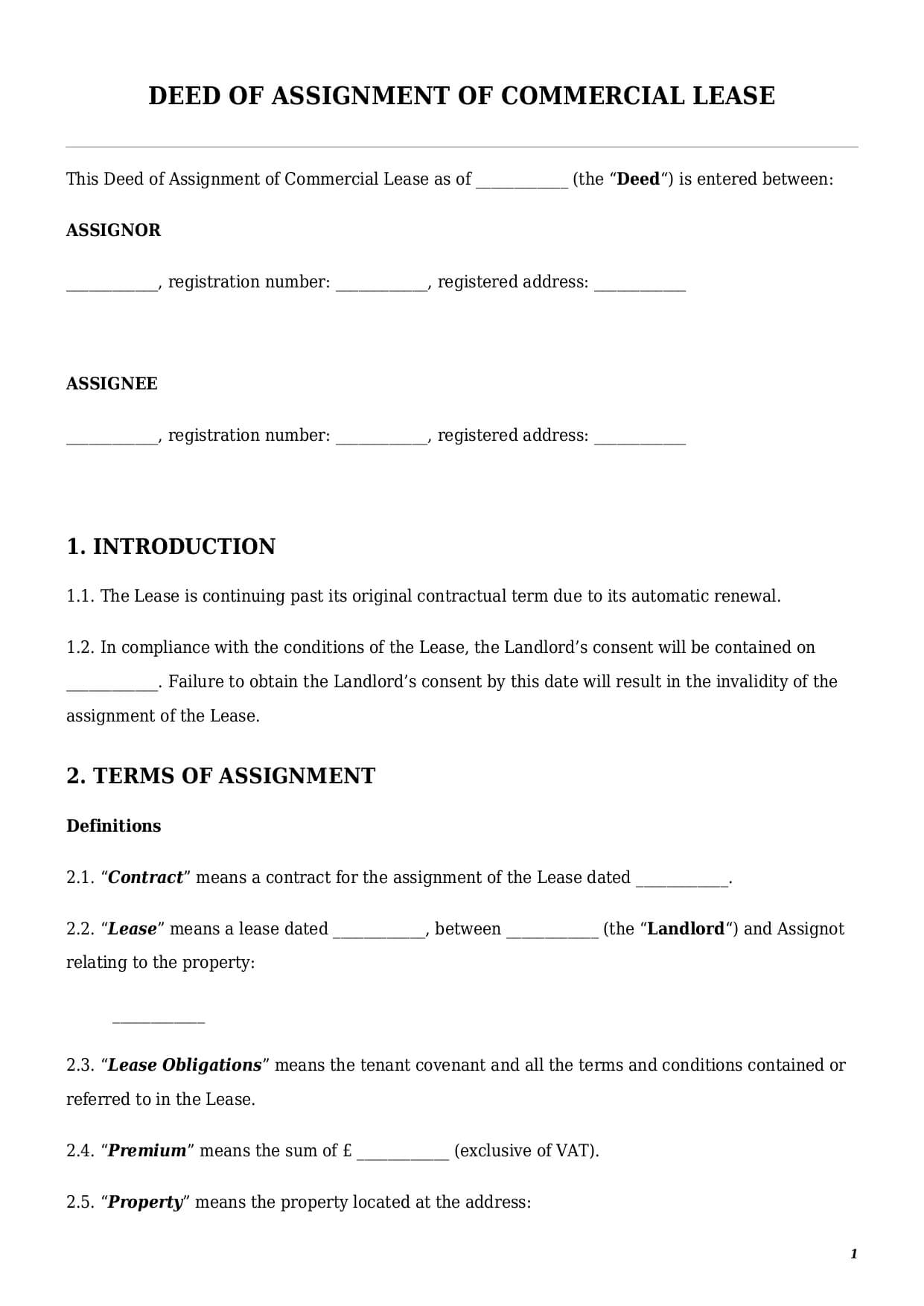
What is a deed of assignment of commercial lease?
A deed of assignment of lease for commercial property is a legal document between the tenant and the third party governing transfer of all rights and interests under the ongoing commercial lease agreement. The document outlines details of the original lease, scope of transferred rights, insurance clause and amount of a premium to be paid.
This document template can be used for different types of commercial real estate, including warehouses, office spaces, co-workings, retail shops, etc.
Who can use this template?
The present deed of assignment of lease sample can be suitable for:
- property owners willing to facilitate the assignment process for their ongoing tenants;
- property management companies searching for a solid template for daily transactions;
- UK businesses looking for a professional template to enter the ongoing lease through assignment;
- commercial tenants.
This template can only be used for commercial properties located in the UK. For the assignment under assured tenancy agreements or lodger agreements, another document should be used instead.
What should be included in this deed of assignment of lease template?
A standard deed of assignment for commercial property in the UK should include:
Original Lease Details
This section must outline:
- full name of the master commercial lease agreement and its date of signing;
- full name of the landlord (an owner of a commercial space) or property management company acting on its behalf;
- address of the commercial property;
- title for the property (full or limited).
Premium
A solid deed of assignment of lease sample shall outline the amount of the premium the assignee shall make for signing this deed. There is no effective regulation in the UK dealing with the minimum or maximum amount of the premium. Therefore, parties can set any amount in line with the real estate market.
The text of the agreement should also additionally outline:
- deadline for paying the premium (usually not later than the date of signing this deed); and
- list of acceptable payment methods assignee can use to make a payment.
Consent
This section is only required when the provision of the original deed of assignment lease requires the assignor to seek prior approval from the landlord. Such an approval should be issued in full compliance with the provisions of the original lease agreement.
What is the difference between assignment and subletting?
Assignment
An assignment in a commercial lease means the transfer of all rights and interests under the ongoing business lease agreement from the tenant to another third party. In simple words, ‘assignment’ means a replacement of the former tenant by the new one.
The deed of assignment of a lease in the UK does not affect, amend or change in any way provisions of the original lease. In fact, the original lease remains fully intact. What does change is the identity of the tenant.
For example, there is a commercial lease agreement between office space owner Jack and small business owner John. The duration of the original lease is 5 years. John’s business does not run well, but early termination of the lease may incur extra fees. Therefore, John decides to assign his rights and obligations under this lease to another entrepreneur who is seeking similar office space at the moment. For Jack, such an assignment means continuation of the lease and stable income. While for John it means exiting from the lease without losing any penny.
Subletting
Subletting is another legal concept which is different from the assignment. It means that the tenant under the original lease transfers their rights and interest to occupy all or part of the leased property to another party. Subletting creates new legal relations between the tenant and that other third party. At the same time, the original lease agreement between the landlord and the tenant remains in force.
For example, there is a commercial lease agreement between office space owner Jack and small business owner John. At some point John realises that he does not need that much space for office employees. For that reason, John decides to sublet further parts of the office to another third party.
How to customise this deed of assignment of lease sample?
To get a fully customisable sample document, follow a few easy steps below:
- Click the “Create Document” button.
- Answer simple questions in the form.
- Select a template’s format – deed of assignment lease PDF or ord.
- E-sign the document.
- Make a payment.
The document is available for immediate download and use right after the purchase.