

.svg)
.svg)
Children Safeguarding Policy
 PDF and
 Word
Word
A child safeguarding policy template is a written document used by organisations in the UK that work with children to ensure their safety and wellbeing.
Reviews

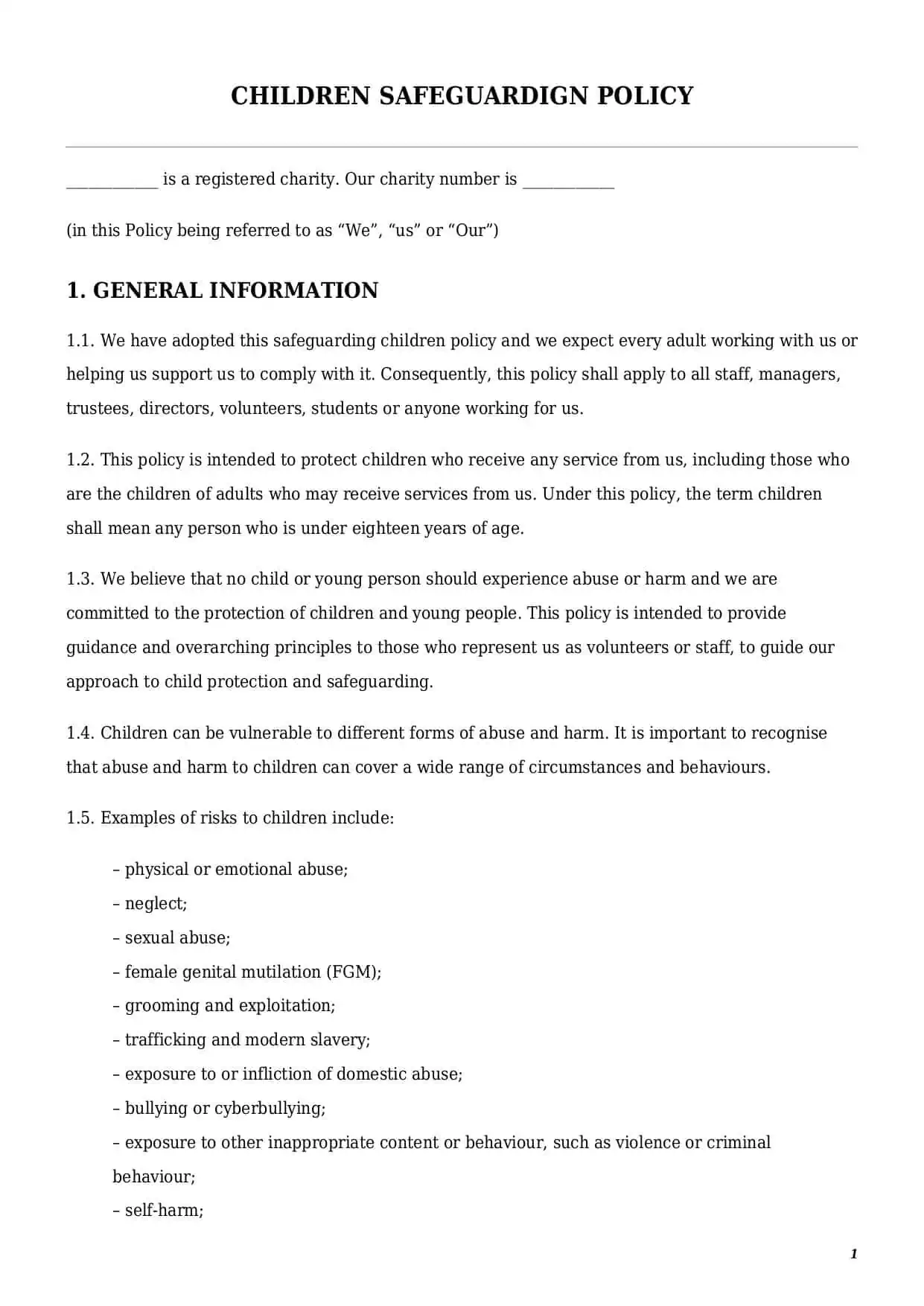
What is a child safeguarding policy?
A child safeguarding policy is a written document that sets out an organisation’s commitment to keeping children safe, the procedures staff and volunteers must follow when they have a concern about a child’s welfare, and the responsibilities of everyone involved in delivering activities or services to children. The main goal of that policy is to ensure children’s safety and wellbeing while studying at school or nursery, doing sports, participating in extracurricular activities, learning new things or doing volunteering work across the UK.
A well-drafted child safeguarding policy template UK is based on the important pillars below:
- definition of the abuse and its form;
- complaint procedure; and
- accountability and legal responsibility for the abuse.
The present template remains the document one for all organisations registered in the UK that provide activities or engage children under the age of 18.
Who needs this child protection and safeguarding policy?
A child safeguarding policy template is relevant to any organisation or individual who works with children or young people under the age of 18, including:
- schools, colleges, nurseries and early years settings;
- sports or youth clubs;
- private tutors and education providers;
- charities and voluntary organisations engaging children and young people.
What should be included in this policy template?
A typical safeguarding and child protection policy template covers the following important sections:
Recruitment Requirements
An organisation should provide safe recruitment to ensure that all individuals engaged in daily work with the children are well-trained, educated and compliant with the recent requirements provided by the effective UK legislation. Before the employment of any such personnel, the organisation has to perform a prior DBS check to ensure a clean criminal record of the applicant.
Designated Safeguarding Lead
The text of a child safeguarding policy template must include details of a designated safeguarding officer appointed to supervise implementation of the policy in the organisation. The policy must define its full name, hours of work, and means of communication such as email and telephone number.
Reporting Requirements
The most important part of that policy is to establish a clear reporting procedure for staff and children. The document shall provide:
- to whom a complaint can be submitted;
- how a complaint can be submitted;
- measures to be taken during the investigation process (for example, suspension of an employee).
Confidentiality vs Mandatory Reporting Requirements
Organisations working with the children in the UK shall maintain confidentiality obligations when it comes to the investigation process of any complaint. However, such an investigation requirement cannot be overridden by a mandatory reporting requirement provided by the Crime and Policing Act 2026 (England and Wales). In such a case, if the organisation’s representative receives a complaint about the sexual abuse of children, the immediate policy reporting is required.
Offline Events
If an organisation organises regular offline events involving the members of the public, the policy should clearly provide if photos can or cannot be taken during such an event.
Online Safety
A solid policy ensuring child safety typically deals with the online presence. This refers to the publication of photos and videos of events and activities involving children on social media, such as Facebook or Instagram. The text of the policy should clearly outline if any photos and videos are shared online. If such a sharing online takes place, the organisation shall ensure the following:
Any photo or video containing the face of a child can only be posted upon the receipt of a prior written consent from a child’s parents or guardians.
Where such consent has not been obtained, the child’s face must be blurred or the image or video must not be published.
Update and Review
A child-friendly safeguarding policy should be able to tackle as many types of abuse and discrimination as possible. Therefore, if a new form of discrimination or abuse emerges, it should be immediately reflected in the provisions of the present policy.
It is also important to review the wording of the policy to ensure it can be read and understood by both adults and children.
What is a child-friendly safeguarding policy?
A child and their well-being are the centre elements for every child safeguarding policy. In fact, the policy cannot be considered safe until it can be read and understood by children, including young people. A child-friendly safeguarding policy typically:
- Uses plain, age-appropriate language;
- Explains in simple terms what abuse is and that it is never the child’s fault;
- Tells children who they can talk to if they are worried about something;
- Makes clear that the organisation takes all concerns seriously;
- It is often available in a shorter, visual format — sometimes co-produced with children themselves.
Common mistakes to avoid with a child safeguarding policy template
If you are planning to draft a safeguarding and child protection policy from scratch, think about these common mistakes people usually make when creating this document for the first time.
Mistake 1: Create a living guide
Most organisations consider having a child safeguarding policy a bureaucratic procedure, so they tend to adopt generic documents without reading them carefully. A solid and well-written child safeguarding policy has to reflect real internal processes and procedures for your organisation by acting as a roadmap. A policy that sits in a filing cabinet unread is worse than useless — it creates a false sense of compliance while leaving children unprotected.
Mistake 2: Review of the Policy
Legislation in the sphere of child protection and well-being has been actively evolving in the UK in recent years. That means a constant amendment process of effective legislation. A solid policy should be able to effectively navigate a changing legislative environment by including a comprehensive amendment clause allowing staff members and stakeholders to reflect all necessary changes in a timely manner.
Mistake 3: Failing to address allegations against staff or volunteers
Many organisations focus their safeguarding procedures entirely on concerns about external abuse. However, sometimes a threat to a child’s wellbeing may be coming from the organisation itself. Every safeguarding policy must include a separate, clearly defined procedure for managing concerns or allegations about the conduct of staff, volunteers, or other trusted adults.
Mistake 4: Step-by-step procedures for responding to concerns
A reporting section of the child safeguarding policy template UK is the most significant, as it provides children and their parents with real means to report any kind of abuse. Therefore, instructions given in that section of the policy should be clear and straight to the point. This section must include means of communication and the responsible person within the organisation for accepting complaints and further actions.
Why use FasterDraft for your child safeguarding policy?
By customising this policy template with FasterDraft, you get the document with the following benefits:
- a template that is suitable for application by charities, fundraising organisations, sports clubs, youth clubs, and childminders operating within the UK;
- a document that fully complies with the Children’s Wellbeing and Schools Act 2026;
- a template created by qualified UK solicitors;
- a document that is fully customisable for specific needs of your organisation;
- a document written in simple and plain English understandable for adults, childcare professionals and children.
How to use this child safeguarding policy template?
To get a fully customisable document template, follow a few easy steps below:
- Click the “Create Document” button.
- Answer simple questions in the form.
- Select a template’s format – child safeguarding policy PDF or Word.
- E-sign the document.
- Make a payment.
The document is ready for instant download immediately after the purchase.
Signed by: _________________________________
Table of content
Frequently Asked Questions (FAQ)
-
1. Is a child safeguarding policy a legal requirement in the UK?
Yes, for most organisations working with children. The specific legal duty varies by organisation type and jurisdiction, but a written safeguarding policy is required by statute for schools across all four UK nations, for registered childcare providers and childminders, for charities regulated by the Charity Commission, and for organisations providing regulated activity with children. For voluntary and community organisations, a safeguarding policy is typically required by funders, insurance providers, and national governing bodies even where there is no direct statutory obligation.
-
2. How often does a child safeguarding policy need to be reviewed?
At a minimum, annually. Ofsted recommends organisations make periodic annual reviews. However, as a rule of thumb, a solid policy should be reviewed immediately once the following occur:
- the new legislation on child safety and regulation is being enforced;
- the new type of discrimination or abuse emerges; or
- in case of internal changes within the organisation.
-
3. What vetting checks are required for people working with children?
The exact check largely depends on the place of registration of the organisation.
For an organisation registered in England and Wales, a Disclosure and Barring Service (DBS) check is required for those in regulated activity with children – typically at an enhanced level with a check against the children’s barred list. In Scotland, the Protecting Vulnerable Groups (PVG) Scheme operated by Disclosure Scotland applies. In Northern Ireland, AccessNI handles vetting.
-
4. Can volunteers be subject to the same safeguarding requirements as paid staff?
Yes. It does not matter if a person is being engaged by the organisation by virtue of an employment contract or as a volunteer. As long as such a person is involved in direct communication and work with the children, performance of the minimum DBS check (for PVG for Scotland and AccessNI for Northern Ireland) is mandatory. Safeguarding obligations apply equally to paid staff, volunteers, trustees, and contractors who work with children.
-
5. Is a child-friendly version of the policy required?
Most regulatory bodies and professional guidance documents recommend that organisations produce a child-friendly version of their safeguarding policy that children and young people can understand.
Ofsted inspectors and equivalent bodies may ask children whether they know who to talk to if they are worried about something, and a child-friendly policy supports this awareness. This template includes a child-friendly summary section that can be adapted and shared directly with children and displayed in your setting.

Looking for something Different?
Start typing to find out our collection of legal documents and contract templates