
.svg)
 United Kingdom
.svg) Australia
Australia

What can go wrong without a tree removal agreement?
Tree removal is one of the highest-risk home services. Disputes are common between neighbors and homeowners and involve paying lots of legal costs. Having a properly drafted template of a tree removal agreement can prevent you from the following risks:
- Property damage with no compensation. A tree falls on your fence, car, or neighbor’s property. Without a written liability clause, it is unclear who shall cover damages and losses that occurred due to an occasional fall of a tree—you or a tree removal service provider.
- Incomplete work and no remedy. The contractor removes the tree but leaves the stump, debris, or damage to your lawn. Without a scope of services in writing, you have no grounds to demand the work to be fully complete, as there is no written proof of what a completed work should look like.
- Unpaid invoices. You complete the job and the client disputes the price or refuses to pay. A written payment schedule clearly outlines the payment deadline and applicable interest rate in case of failure to pay on time, as well as acceptable payment methods.
- Neighbor disputes. Trees on or near boundary lines are a common source of legal conflict. A clear agreement defining the exact location of work protects you from third-party claims.
No cancellation protection. A client cancels the day before a scheduled job, costing you time and equipment. Without a cancellation clause, you cannot claim any payment and absorb the loss.
A tree removal contract costs a fraction of what one unresolved dispute would cost in time, legal fees, or damaged client relationships.
What is a tree removal agreement?
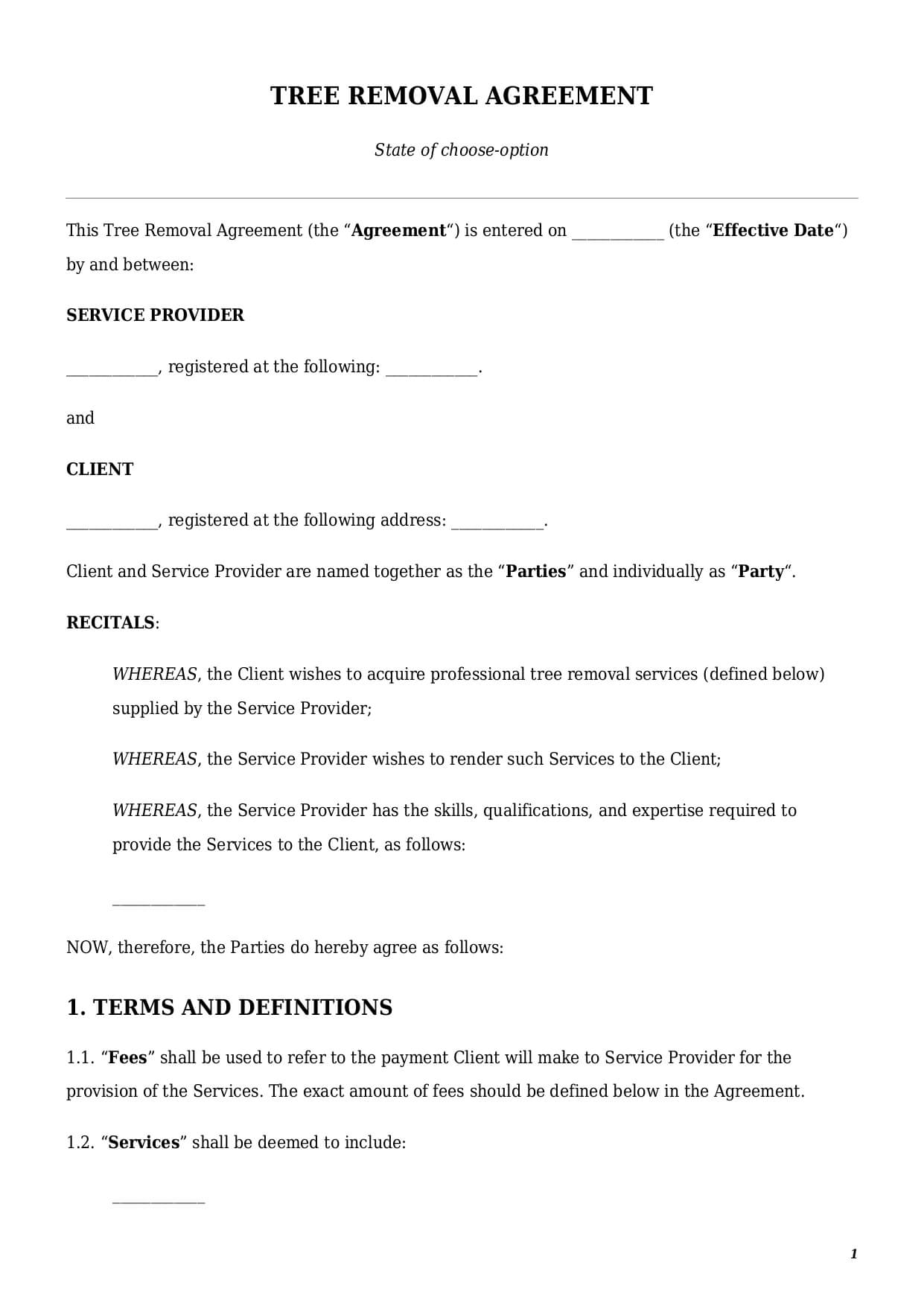
A tree removal agreement is a legally binding contract outlining the terms and conditions for removing one or more trees from a specified property. This document clearly defines:
- full names, addresses, and contact details of parties involved;
- scope of services;
- payment terms;
- safety standards;
- liabilities and disclaimers;
- provider’s confidentiality obligation, etc.
The parties involved in a tree removal agreement sample are a client and a service provider. A client could be a homeowner, tenant, property manager, business, local council, or any other individual or entity who needs tree removal services. In the case of a tree removal agreement between neighbors template, the clients are usually neighbors who are willing to split the cost to remove or cut certain trees.
A service provider is a registered business or a self-employed person who is ready to provide requested services in exchange for remuneration. While federal law does not require service providers to hold specific licenses for a tree removal activity, having additional qualifications is always an advantage.
What does this tree removal agreement template include?
Our solid tree removal agreement template covers all essential clauses every business that provides tree trimming services must have. Below we made a list of all essential clauses a good template should have.
Description of Services
The most critical part for every tree removal agreement sample is the inclusion of a detailed description of services. The list of services may include cutting and removing one or more trees, disposing of or hauling away debris, site cleanup, etc. Failure to define the scope of services clearly may result in the scope creep. If the client requires any additional services such as cleaning or lawn care services, separate service provision agreement should be signed in addition to the present document.
Apart from that, the text of a contract shall define if a service provider plans to use subcontractors or not. Engagement of subcontractors for the provision of services shall be made separately by signing an independent contractor agreement for subcontractors. Some property owners and clients may not wish to accept services from third parties. Therefore, this is something the parties shall discuss before signing the contract.
Apart from that, a detailed description of services under a tree removal agreement shall include the exact location where services should be provided.
Finally, as a general rule, a service provider shall perform their services in compliance with applicable state and federal safety and health regulations, including noise limitations, cleanup, and disposal of garbage.
Schedule of Services and Cancellation Policy
Our text of every tree removal agreement template also defines the schedule according to which services should be provided. There are three ways how tree removal services could be rendered:
- on a specific date;
- on an as-needed basis (i.e., a client shall send a separate prior request each time they need services); or
- according to a specific schedule (i.e., exact dates and times when services should be rendered).
It is also highly recommended to address a cancellation policy once the client changes their mind. A cancellation clause provides a right to cancel ordered services by sending a prior written notice to a service provider. Such a cancellation notice could be sent 12, 24, 36, or more hours prior to the agreed date. Failure to adhere to a cancellation policy results in a client being liable to pay partially or in full for ordered services.
Payment Provisions
This tree removal contracts clarifies payment terms. Therefore, the present section includes:
- agreed payment structure (e.g., hourly rate, fixed sum, daily rate);
- invoicing period (e.g., at the end of every week, upon provision of all services);
- acceptable payment methods (e.g., cash or bank transfers).
Even if a client fails to pay the due sum and the contract is being terminated, a client nevertheless remains liable to pay the remaining debt. Therefore, even a simple tree removal contract should clearly state that any outstanding payment obligations shall survive the termination or expiration of the contract.
Insurance and Liability
Another important section a sample tree removal contract should have is the parties’ liability clause. According to the general rule, the parties remain liable for all damages, injuries, and losses caused to another party. However, there are a number of exceptions, which parties can use to limit their contractual liability:
- Types of losses: A party may not be liable for loss of goodwill, profits, business, or any economic loss. The parties have to clearly define which losses shall not be covered by the liability clause.
- Threshold: A party’s liability under the tree removal contract can be limited to a certain amount of money. In case of a dispute, a liable party won’t be required to pay more than the established maximum threshold. The parties may establish any threshold they wish to. The most common is to limit either party’s liability to the amount of all fees paid under the agreement.
- Limitations: Parties under the contract may not limit or exclude their liability for either party’s death or injury caused by gross misconduct or negligence.
- Insurance: It is advisable for businesses and individuals to have additional liability insurance coverage once either party declares losses and seeks compensation.
Compliance requirements
This template ensures that the provision of trimming services under the contract fully aligns with the applicable federal, state, and local laws, including:
- Federal Level. The tree removal service providers shall fully comply with the Endangered Species Act (ESA), which prohibits any action that results in a “take” of a listed endangered species. Penalties for any violation of rules defined in the cited act may result in significant fines.
- State Level. For operation on the territory of a specific state, the service provider must possess all respective permit systems and authorizations. Failure to comply with such a requirement results in a tree’s unauthorized removal, which is a state crime in California and Florida. This template includes a solid compliance clause to ensure that the services are being provided in accordance with the state-specific requirements.
- Licensing. Tree service licensing requirements vary significantly by state. In Florida, tree trimming and removal is regulated through the landscape contractor licensing structure administered by the Florida Department of Business and Professional Regulation (FL DBPR). In states such as Arizona, Michigan, and Maryland, tree work is typically performed under a general landscape contractor license with no separate tree-specific license required at the state level. Where a state contractor license is required, proof of general liability insurance—commonly set at $1 million per occurrence for specialty contractor classifications—and a surety bond are typically prerequisites before a license is issued or renewed.
Why choose this template over others?
If you customize your tree removal agreement with FasterDraft, you get the following benefits:
- Saves legal costs compared to hiring a real lawyer.
- Offers state-specific clauses
- Ready in minutes, not days or weeks
- Drafted by real lawyers—no AI generation;
- Available for download in an editable Word or PDF version;
- Covers liability and insurance clauses rarely
- Cancellation policy included a free bonus.
How to get a printable tree removal contract template at Faster Draft?
To personalize your legal document template, follow a few easy steps below:
- Click the button “Create Document.”
- Answer simple questions in the form.
- Select a template’s format—tree removal agreement PDF or Word.
- Make a payment.
- E-sign, download, print, and use your customized document in minutes.
This article is reviewed by Daria Turanska, a lawyer with 15 years’ contract drafting experience. Fact-checked by Sarah Collins.