
.svg)
 United Kingdom
.svg) Australia
Australia

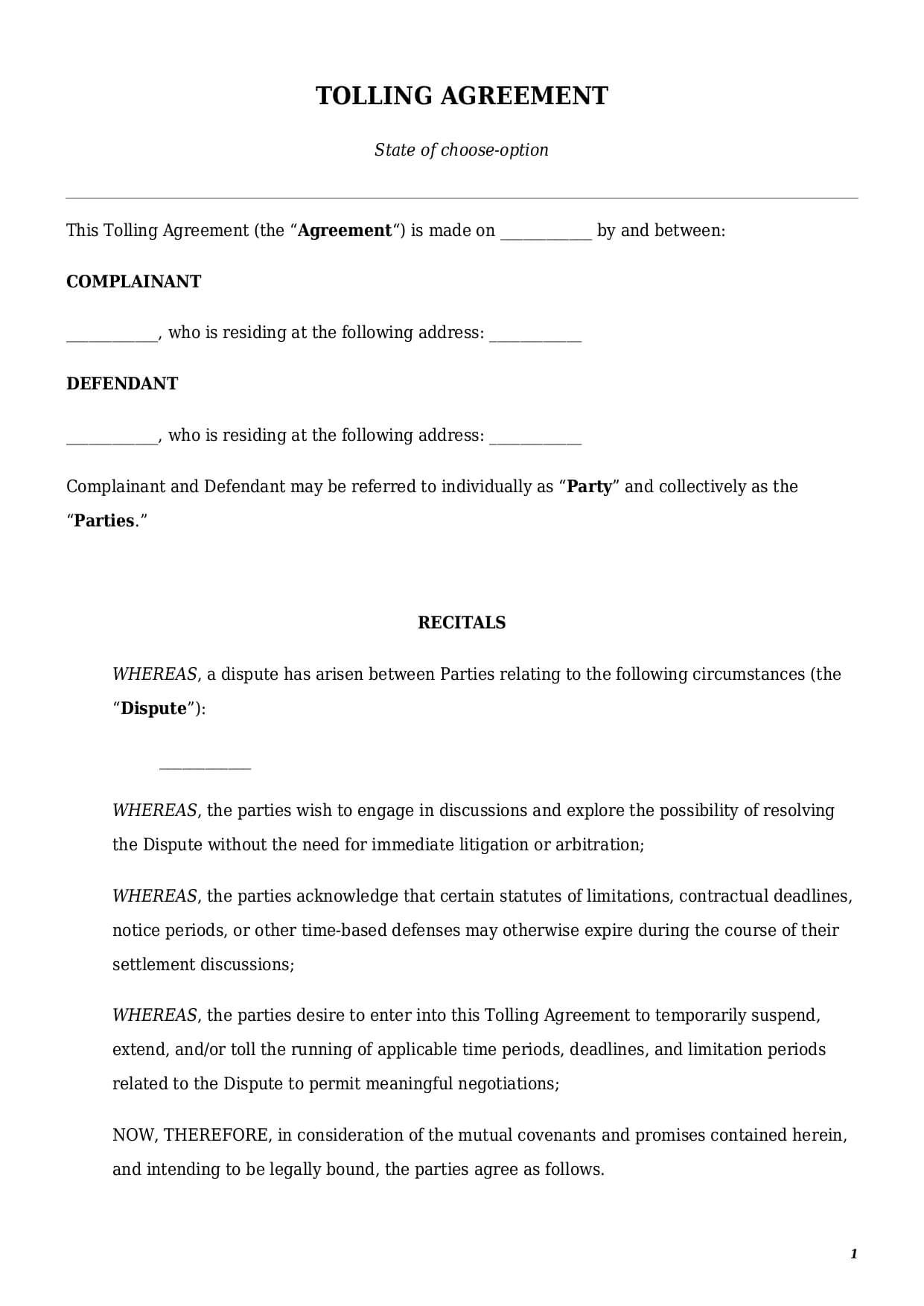
What is a tolling agreement?
A tolling agreement is a legally binding contract between two parties that aims to pause the running of a statute of limitations in order to mitigate the existing dispute outside of the court. Conclusion of a tolling agreement is a parties’ choice, rather than obligation. It means that if either party to a dispute does not want to enter a tolling agreement, they could proceed with a dispute resolution via arbitration or litigation.
The parties involved in tolling agreements are the defendant and the complainant. A complainant is a person who believes that their legal rights and interests were violated. A defendant is a person who is being accused of wrongdoing (e.g., injuries, violation of contractual duties, etc.).
The purpose of a tolling agreement is to preserve each party’s rights without forcing them into rushed litigation.
When do you need a tolling agreement?
Tolling agreements are being used frequently while mitigating disputes and conflicts arising from:
- Contract Disputes. Conflicts arise between counterparties due to the execution of various types of contracts, including service agreements, supply of goods, etc. For instance, either party fails to provide requested services on time, or the client fails to pay before the agreed deadline, etc.
- Employment Disputes. In the course of employment relations, conflicts at the workplace could pop up quite frequently. For instance, an employee may report discrimination or workplace harassment.
- Personal Injury Cases. Disputes regarding the compensation for submitted medical claims usually take lots of time. This is why a tolling agreement could be a helpful solution.
- Insurance Claims. Insurers and claimants often use tolling agreements to allow time for claim evaluation without running into litigation immediately.
What to include in a tolling agreement sample?
A well-drafted tolling agreement sample must include key details listed below:
- Details of the parties involved. The text of a tolling agreement shall provide the full name, address, and contact email of both parties signing this agreement. Besides that, the parties listed in a document’s preamble must put their signatures at the end of the document as well.
- Dispute details. Another important element is to describe the essence of a dispute or complaint between the parties. Tolling agreements could apply to various cases, including employment disputes, business negotiations, insurance claims, etc.
- Tolling date. This is the date by which parties undertake to negotiate to reach a solution for their dispute. Depending on the specifics of a case and applicable state legislation, the tolling date could be a fixed date in the future or a certain event in the future.
- No litigation. A good tolling agreement example for contract disputes must also include a no litigation disclaimer. It means that both parties guarantee each other that they will not take a dispute to a court before the tolling date.
- Confidentiality. This is an optional clause parties may add to the text of a tolling agreement. Under this clause, both parties undertake to refrain from disclosure of any sensitive or personal information related to a dispute or to the parties. If the parties wish so, they could also outline confidential obligations in a separate non-disclosure agreement.
- Governing law. This is a law of a state that should apply for execution, interpretation, and termination of tolling agreements. Usually it should be a state where either party or a subject to a dispute is located.
How to customize a tolling agreement sample at FasterDraft?
To get a customizable tolling contract for attorneys, follow a few easy steps below:
- Click the “Create Document” button.
- Answer simple questions in the form.
- Select a template’s format—tolling agreement template PDF or Word.
- Make a payment.
- Download, sign, and use this document.