
.svg)
 United Kingdom
.svg) Australia
Australia

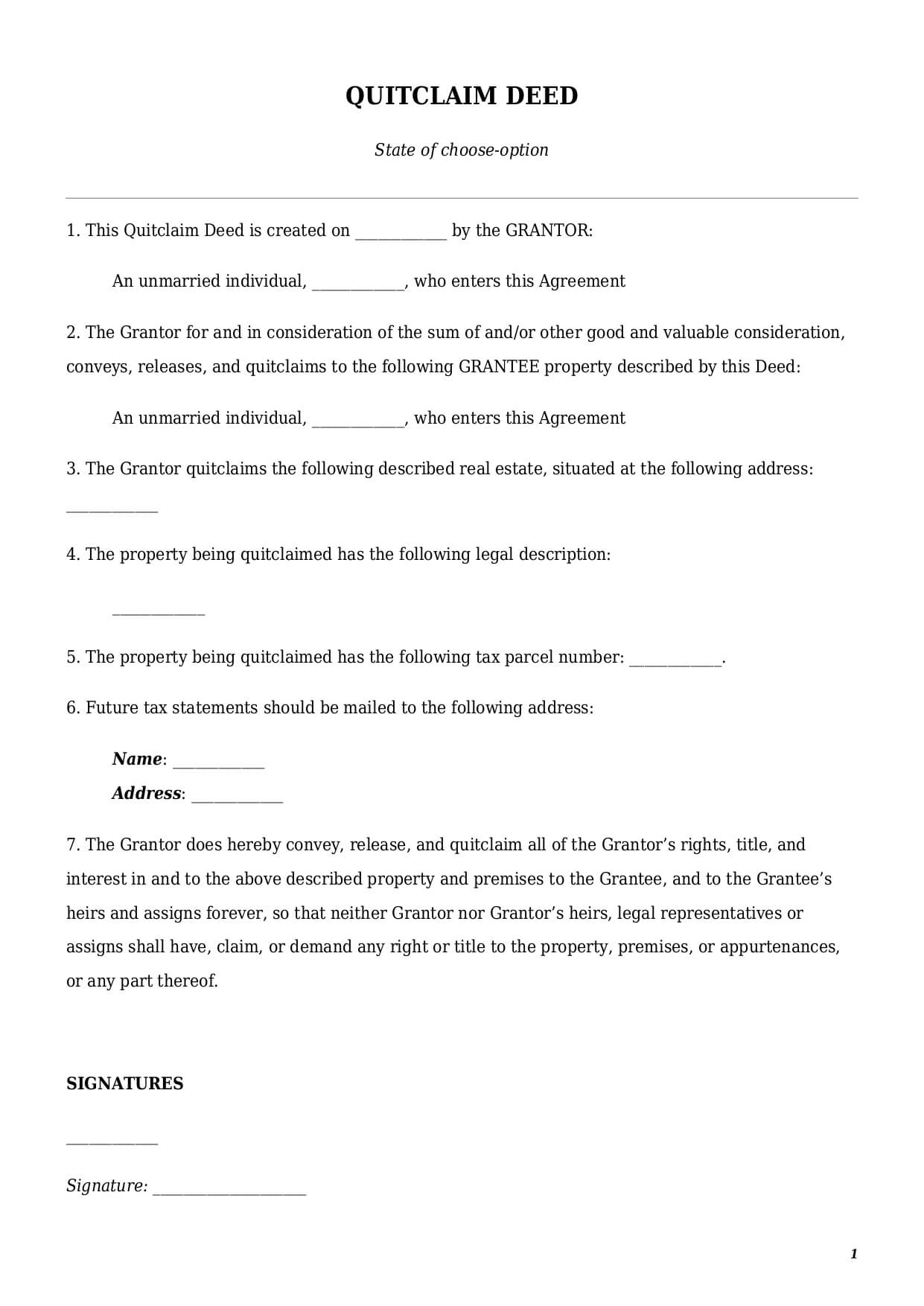
What is a quitclaim deed?
Definition
A quitclaim deed is a legal document used in real estate to quickly and efficiently transfer ownership interest in property from one party to another. This document does not guarantee, however, a transfer of the property’s clear title.
The parties involved in this document are a grantor and a grantee. A grantor is a holder of a property title who is willing to transfer it to another party for or without consideration. A grantee is a person to whom a title is being transferred. Both parties could be individuals, trusts, companies, or organizations.
A quitclaim deed template could be used for a transfer of real estate only, including a house, land, farm, etc. Therefore, it could not apply towards the sale-purchase of goods.
Practical Application of Quitclaim Deed
A quitclaim deed template is one of the most frequently used legal documents in the U.S. The most common situations of its application are the following:
- when either spouse wishes to transfer their title in a property to another spouse due to marriage, separation, divorce, or other circumstances;
- when parents wish to transfer some property to their children or grandchildren;
- when there is a need to resolve technical mistakes or errors in a property’s documents, etc.
Difference between a quitclaim deed and a sale-purchase agreement
Even if both documents are dealing with a transfer of the real estate between parties, they differ significantly in terms of legal aspects of such a transfer:
- Parties. Parties to a quitclaim deed form are mostly family members, trusted business partners, tenants, and landlords, which is not common for a traditional sale-purchase agreement.
- Title. Under a quitclaim deed a transferred property may have encumbrances attached, including tenants, mortgages, etc. This is not the case, however, for a traditional sale of property agreement.
- Complexity. A quitclaim deed is a simple document that includes only the parties’ and the property’s details. At the same time, a sale of a real estate document is a complex legal instrument that involves parties’ representations and guarantees, payment terms, material breach circumstances, etc.
How to create a quitclaim deed form?
To draft a complete and legally sound deed document, include the information listed below:
Details of Grantor and Grantee
The text of a every deed template must include:
- full name of the parties (if there are several grantors, all names should be listed in the text of a deed);
- grantor’s status (applies only if either party is a physical individual);
- full name of a representative (applies only if either party is a business, organization, or trust).
Details of the Property
A legal heart of every quitclaim deed template is a detailed description of the property that shall include:
- tax parcel number (this information could be found in a property’s tax bills, property’s real-purchase deed, or other documents);
- full address of a property;
- boundaries schema or plan (a grantor may optionally attach a property’s boundaries report to this deed as well);
- name of a state where property is located (for instance, Florida Quitclaim Deed means that the property is located in Florida).
Besides that, the text of a deed must also reflect the name of a person and their residential address where a property’s tax statement should be sent after the deed’s notarization.
Notarization
The last mandatory step is a notarization process. All quitclaim deed forms in the U.S. should be notarized, which is a federal requirement. Notarization ensures the clarity of a legal title over the property, as well as its record in the official register.
Once the document is complete, signed, and notarized, a notary or a grantor shall deliver such a document to a local county’s register to finalize the transfer.
Please note that notarization and council fees for registration of a quitclaim deed vary depending on the state and area.
How to customize a quitclaim deed at FasterDraft?
To get a fully customized legal document, follow a few easy steps below:
- Click the “Create Document” button.
- Answer simple questions in the form.
- Select a template’s format—quitclaim deed template PDF or Word.
- Make a payment.
- Download, print, sign, and notarize this document to make it fully valid.