
.svg)
 United Kingdom
.svg) Australia
Australia

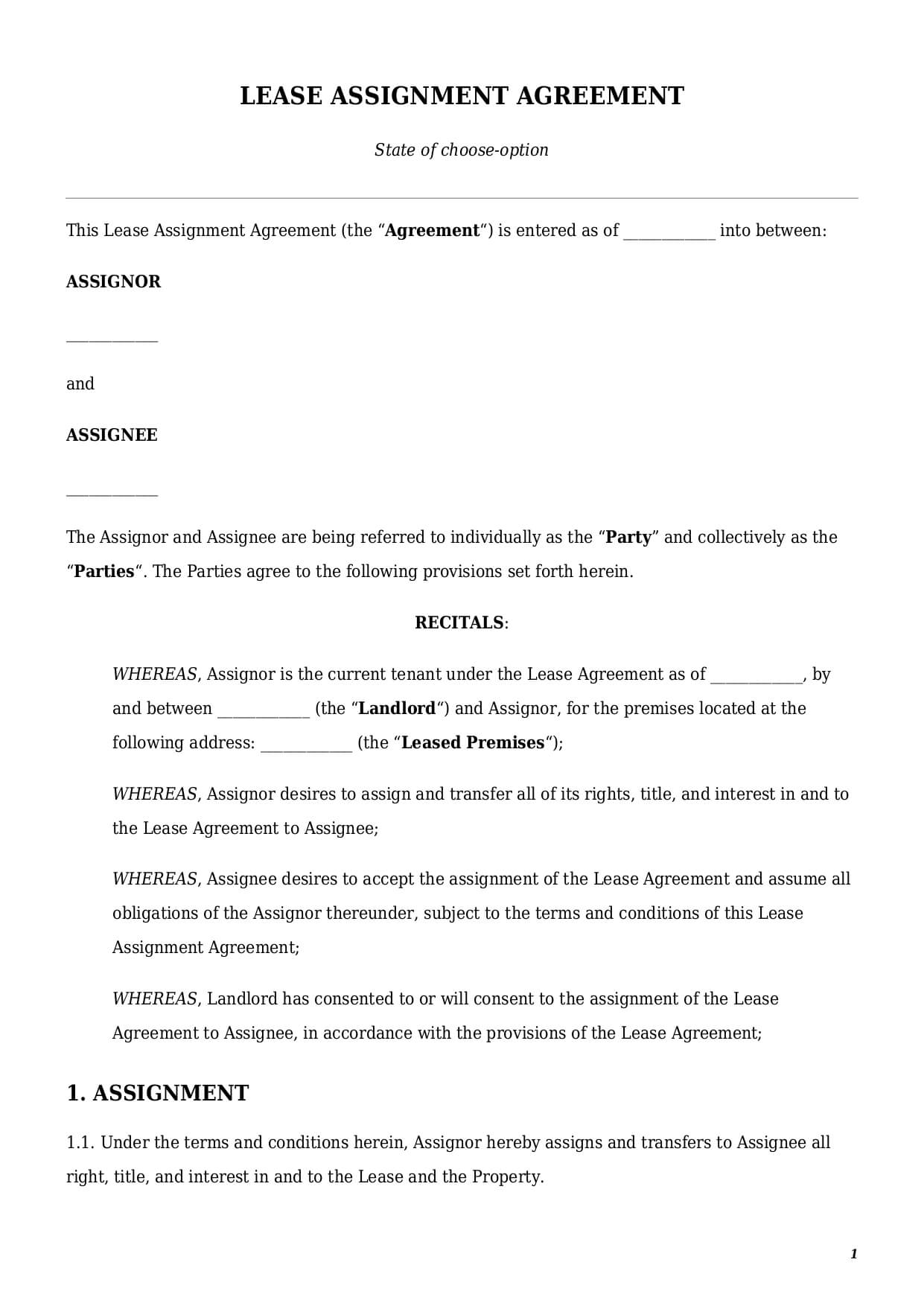
What is a lease assignment agreement?
A lease assignment agreement template is a formal legal contract that allows a tenant to transfer all of their rights and obligations under an existing lease agreement to another party. This document ensures that the lease transfer is legally binding and protects the interests of all parties involved, including the landlord. A lease transfer agreement is suitable when assigning rights and obligations under commercial and residential leases or short-term rental contracts.
The parties involved in an assignment of lease agreement are
- Assignor. An individual, business, or organization that is a tenant under a current lease agreement. This is a person who wants to transfer their rights and obligations under the lease agreement to another party.
- Assignee. Any third party who becomes a new tenant under the lease assignment agreement.
Having a solid written lease assignment agreement template is essential for many reasons:
- First, a written document minimized the risk of potential disputes between the parties;
- Second, a written document serves as a solid record of a landlord’s approval for an assignment.
- Third, a lease transfer agreement ensures compliance with federal and state laws.
How to draft a sample assignment of lease agreement?
Creating an assignment of lease agreement is not an easy task, even for lawyers. We’ve got you covered. Below, we made a short FREE list of the most essential tips you need to know before drafting your lease assignment agreement from scratch.
Tip No. 1: Landlord’s Consent
Entering an assignment of a lease agreement is only possible after a landlord’s permission. This is a written authorization issued by a property’s owner or manager. Such an authorization cannot be obtained post-factum—i.e., after signing a lease assignment agreement.
If, however, the text of the original lease agreement allows assignment of rights and obligations without any prior approval, you can proceed with signing a lease assignment agreement without receiving a prior approval.
Tip No. 2: Details of Lease
The text of every sample lease assignment agreement must include:
- name and date of signing of the original lease agreement;
- full name and contact details of a landlord;
- date of assignment (i.e., a date on which a third party becomes the new tenant); and
- full address of the leased property.
Tip No. 3: Scope of Assignment
Under an assignment of a lease agreement, a tenant can assign their liabilities under the existing lease in part or in full.
In case of a partial assignment, it means that an assignor remains fully liable if an assignee damages a rental property. Contrary to that, in the case of a full assignment, an assignee remains fully liable for any damage to a rental property.
Tip No. 4: Lead-Based Paint Disclosure
If your plan is to use this lease transfer agreement for a residential building built before 1978, the text of the document must include a lead-based paint disclosure.
This disclosure shall inform an assignee about the existence (if applicable) of lead paint elements in a rental property. Lead paint represents a serious danger to the health of people, especially for children and pregnant women.
Tip No. 5: Applicable Law
Another important element is the selection of applicable laws. This is a law of a state that shall apply to the provision of a sample lease assignment agreement. While the parties are free to choose the laws of any state, the most common options include:
- a state, the laws of which apply to the original lease agreement;
- a state where the rental property is located;
- a state where either the assignor or assignee is currently based or resides.
How to customize this agreement at FasterDraft?
To get a fully customized legal document, follow the easy steps below:
- Click the “Create Document” button.
- Answer simple questions in an assignment of lease agreement form.
- Select a template’s format—lease assignment agreement PDF or Word.
- Make a payment.
- Download, print, sign, and use the document.