
.svg)
 United Kingdom
.svg) Australia
Australia

What is a clean desk policy?
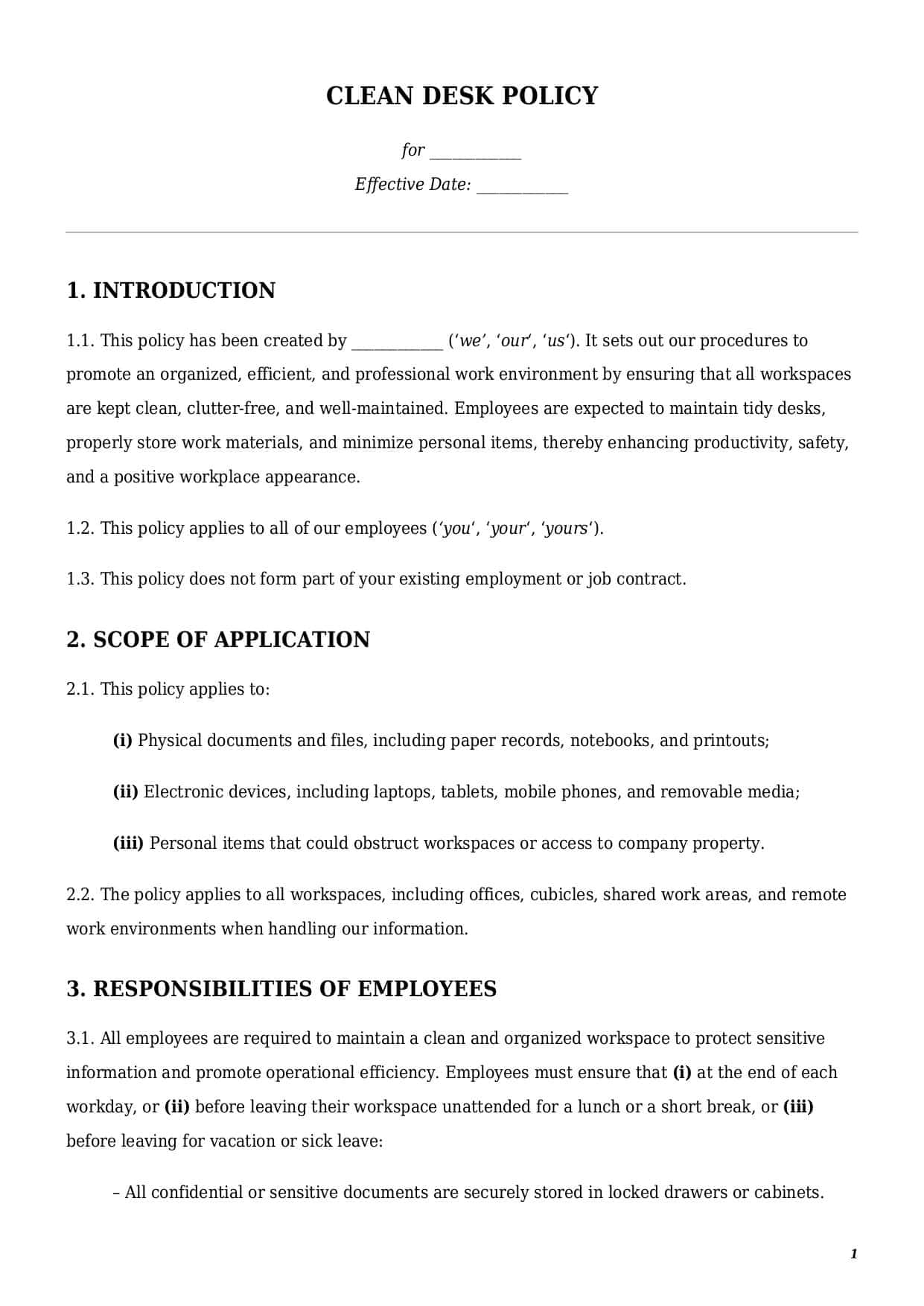
A clean desk policy is a workplace internal document that requires employees to keep their desks and work areas organized, tidy, and free of unnecessary items. Having a clean desk policy for employees does not only promote efficiency, professionalism, and workplace safety but also protects sensitive information from its disclosure.
A clean desk policy template normally remains an integral part of a more complex company’s regulation known as the Employee Handbook. While a clean desk policy for employees tackles only one aspect of handling confidential information in a workspace, an employee handbook addresses as well vacation and sick leave, disciplinary procedures, harassment policies, and much more.
Who should use this clean desk policy?
Having even a simple clean desk policy template is suitable for businesses of all sizes, including
- big corporations with lots of remote teams and outsourced staff when the risk of leaks of confidential information is too high;
- startups who may need to use shared office environments for doing their business;
- employers who want to prevent sensitive information from unintentional disclosure to third parties;
- HR departments and compliance officers who need a solid, clear desk policy template for handling confidential records, client data, or company-owned equipment.
What to include in a clean desk policy template?
Unlike other organizations’ internal corporate policies and regulations, a clean desk policy template usually has a simple structure. Below we created for you a free checklist of things you must include in your clean desk policy.
Define Purpose
A clean desk policy is an internal set of guidelines employees shall comply with. Therefore, the document should not only be written in simple language but also clearly define its initial purpose. All in all, this policy serves a dual purpose:
- On the one hand, it aims to organize the workspace and to achieve clearness; and
- On the other hand, it protects the organization’s confidential information that could be unintentionally exposed to third parties while certain notes or documents have been left unattended.
The clearer you, as a business owner, define a policy’s goals, the greater understanding employees may get about their workplace duties and obligations.
Finally, avoid the inclusion in the text of a clean desk policy other additional information that do not relate to the document’s subject. For instance, if an employee violates provisions of a clean desk policy, such an employee shall face disciplinary actions. If your organization has a separate disciplinary manual in place, there is no need to explain the disciplinary procedure again in the text of a present clean desk policy. It would be just enough to make a reference to an existing disciplinary policy, which an employee shall consult as well.
Scope of Application
Another important pillar for every clean desk policy sample is the definition of its scope of application. In other words, the policy must define categories of employees who shall abide by its provisions. Thus, the text of the policy shall clearly define which category of employees listed below shall be covered:
- full-time employees;
- part-time employees;
- seasonal workers;
- project employees; and
- contractors on a retainer basis or services agreements.
Definition of Clean Desk
It is essential for every clean desk policy template to clearly outline a list of things and items that shall not be left unattended. It does not necessarily mean that this policy must prohibit placement of items or documents that may include confidential information. In fact, employees have to maintain a clean and organized workspace and make sure that:
- Personal items, food, or other clutter are minimized;
- Printouts or notes with confidential information shall either be in locked drawers or destroyed via shredder. s;
- Whiteboards or other surfaces shall be cleared immediately after their usage;
- Electronic devices are logged off, locked, or password-protected, etc.
Policy Amendment and Distribution
A satisfactory clean desk policy example shall also define how often the document could be updated or reviewed by an organization. As a rule of thumb, an organization usually reserves an exclusive right to change or amend the policy at any time without prior written notice or consent of its employees.
Once you amend a clean desk policy for employees, it is time to decide how an organization shall inform their employees about amendments. In the list below we suggest all available options an organization could pick up from to notify their staff:
- First, notification via sending personal corporate emails with an amended policy in the attachment;
- Second, notification via physical distribution of printed copies of an amended policy amongst employees;
- Third, notification via an organization’s database or intranet.
Last but not least, depending on a company’s internal bylaws, this clean desk policy template may need to be signed to become a valid legal document. If this is the case, a company’s authorized legal representative or a staff member shall put their signature on it. Usually, it is a company’s CEO, head of the HR department, or head of the compliance department who shall sign a clean desk policy sample.
How to customize this policy at FasterDraft?
To get a fully customized legal document template, follow a few easy steps below:
- Click the “Create Document” button.
- Answer simple questions in the form.
- Select a template’s format—clean desk policy PDF or Word.
- Make a payment.
- E-sign, download, and distribute this policy amongst employees of your company.