
.svg)
 United Kingdom
.svg) Australia
Australia

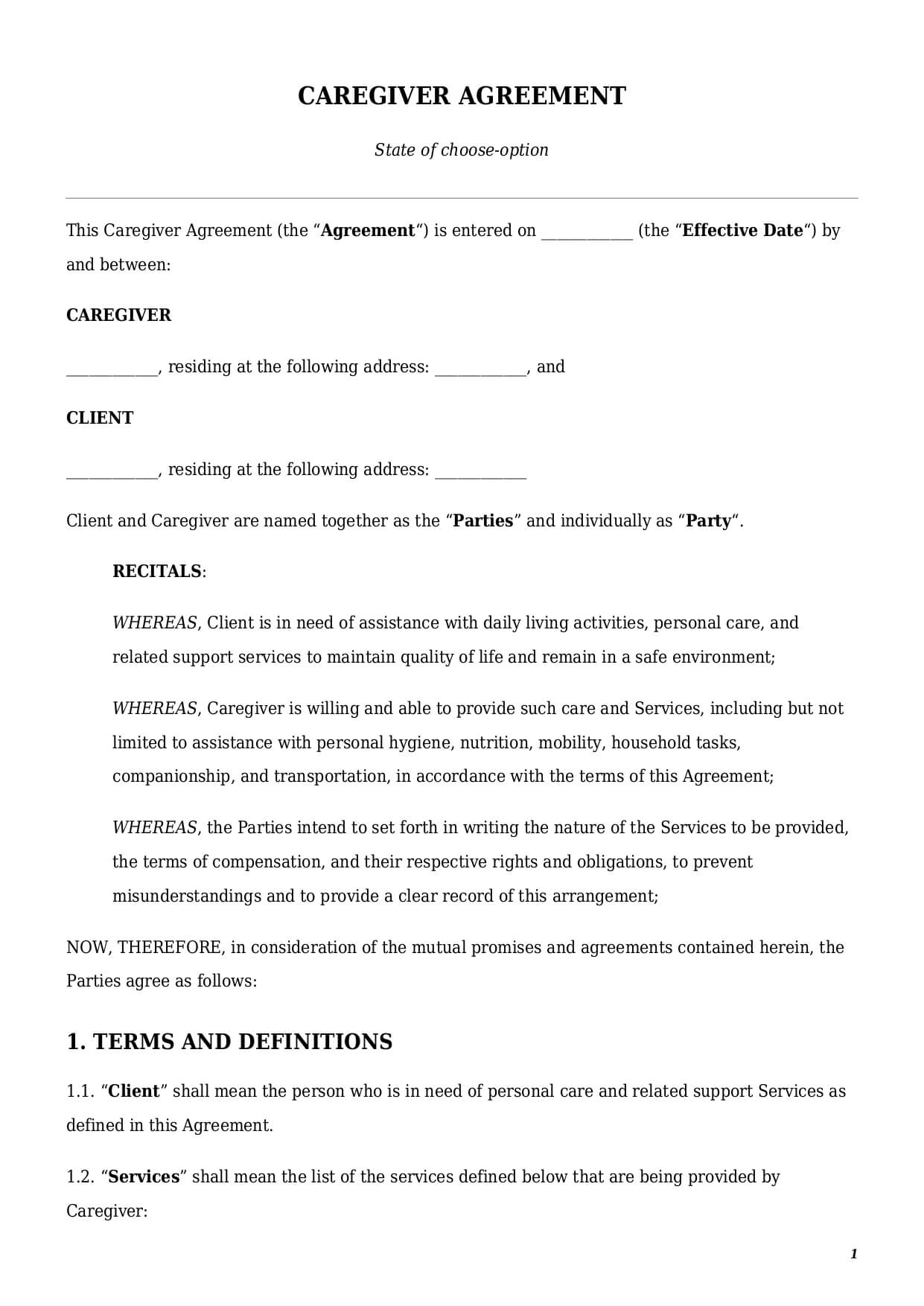
What is a caregiver agreement?
A caregiver agreement is a legally binding document that outlines the rights, responsibilities, and obligations between an individual requiring care and the person providing care. A caregiver contract agreement provides clarity for both parties regarding their roles, expectations, and mutual obligations.
The parties to a caregiver agreement sample are:
- Caregiver: An individual or business that provides elderly care services and assistance. A caregiver shall possess a special license and experience to be able to provide those services.
- Guardian: An individual who enters a caregiver contract to order care services for their close relative or a friend. A guardian is usually a person appointed by a living will or court to adopt health care decisions on behalf of another person. When an elderly person does not have a guardian, they can sign the present contract independently. However, when the guardian is appointed, only he or she can sign the present agreement.
- Client: An elderly person or a person of any age who needs medical care and assistance.
The main purpose of a caregiver agreement sample is to document the elderly care arrangement between the client/guardian and the caregiver. A well-structured document shall include the following important details:
- full names, addresses, and contact information of the parties;
- detailed description of services provided;
- location and schedule of services;
- payment provisions;
- termination clause;
- confidentiality obligations;
- governing law (usually this is a state where the client resides); and
- dispute resolution clause.
How to draft a caregiver agreement template?
Drafting a caregiver agreement template could be a challenging task and requires attention to detail. To create a comprehensive document, parties have to include the list of essential elements without which the document cannot become complete. Those elements are listed below:
Scope of Services
The key part of every sample caregiver agreement is to clearly define the scope of services. The scope of services largely depends on the arrangement between the parties. Some clients may need only emotional support and general care, while others require administration of medication, mobility assistance, and more.
If a caregiver provides medical assistance like administering injections or managing equipment, a caregiver shall possess the respective certification, as well as a basic medical background. It is advisable to ask for proof of such certification before signing the contract.
When it comes to the provision of the services, a typical sample caregiver agreement shall include the following additional limitations:
- A caregiver cannot meet with third parties, including family members or friends, during the provision of services.
- A caregiver cannot consume alcohol or smoke while on duty; and
- A caregiver shall maintain a simple daily journal describing a person’s day and activities done.
Location and Working Schedule
A well-drafted caregiver agreement contract must clarify the exact location of the provision of services. Usually a caregiver takes care of elderly people either at their home or in a separate medical facility.
The working schedule is another key component that ensures clarity and helps to manage both parties’ expectations. Parties may agree upon the following working schedule:
- fixed hours and days of work (e.g., from Monday to Friday from 9am to 6pm);
- fluctuating weekly schedule (e.g., 40 hours of care per week; exact hours and days shall be agreed upon each week);
- on an as-needed basis.
Overnight Stay
Some caregiver agreements may include an overnight stay clause, when the caregiver is required to stay with a client and provide continuous care. To include that clause, the following important consideration should be taken into account:
- Can a caregiver take short naps?
- What is the caregiver’s compensation for the overnight stay?
- How many days per month should overnight services be provided?
Payment Terms
A good example of a sample caregiver agreement must outline:
- type of compensation (e.g., fixed fee, hourly rate, weekly rate);
- type of invoicing (e.g., weekly, monthly);
- payment method (e.g., cash, PayPal, bank transfer);
- types of additional expenses (e.g., meals, transportation).
Confidentiality
Provision of elderly care services is always a delicate and sensitive matter. In the course of their work, a caregiver is exposed to a client’s confidential information, like information about life, medical history, family relations, etc. Therefore, protection of confidentiality is a must-have clause for every caregiver agreement sample.
This obligation implies that a caregiver cannot disclose any of that information during the term of the agreement and for a certain period of time after a contract’s termination.
Termination
Either party can end a caregiver agreement at any time by sending a prior written notice to the other party. The parties are free to choose any duration for a notice period, like 10, 14, or 30 days. The client/guardian remains liable for paying in full for all the services provided before the termination date.
Upon the end of the contract, a caregiver must return any keys, access cards, and remote controllers from a client’s place of residence, when applicable.
How to customize an agreement template at FasterDraft?
To get a fully customized caregiver agreement, follow a few easy steps below:
- Click the “Create Document” button.
- Answer simple questions in the form.
- Select a template’s format—caregiver contract PDF or Word.
- Make a payment.
- E-sign, download, print, and use the document instantly.