Shareholders Agreement

  • Suitable For:Canada (9 provinces + 3 territories)
  • Downloads:1,341
  • Last Updated:
  • Time to Complete:8 min.
  • Available formats:PDF and Word

If you own a Canadian corporation with a co-founder, a family member, or an investor, you need this customizable shareholder agreement template Canada. The document fully complies with the Canada Business Corporations Act, as well as aligns with provincial legislation in Ontario, Alberta, British Columbia, and others.

Reviews

Trustpilot
5.0
My business partner and I needed a shareholders agreement to put our arrangements in writing. This template was well organised and easy to customise with details about share ownership, decision-making, and responsibilities. It gave us a useful starting point and saved us quite a bit of time preparing the initial draft.
— Christopher, Start-up Founder

Create document

  • LEGAL GUARANTEE · If you find a mistake, we will return back 100 % from purchase price.
  • Secure payment by Airwallex
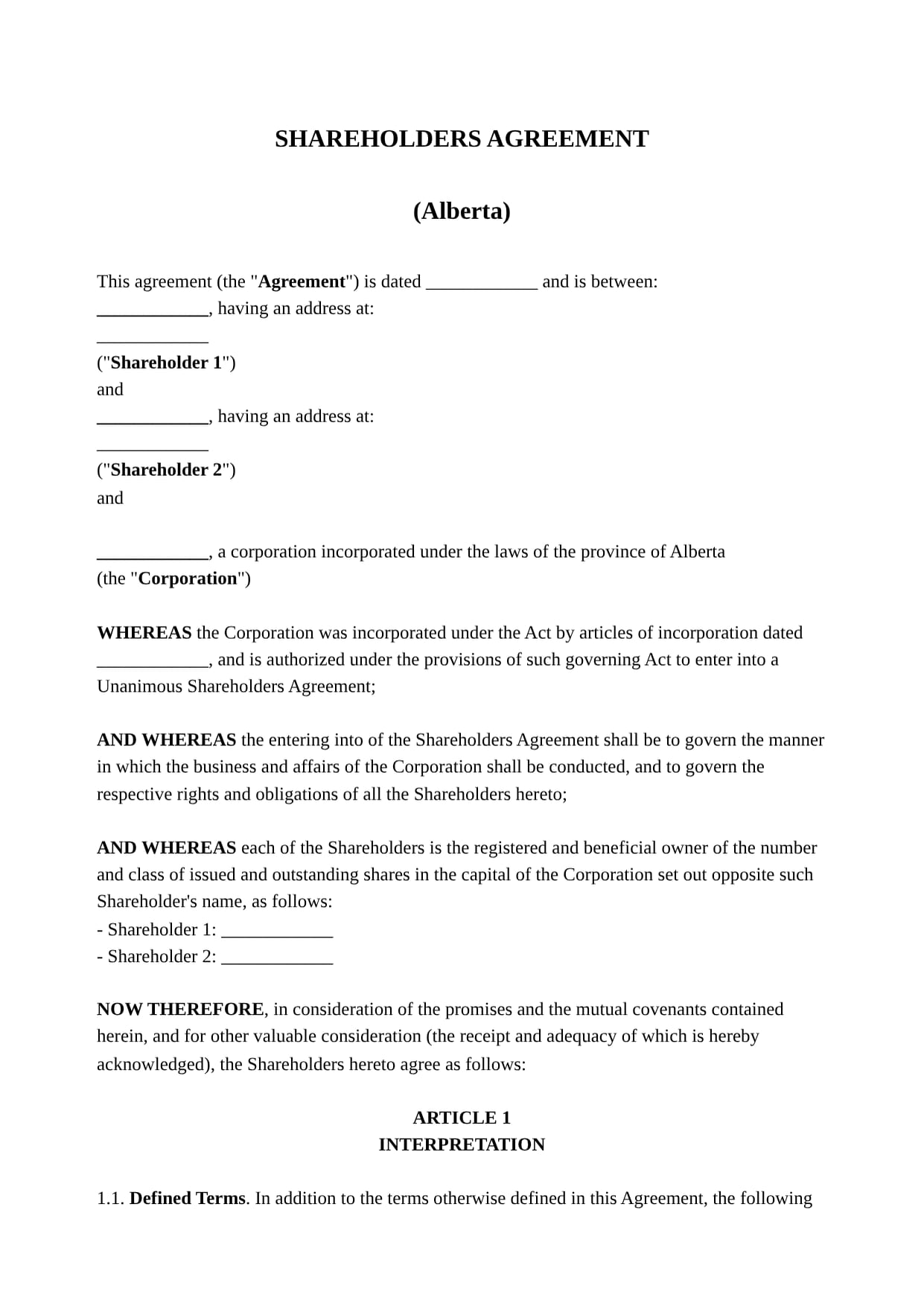
Shareholders Agreement template for Canada: the first page of the document

Who needs a shareholders agreement template in Canada?

While having a shareholders agreement template is not mandated by Canadian federal law or provincial law, having a short document is essential for everyone, and here is why:

Co-founders of a new corporation

Setting up and registering a legal entity does not protect you against potential disputes along the road. While incorporation documents cover the mechanics, including share classes, directors, and officers, a solid shareholders’ agreement template defines:

  • In which circumstances a founder can sell their share and how the selling price is defined;
  • What happens when either of the founders stops to show up or dies?
  • In which proportion the profits should be allocated, etc.

Family businesses passing shares between generations.

A properly drafted shareholders agreement in Canada protects generational family businesses against share transfer to third parties as well as may define the succession of shares.

Small businesses bringing in an investor

Whether it is a family friend putting in $50,000 or an angel at $500,000, the agreement sets information rights, pre-emptive rights, and exit mechanics. Without it, the investor is relying on the articles alone, which usually say nothing about any of these.

Professional corporations

Doctors, dentists, lawyers, and accountants, incorporated with partners, still need a shareholders agreement on top of the regulatory requirements of their college or law society. The document can also be helpful in dealing with reputation damage caused by unprofessional behaviour of either partner.

A shareholders agreement template is a starting point, not a finished document. The five considerations below decide whether the final version will hold up when it is tested.

Share transfer restrictions

The transfer restrictions are the part that actually protects the business. A usable template needs at least:

  • A right of first refusal (ROFR) or right of first offer giving existing shareholders priority before a share can be sold to an outsider;
  • Drag-along rights let a supermajority force a minority to join a sale of the whole company;
  • Tag-along rights: letting a minority join a sale on the same terms a majority negotiates;
  • A shotgun (buy-sell) clause forcing one shareholder to either buy the other out or be bought out at the price they themselves named;
  • Piggyback and pre-emptive rights on new share issues.

These restrictions interact with the restrictions on share transfer that sit in the articles themselves (for a CBCA corporation, these are the restrictions contemplated by section 49(8)). If the articles and the agreement conflict, the court will try to read them together, but the drafter should not leave it to the court — the template should make the agreement expressly subject to, or override (where permitted), the articles.

Mandatory deadlock resolution for 50/50 corporations

A 50/50 corporation with no deadlock mechanism is a lawsuit waiting to happen. A well-written template must offer legal tools on how the dispute could be resolved, including good-faith negotiation, then mediation, then either arbitration under the provincial arbitration statute or a mandatory buy-sell such as the shotgun clause.

Valuation of shares mechanism

Whenever a trigger event occurs that requires a purchase of shares, including the cases of disability, death, departure, or sale, the solid document template must define how the share’s price is to be determined. Common options include either of the following:

  • Formula valuation (book value, EBITDA multiple, revenue multiple).
  • Annually agreed value signed off by all shareholders.
  • Independent appraisal by third parties such as external auditors or accountants.

How to customise this template with FasterDraft?

To generate your DIY shareholders agreement template, follow these steps:

  1. Click the button “Create Document.”
  2. Answer simple questions in the guided questionnaire.
  3. Select a template’s format—PDF or Word.
  4. Make a payment.

The document is ready for instant digital download immediately after the purchase.

Frequently Asked Questions (FAQ)

1. Is a shareholders agreement legally required in Canada?

There is no statutory or federal Canadian law that obliges shareholders to sign a shareholders agreement.

2. Can I use a free shareholders agreement template Word in Canada?

We strongly discourage using a free shareholders agreement template Word document, as it may not be fully suitable for the individual circumstances of your business. For example, a free template may deal with corporations registered in Ontario, while you are planning to start your business in British Columbia. Considering the difference between provincial regulations, using a template from the wrong jurisdiction can significantly backfire in the future.

3. What is the difference between a unanimous shareholders agreement and a regular shareholders agreement?

The main difference lies in the number of parties to the agreement. In a regular shareholders’ agreement, the contract is signed between two or several shareholders. This means some shareholders may choose not to join the contract.

On the other hand, a unanimous shareholders’ agreement is a specific statutory instrument under section 146 CBCA (and provincial equivalents) that is signed by every shareholder and can actually transfer powers of the directors to the shareholders.

While under a regular shareholders’ agreement a new shareholder may choose not to sign it, in the case of a unanimous shareholders’ agreement a future investor and shareholder is obliged to sign a deed of accession.

4. How does life insurance fit into a shareholders agreement?

Two common structures. The criss-cross structure has each shareholder own a policy on each of the other shareholders; on death, the surviving shareholders use the proceeds to buy the deceased’s shares directly from the estate. The corporate-owned structure has the corporation own the policies; on death, the corporation receives the proceeds, credits the capital dividend account under section 89(1)(d) of the Income Tax Act, and uses a capital dividend election under section 83(2) to redeem the deceased’s shares with tax-free dividends. Each has different tax and creditor-protection consequences. The agreement has to spell out which structure applies, who owns the policy, who pays the premiums, the beneficiary designation, and the mechanical steps on death.

5. Does a shareholders agreement override the articles?

The shareholders agreement template Canada neither overrides nor replaces the articles. In Canada, the articles are the constitutional document of the corporation and sit above the shareholders’ agreement in the hierarchy. Without the articles, incorporation of a company is not possible.

A shareholders’ agreement template is a choice of a corporation’s shareholders. There are lots of corporations in Canada that are run without having an additional shareholders agreement.

If a corporation chooses to have a unanimous shareholders’ agreement, in such a case, under section 146 of the CBCA, it can override the default rules in the statute itself, including some matters that would otherwise sit with the directors.

Back to top

Looking For Something Different?

Start typing to find out our collection of legal documents and contract templates

Create document