

.svg)
.svg)
Last Will and Testament
 PDF and
 Word
Word
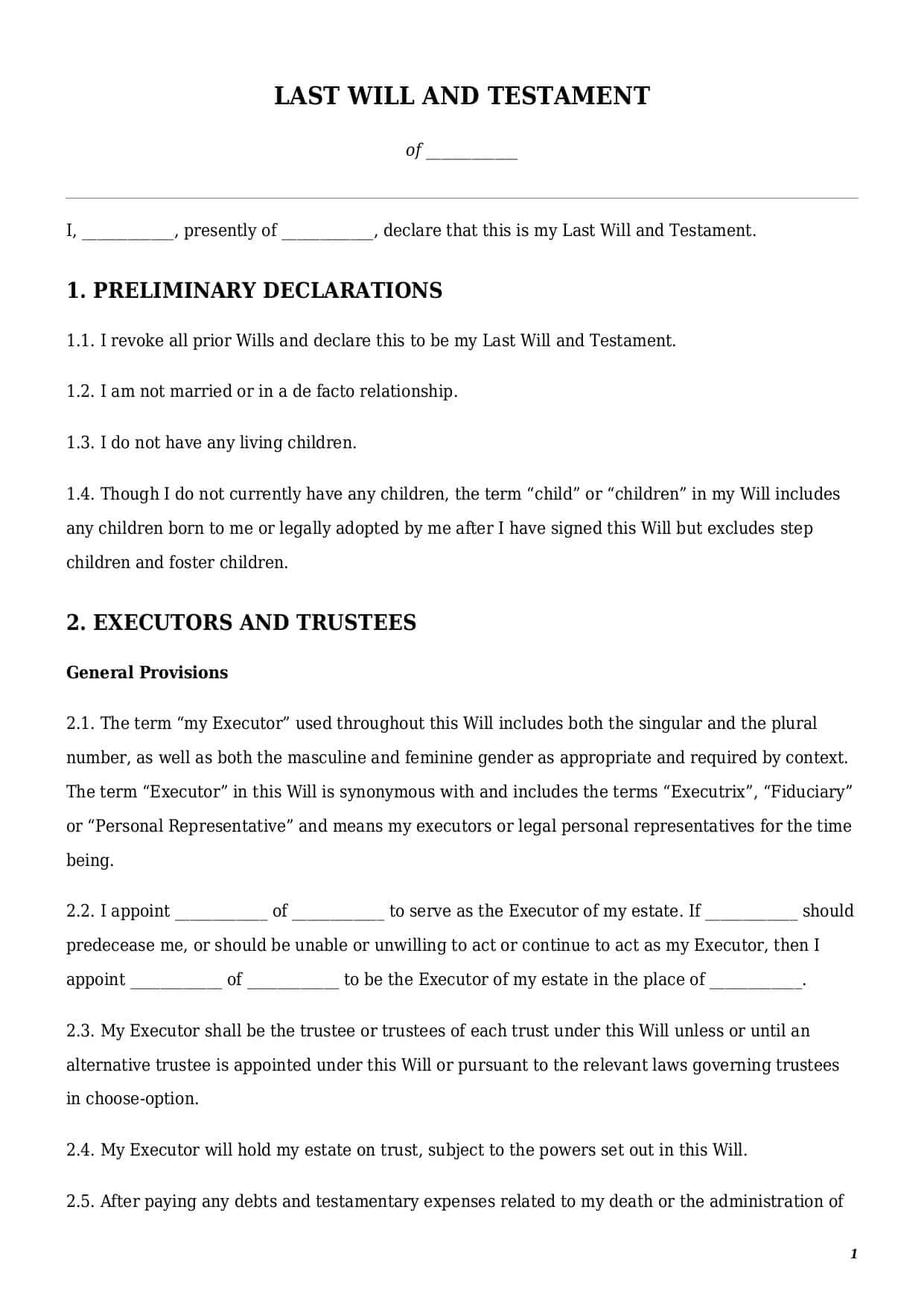
This professionally drafted Last Will and Testament template for Australia allows you to clearly set out how your assets will be distributed, appoint a trusted executor, and protect your loved ones.
Reviews

Who is this last will and testament template suitable for?
A solid last will and testament sample can be useful in many life situations, including:
- married couples who wish to determine how their joint marital estate is to be divided after either spouse’s death;
- individuals with children from previous marriages willing to ensure that their estate is distributed according to their wishes;
- couples in a de facto relationship who need to divide their assets properly;
- parents with multiple children who want to ensure their estate is divided fairly;
- business owners and property owners wanting to ensure a smooth transition of their assets and business after their death;
- anyone who want peacefully determine the distribution of their estate after their death.
What’s included in this last Will and testament Template?
Preliminary declarations
Every last will and testament Australia should begin with a number of important legal disclaimers and declarations, including:
- the full name of a testator and their date of birth;
- full residential address and the name of a state or territory;
- family status (such as married, divorced, in de facto relations, single, or widowed);
- full names and dates of birth of any living children (including those over 18 years old and any from previous marriages or de facto relations);
- revocation of any prior will (if relevant).
Designation of Beneficiaries
A beneficiary can be an individual, trust or charity organisation regardless of nationality, age, gender or legal capacity. A testator may appoint one or multiple beneficiaries, and there is no requirement for a prior personal connection to the testator. In other words, a testator may even include a complete stranger.
If, however, a beneficiary is a minor (under the age of 18), in that case a testator must additionally consider appointing a legal guardian. A legal guardian does not inherit any part of the residue estate but is responsible for a child’s wellbeing until they reach the age of majority. On top of that, a legal guardian remains fully responsible for managing the child’s property on their behalf.
Appointment of Executor
Every last will and testament sample must include information about the appointed executor. All Australian states allow the executor to also be appointed as a beneficiary under the will. To act as an executor, a person must be at least 18 years of age and have full legal capacity.
It is also common to appoint a professional trustee company to act as an executor. However, most Australians avoid this due to additional costs. In the state of Tasmania, a guardian must separately consent for such an appointment; otherwise, the provisions of the will become invalid.
Residual estate clause
This is the central element of any last will and testament document, allowing the testator to specify the way their residue estate shall be distributed amongst named beneficiaries. In simple words, the residue estate is what is left from a testator’s estate minus debts, taxes and other ongoing liabilities.
In contrast to the succession without the will, distribution of the estate under the will can take any form and share. Below there are several of the most common practices of distribution of the residue:
- to one named beneficiary (for example, spouse, friend, or youngest son);
- to surviving children in equal parts;
- to surviving children in unequal parts, etc.
It is also common to prescribe alternative beneficiaries as well for the situation when neither of the named beneficiaries survives the testator.
Appointment of the pet caretaker
If the testator wishes to provide for a pet, it is important to plan for the animal’s ongoing care. Australian state and territory legislation considers pets as property, so pets cannot directly inherit the property. Therefore, you cannot name your pet as a beneficiary under the last will and testament sample.
However, it is common to appoint a petcare guardian responsible for the care and well-being of your pet after your death. A petcare guardian can be any individual, animal shelter or charity organisation. It is also common to provide a fixed one-time fee for a petcare guardian to ensure the proper care and feeding for your pet.
Appointment of substitutes
In many cases individuals consider creating the will long before their death. Therefore, inclusion of alternative executors and guardians might be necessary steps to ensure continuity of a testator’s wishes and possibility of execution of the last will and testament in full.
An appointed substitute is one more individual, trustee or trust company who shall be in charge of managing a testator’s estate, looking after a pet, and executing the will in a situation when the primary executor or guardian is unable to do so. In practice there could be various reasons why the primarily appointed executor or guardian refuses to perform their duties, including:
- change of circumstances;
- relocation to another country;
- health or mental problems;
- death or bankruptcy.
What are the key features of this last will and testament template?
By customising and downloading this last will and testament sample from FasterDraft, you get:
- a printable last will and testament template Australia that is tailored to your specific circumstances;
- instant download of a customisable template in PDF and Word;
- a document designed to comply with relevant Australian states’ and territories’ wills and succession acts;
- a document drafted in a clear manner and professional formatting;
- a fully complete document template that includes all necessary clauses;
- a fully editable document that you can amend any time after the purchase.
Why do you need a last will and testament in Australia?
Although having a last will and testament in Australia is not legally required, many Australians choose to create one for the following reasons:
- The property is distributed after a testator’s death according to a testator’s wishes, rather than under government inheritance laws;
- Your loved ones are properly protected;
- It reduces the risk of family disputes and costly legal procedures;
- It helps maintain peace and stability among your loved ones after your death;
- Your intended beneficiaries received what you have chosen for them, rather than what the law determines;
- You retain control of your estate even after your death.
Legal Requirements for a Valid Will in Australia
To create a legally valid last will and testament Australia, a testator must follow four important steps.
Step 1. Read the Document Carefully
Once the last will and testament template is prepared, a testator should take time to read it carefully. You should not sign the will on the same day as you drafted it. It is important to ensure that the testator fully understands the document and the effect of their decisions.
A testator should also consider the following questions:
- Have I included all intended beneficiaries, such as a friend or a family member?
- Have I considered appointing a legal guardian for my minor children?
- Have I considered excluding any person from the will?
Step 2. Arrange for witnesses
All Australian states and territories require a last will and testament to be signed in the presence of at least two witnesses who are 18 years of age or older. This is the uniform rule that applies throughout the country. However, the requirements of who can act as a witness usually vary depending on the state.
For example, under the Wills Act 1997 in the state of Victoria, a witness may also be a beneficiary. In contrast, the Succession Act 1981 of the state of Queensland requires witnesses to be strongly independent and not beneficiaries.
Step 3. Sign the Document
All last will and testament documents must be signed by a testator. Electronic execution is also permissible in most of the Australian states and territories, excluding Tasmania, South Australia and the Northern Territory. All in all, the paper execution remains the most accepted method of signing the document.
Steps 4. Keep the document safe
Once the document is properly signed by a testator and two witnesses, it should be kept in a safe place. You may keep it at home, in the bank safe deposit box, with your lawyer, or even with a friend.
How to customise a last will and testament with FasterDraft?
To get a fully customisable last will and testament document, follow the instructions given below:
- Click the “Create Document” button.
- Answer simple questions in the last will and testament form.
- Select a template format – last will and testament template Word or PDF.
- Make a payment.
- Download will template Australia instantly.
Table of content
Frequently Asked Questions (FAQ)
-
1. Is this legally binding in Australia?
Yes. Once properly signed and witnessed, the last will and testament becomes a legally binding document. If a testator dies after signing the will, the document serves as the only valid instruction for how the testator’s estate shall be distributed.
This last will and testament sample is being construed in accordance with the laws of the applicable state or territory selected by a user in the questionnaire. Therefore, the will shall be interpreted and administered under the laws of that jurisdiction.
-
2. Can I edit this template?
Yes, if you download the last will and testament doc format, you can easily edit and amend the document after the purchase at any time.
-
3. Does this replace legal advice?
No. This last will and testament template does not constitute legal advice. FasterDraft is an online legal platform where you can customise legal documents for various everyday situations.
We do not offer any legal advice or recommendations to our users in Australia. If you are in doubt about this document, we strongly recommend consulting your Australian lawyer before signing the document.