

.svg)
.svg)
Partnership Agreement
 PDF and
 Word
Word
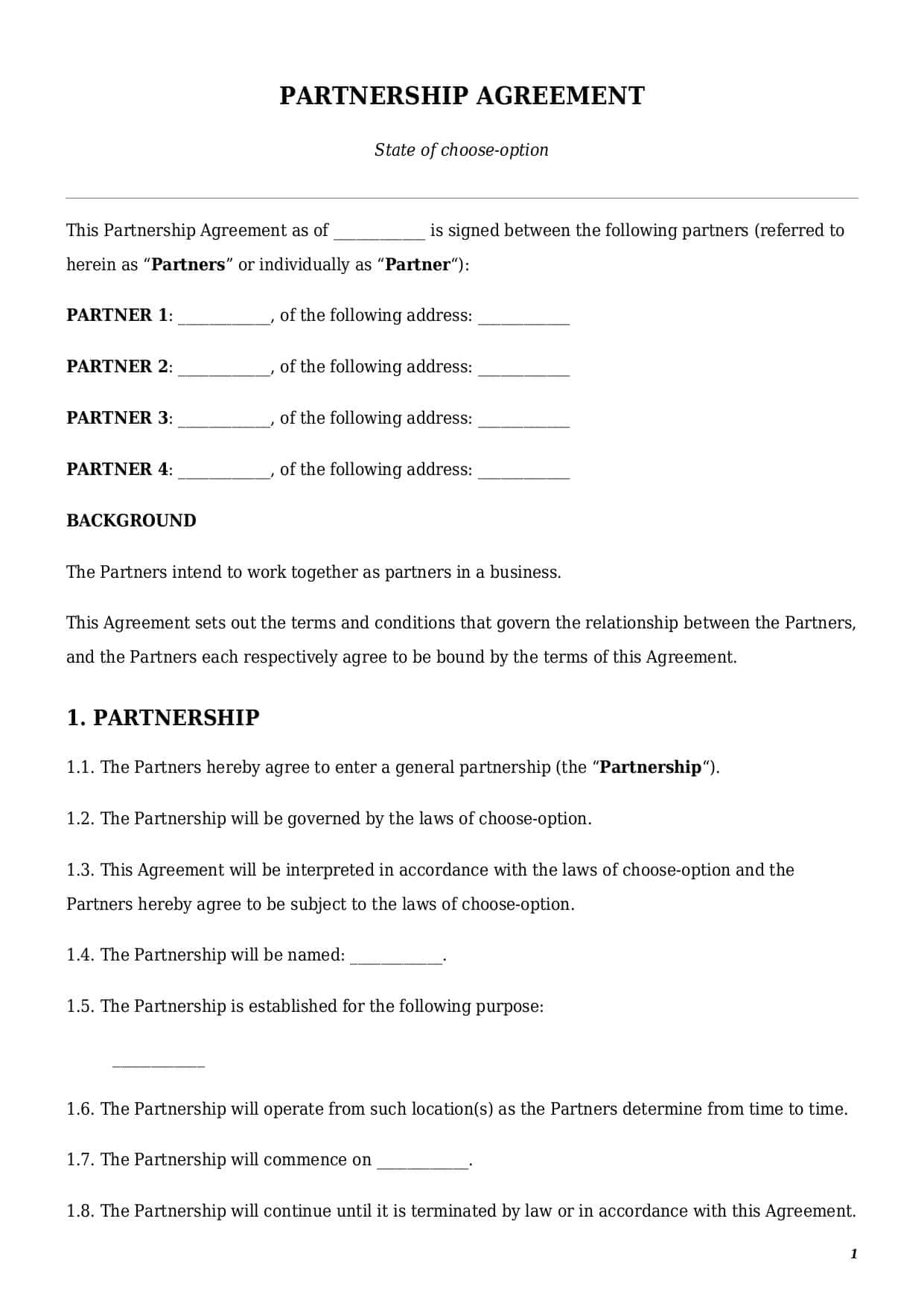
This partnership agreement template sets up clear rules for the operation, management and dissolution of different types of partnerships operating across Australia.
Reviews

What is a partnership agreement?
A partnership agreement is a legally binding contract that governs the relationship between two or more partners running a business together in Australia. The present document template can be customised for a wide range of different partnerships, including limited partnerships, general partnerships and incorporated limited partnerships.
A standard business partnership agreement template defines:
- each partner’s duties, responsibilities and contributions;
- the partnership’s management model;
- profit-sharing arrangements;
- decision-making process;
- dissolution of the partnership;
- withdrawal of partners; etc.
Who needs this partnership agreement template?
A solid and comprehensive sample partnership agreement can be useful for:
- investors and founders who want to establish a partnership in Australia;
- existing partners who want to replace or update their existing partnership agreement;
- in-house lawyers who provide ongoing legal support for partnerships operating across Australia.
What to include in this partnership agreement template?
Most state and territory partnership acts set out the exact list of clauses that a comprehensive partnership agreement should include.
Partner Details
Every partnership agreement template Australia must include full identification details of the partners. A partner could be an individual or a company, depending on the partnership’s type. In any case, the text of a partnership agreement shall lay out:
- the full legal name of each partner;
- mailing address and contact information;
- ACN or ABN number (if the partner is a company).
All partners entering this partnership agreement must sign it. Without the signatures of every partner, the document cannot become legally binding.
Capital Contributions
To form a partnership in Australia each partner has to make a capital contribution. Thus, the text of a sample partnership agreement shall define each partner’s contribution as follows:
- contribution’s type and short description (for example, cash, services, works, equipment);
- contribution’s value in Australia dollars;
- contribution’s date (this is the date on which the contribution is made).
Withdrawal of Partner
During the course of the partnership, new partners may join the partnership, while existing partners may leave. Therefore, a template for business partnership agreement should outline the circumstances under which the partner could be removed involuntarily. These circumstances include:
- death of a partner or his/her serious illness;
- breach of fiduciary duty by a partner;
- criminal conviction of a partner;
- reaching a certain age (for example, 65 years old);
- personal bankruptcy (all states and territories except Queensland); or
- breach of the present partnership agreement.
Besides that, each partner should be able to leave at will. Therefore, the text of each partnership business agreement must define each partner’s uninterrupted right to leave the partnership at any time.
Dissolution of Partnership
A comprehensive business partnership agreement template shall cover not only the formation, management and financial aspects of the partnership’s activity but also the process of its dissolution. Dissolution is the voluntary winding up and the liquidation of the partnership.
The partnership agreement shall clearly define how partners will handle key aspects of the dissolution, including:
- how the vote for the dissolution of the partnership should be adopted (for example, by simple majority of all partners);
- how the partnership’s assets and profits should be divided after the dissolution (for example, pro rata to each partner’s financial contribution); and
- how the partnership’s losses and remaining liabilities should be divided between the partners (for example, pro rata to each partner’s interest in the partnership);
- how the valuation of the partnership’s assets should be performed.
Liability Insurance
The partnership does not operate as a separate legal entity. That means that partners remain personally liable for any losses and liabilities arising from the partnership’s business operations. For this reason, protection of each partner’s liability is a key consideration before forming a partnership.
In Australia, a partnership agreement contract sample can set out obligations for each partner to obtain:
- life insurance;
- public liability insurance;
- professional liability insurance (only relevant when the partnership shall provide professional services, such as legal or accounting);
- worker’s compensation insurance (only relevant when the partnership intends to hire employees or independent contractors for the performance of certain works).
Duties of Partners
It is common for partners to leave out this section when drafting a sample partnership agreement template, assuming that default provisions from a state or a territory partnership act will suffice. However, the right decision is to consider in advance the duties of the partners, including:
- Duty to devote time. Each partner shall devote such time and attention as is reasonably required for the ongoing operation of the partnership.
- Duty to pay private debts. This obligation reminds us that each partner shall keep indemnified at any time each partner and the partnership in general against any personal losses or debts.
- Duty to deposit partnership funds. When either partner receives any money on behalf of the partnership, the money should be immediately deposited in the partnership’s account.
- Forbidden acts. For example, every partner shall not mortgage, assign or charge their interest in the partnership at any time. On top of that, each partner shall refrain from confessing any judgement against the partnership.
Dispute Resolution and Governing Law
A partnership must be established and operate in accordance with the laws of the selected Australian state or territory. Usually the governing law is the law of a state where most of the partners reside or are based or where the partnership’s business will be performed.
Although partnership legislation across Australia is broadly similar, there are still important differences between states and territories. These variations may affect the formation process, winding-up procedure, withdrawal of partners, etc.
What are the key benefits of using a customisable sample partnership agreement?
There are many benefits to customising a partnership agreement on our legaltech platform FasterDraft, including:
- a document that could be customised to apply in the selected state or territory in Australia;
- a document that is fully compliant with state and territory partnership acts;
- a document created by legal professionals, and never by AI;
- a document written in a clear and plain language that is easy to understand;
- a document that is 100% unique and tailored to your specific circumstances;
- a streamlined customisation process that saves your time.
How to customise a partnership agreement with FasterDraft?
To get a fully customisable partnership agreement sample, follow a few easy steps below:
- Click the “Create Document” button.
- Answer simple questions in the form.
- Select a template’s format – partnership agreement template Australia PDF or Word.
- E-sign the document.
- Make a payment.
Instantly download the document.
Table of content
Frequently Asked Questions (FAQ)
-
1. Is this Partnership Agreement legally enforceable in Australia?
Yes. This business partnership agreement is legally valid and enforceable once it has been signed by all partners involved. Without signing, the agreement is not legally binding.
-
2. Can it be used for more than two partners?
The partnership in Australia requires at least two partners. Therefore having two partners is a minimum requirement. This sample partnership agreement could be customised for 2, 3 and more partners.
-
3. Is it suitable for existing partnerships?
Yes, this business partnership agreement could be used for existing partnerships to update or amend specific provisions.
-
4. Which states and territories does this partnership agreement apply to?
You can use this template for all six states and two territories in Australia, including:
- New South Wales;
- Queensland;
- Victoria;
- South Australia;
- Western Australia;
- Tasmania;
- Australian Capital Territory; and
- Northern Territory.
When completing the questionnaire, you can select the state or territory law that will apply to your partnership agreement.