

.svg)
.svg)
Short-Term Rental Contract
 PDF and
 Word
Word
A short-term rental contract, also known as a vacation rental agreement, is a legal document used for a short-time property rental. It is a type of lease agreement that defines house rules, payment terms, cancellation policy, cleaning, security deposit, etc.
Reviews

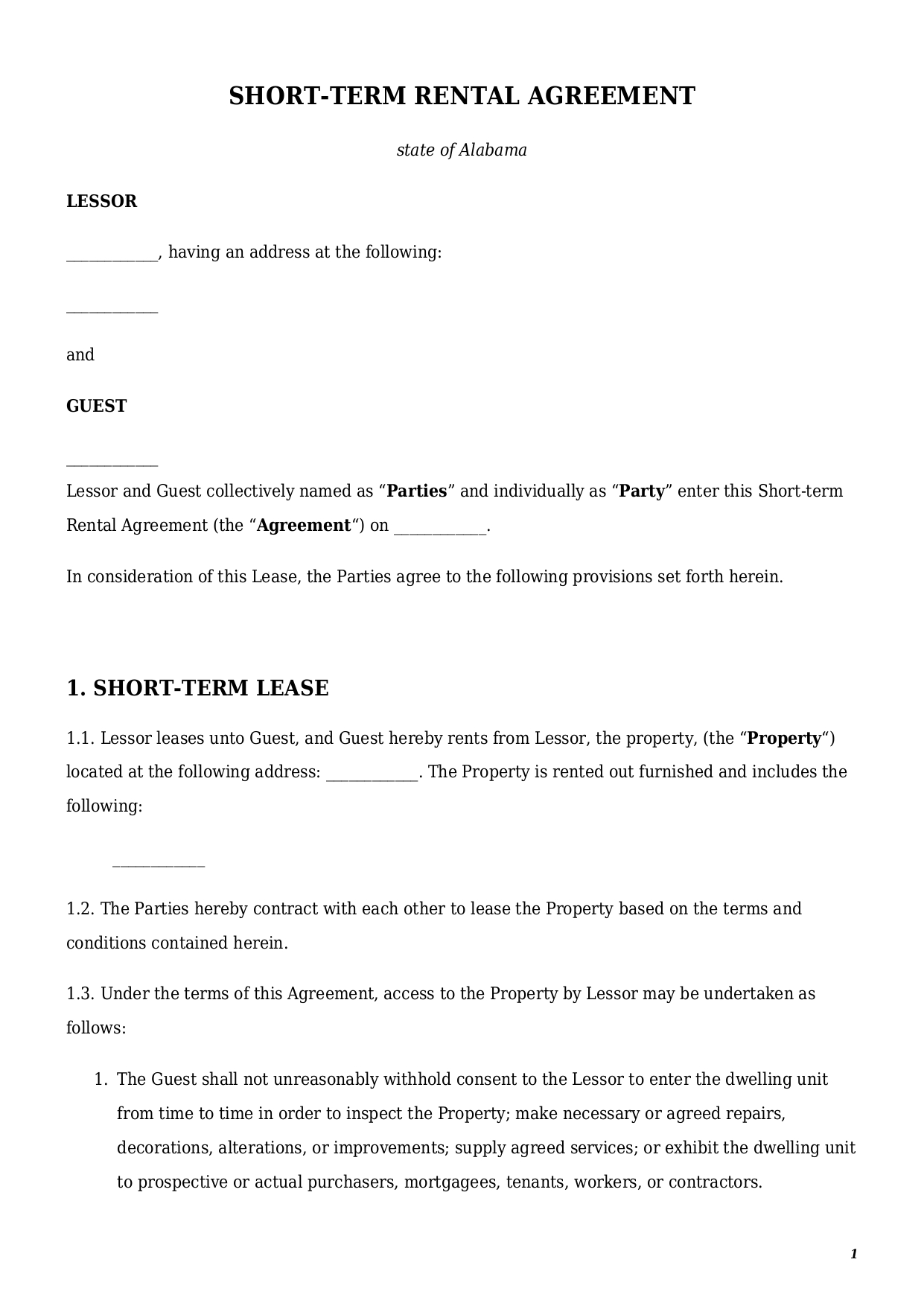
What is a short-term rental agreement?
A short-term rental agreement is a type of lease when an owner rents out a property to a guest for a short period of time. This agreement defines the duration of the lease, type of rental property, parties’ obligations, payment terms, etc.
The following components should be included in a short-term rental agreement template:
- Description of rental property;
- Payment terms;
- Duration of rental agreement, including check-in and check-out time;
- Terms and Conditions for usage of a rented property;
- Cancellation, guest, and key policy;
- Termination clause;
- Disputes resolution clause.
A short-term rental contract is suitable for renting out different types of property, including condominiums, apartments, studios, villas, cottages, and cabins. The parties to a short-term rental agreement are a lessor and a guest. A guest could only be a physical person. A lessor is usually an owner of rental property, property management company or its official representative.
Is a written Short-Term Rental Agreement Mandatory?
As a general rule there is no mandatory federal or state regulation obliging parties to enter a written short-term rental agreement at all times. Under the statute of frauds, most states require execution of the agreement in writting, only when such an agreement cannot be performed within 12 calendar months. Since, most of short-term rentals are aimed to last for a few days or weeks, a written requirement rarely applies.
However, in limited number of cases local city ordinance may mandate property owners to enter with their guests into written vacation rental agreements at all times – for instance, this is the case for the ordinance 2075 of the City of Palm Springs, California.
Besides that many Airbnb/VRBO hosts choose to have a professionally drafted written agreement for:
- Defining clear rental terms.
- Setting out rights and obligations for both parties.
- Clarifying payment terms and rules for security deposit.
- Building policies to guide a guest’s behavior.
Who Needs a Short-Term Rental Agreement?
Short-term lease contracts are helpful for:
-
Frequent Travelers and Nomads.
If you travel around and do not want to stay long in one place, a short-term rental contract is for you. You may use it each time to check in at the new place.
For instance, Jack loves to travel by car around the United States. Most of the time he sleeps in his car. Though sometimes he wants to stay for a few days in a new place. This is when having a ready-made short-term rental contract template may help. Jack can swiftly negotiate terms with his new landlords and move in quickly.
-
Property Owners.
If you have a nice apartment in a city’s downtown or a quiet lake house, you may think to rent it out. It may also serve as an extra source of income for your family.
For instance, Jessica and Peter live in a suburb of a big city, where they also have a tiny apartment. They have heard that during the Christmas holidays the rental prices skyrocket. They are planning to rent out their apartment in December and January to get extra cash. Jessica and Peter sit to discuss a short-term rental lease template together.
-
Owners of Airbnb’s property.
If you are thinking of starting your own vacation rental business, a short-term lease contract is a must. It helps to define strict rules for your guests, as well as to legally protect your property.
For example, Malissa has a nice one-bedroom apartment located in a city center. She put nice furniture and decoration inside it. The next step is to find guests. She starts advertising her property on a popular rental platform. Malissa plans to sign an additional Airbnb rental agreement with every guest.
-
Professional Property Managers.
Having a solid template of a rental agreement is vital for a rental business. You may have lots of clients to whom you rent out property on a daily basis. Which leaves you no room for a mistake. A short-term rental agreement template ensures clarity of terms, lack of ambiguity, and protection of property.
Which type of document does your vacation rental business actually need?
Whether you are a professional Airbnb/VRBO host doing a short-term rental business or a property owner operating occasional short-term rental with a property management company, defining the right legal document is the most important step. Choosing the wrong document can directly affect your legal status, as well as create long-term tenancy relations you are not looking for.
| Month-to-Month Lease | Residential Lease Agreement | Short-Term Vacation Rental Agreement | |
|---|---|---|---|
| Legal framework | State landlord-tenant laws. | State landlord-tenant laws. | State and local laws regulating short-term accommodations, with many cities and counties imposing additional licensing, zoning, tax, and registration requirements (e.g., in New York City hosts must be registered with the Mayor’s Office and be physically present throughout the whole stay). |
| Purpose | Provides flexible residential housing without committing to a fixed term. | Provides stable long-term residential housing with fixed contractual terms. | Temporary accommodation for vacations, holidays, business travel, or other short stays. |
| Typical duration | One-month periods that automatically renew until terminated by either party. | Fixed term, for example 6, 12 or 24 months, or longer. | Usually a few days to several weeks. |
| Security deposit regulation | State laws govern the maximum amount of deposit, as well as holding requirements, deductions, and return deadlines. | State laws govern the maximum amount of deposit, as well as holding requirements, deductions, and return deadlines. | No state or local laws regulate the deposit cap or its return terms. This is governed solely by the short-term rental agreement between the parties. |
| Eviction | If the tenant fails to vacate after lawful termination or breaches the agreement, the landlord generally must follow the state’s formal eviction process. | If the tenant breaches the lease or remains after expiration without legal right to stay, the landlord generally must follow the state’s formal eviction process. | The guest can be expelled from the property while the guest remains within the “transient guest” period, that typically lasts up to 30 days. After such a period, the guest acquires “tenant” status, making self-help eviction illegal, and the state laws governing tenant evictions apply. |
| Renewal | Automatic monthly renewal unless either party gives a prior written termination notice. Depending on the state laws, the notice can be between 14 and 30 days. | Unless the original lease agreement provides automatic renewal, the agreement ends on the last date of its term. A holdover tenant may become a month-to-month tenant in many states. | There is no renewal. The guest can make a new booking, upon the property’s availability. |
All in all: A short-term rental agreement is intended for renting out a property to third parties for tourist, business, and recreational purposes. If you are willing to rent out your property for residential and living purposes only, in that case, using a month-to-month rental contract or residential lease agreement template could be the right choice. For short-term residential rentals not related to vacation or tourist rent, a month-to-month rental agreement should be used. A standard residential lease agreement should be used for any fixed-term residential tenancy — a few months or several years — where the purpose is ordinary living, not travel or vacation stays.
Important Regulatory Considerations Airbnb & VRBO Hosts Should Know Before Listing a Short-Term Rental
There is a set of additional compliance requirements host must be aware of when entering a short-term rental contract:
No Lead-Based Paint Disclosure Needed
According to the applicable federal regulation, any residential building or property built before 1978 requires provision of a lead-based paint disclosure to any tenant planning to rent it out. Unlike with a standard residential lease agreement, short-term rental normally are normally exempt from such a requirement provided the total duration of the short-term lease does not exceed 100 consecutive days, including all renewals or extension of stay.
If, however, your guest is planning to prolong the booking which may result in exceeding 100-days’ period, in such a case it is better to attach a lead paint based disclosure statement along with the confirmation for the new booking.
The 14-Day Tax-Free Rule
Under 26 U.S.C. § 280A(g), if you rent out a property for 14 days or less during one calendar year, your rental income becomes entirely tax-free at the federal level without the need of submitting any reporting requirements. This tax exemption rule is also known as the Augusta Rule.
However, the Augusta Rule does not apply to state, occupancy or transient rental taxes that may apply to short-term rental in some states or cities. Florida, for example, requires a 6% state sales tax on transient rental income plus a county Tourist Development Tax (2–6%, depending on county), both registered and remitted separately through the Florida Department of Revenue and the local county tax collector.
Local and State Authorization
Certain cities across the state may issue separate ordinance imposing additional requirement for vacation rental in their area. For example, the ordinance 2075 of the City of Palm Springs, California mandates all short-term property owners to apply for a vacation rental registration certificate.
Failure to comply with any such requirement lead to application of fines on property owners. For instance, failure to comply with the New York City’s Local Law 18 requiring a short-term rental registration may result in application of fines up to $ 1,000 – $ 7,500 for unregistered listings.
Some cities may define the types of buildings or residential units that are not eligible for short-term rentals. For instance, New York City maintains a Prohibited Buildings List identifying buildings where short-term rentals are not permitted.
HOA Regulation
Even where state and city law permit short-term rentals, an HOA or condo association’s recorded declaration and bylaws can independently ban or restrict them. Such restrictions may have different forms, for example:
- limiting categories of tenants to whom the short-term rental can be provided (for example, no students, no families with kids);
- limiting the minimum required cap to stay (for example, 30, 60, or 90 days);
- requiring property owners to apply for a prior written permission to list property on short-term rentals platforms etc.
How do I write short-term rental terms and conditions?
A short-term lease agreement needs to have a number of essential elements:
Parties Details
A short-term lease contract template should include the names and addresses of a landlord and tenants. If a tenant is a foreigner, include their passport ID’ details as well. Having the contact information of both parties is also important. It could be phone numbers, emails, or social media accounts. If there is an emergency in a rental property, a guest may reach their host immediately.
Duration of Stay
The duration of a vacation rental contract is defined in days or weeks. A vacation rental contract does not have a prolongation clause. It means that it expires on the last date of its term.
Listing Description of Property: In and Out
Describe a property that you rent out in as much detail as possible, including:
- Size of apartment (in sq. ft.)
- Number of bathrooms and bedrooms
- Kitchen or kitchenette availability
- Balcony or terrace availability
- Exact location
- Property’s recent photos.
A good short-term rental template should also list what is inside the apartment, including:
- All kitchen equipment, including oven, refrigerator, cutlery, etc.;
- All furniture, including number of beds;
- All toiletry equipment (if any);
- TV, Wi-Fi, washing machine, air conditioner.
Avoid mentioning equipment or furniture that are not available or do not function. It may result in potential conflicts with guests.
For instance, Jemma rents out a vacation property with her 3-year-old son. She selects a property because it has a fridge, where she can keep food for her son. When they move in, Jemma finds out there is no fridge. She complains that a property’s listing description is not accurate and leaves negative feedback.
House Rules
House rules is a clause in a short-term lease contract defining the way a vacation property should be used. At first sight it may look unnecessary. Yet, the practice says the opposite. Well-drafted house rules allow you to define dos and don’ts in using a rental property. They also help to set up owners’ expectations about the exact purpose of a property’s usage.
- Smoking. Every rental agreement should clearly define the smoking policy. Smoking could be prohibited, limited, or allowed in a rental property. If smoking is limited, a vacation rental contract has to define the exact areas where it is allowed to smoke.
- Pets. A vacation rental lease template should state if pets are allowed or not. A host may allow you to stay with certain types of pets only. It is a common practice to charge extra fees for staying with pets. Normally an enhanced cleaning applies to rental properties with pets.
- Children. A vacation rental agreement template may not allow children under a certain age. Some hosts might be scared of furniture being damaged or neighborhood complaints.
- Hosting a Party. A vacation rental contract template prohibits organizing parties in most of the cases. Having a party may cause unintentional property damage or complaints from neighbors. Property owners may also not be able to control the list of guests invited to a party.
- Check-in and check-out time. It is a common practice to include the exact date and time for check-in and check-out. If a guest needs to arrive earlier or leave later, it should be agreed upon in advance with a host. An Airbnb rental agreement template may include an extra fee for earlier check-in.
- Usage of Common Areas. A guest may have additional free access to common areas like the swimming pool or gym. Thus, a short-term lease contract template should explain rules for their usage. For instance, if a common pool could be used from Monday till Friday only, guests should be informed of the same.
Payment Terms and Security Deposit
Except for an accommodation price, payment terms are not included in a property listing description. Thus, they should be agreed upon separately in a rental agreement. Payment terms usually explain when and how a payment for a rental property is withdrawn. A short-term lease template may also define the exact list of payment methods available. Depending on the host, a payment can be made during booking, upon arrival, or at the check-out. A preferred way should also be clearly stated in the text of the agreement.
A security deposit is a fixed amount of money used to secure a property against possible damage. A security deposit is refundable upon check-out. Depending on the situation, a security deposit might be transferred before or on the date of check-in.
Occupancy Limits and Guests Policy
Most vacation properties are rented out by families with kids or groups of friends. A host should think in advance about occupancy limits of a property. This is a maximum number of guests or maximum occupancy a property may have. Check fire regulations in your state to make sure the maximum occupancy of a property is in line with them.
A vacation rental contract template should say a word about inviting guests. Even if parties are not allowed, guests still can be invited. If not, a limitation should be clearly stated in a vacation rental contract.
Cancellation Policy
A cancellation policy helps your rental business to be professional. Besides that, a cancellation policy means a client-oriented approach. Think in advance about terms and conditions for your cancellation policy. A vacation rental contract template should address the following:
- In which cases is a full refund possible?
- In which cases is a partial refund possible?
- In which case is a change of stay possible?
Cleaning
A clean and tidy vacation property creates a good impression and guarantees good reviews. A short-term rental agreement template should address the following:
- Cleaning could be included in a price or charged as an extra fee;
- Cleaning could be regular or only at the check-in;
- Cleaning could be mandatory upon check-out or not.
Key Policy
A vacation rental contract should also explain how a guest can access a rental property. Think in advance carefully about:
- How to transfer keys to a guest before or on a date of check-in?
- What else does a guest need to access a rental property: entering a pin code, a key from a gate, etc.?
- How does a guest have to return a key at check-out?
- What happens if a guest loses their keys?
How to Get Your Short-Term Lease Agreement Template at Faster Draft?
At Faster Draft, you can generate a customized short-term lease agreement form easily. Simply follow the steps below:
- Press button “Create a Document.” A questionnaire will pop up on your screen.
- Answer questions. Your answers help to customize a document.
- Select a template’s format: Short-Term Rental Agreement Template Word or Short-Term Rental Agreement Template PDF.
- E-sign the document online (if you are a host).
- Make a payment.
- The document is ready for instant digital download immediately after the purchase.
- Print the document out in 2 copies.
How to use a Short-Term Lease Agreement?
A process of creating a vacation rental contract template might be vague. We prepared a short checklist to follow for an easier experience:
- Know your guest. Try to get some information about your guests in advance. Who they are and what they do. If it is a renting platform like Airbnb, do not hesitate to write to them directly. While making a reservation or booking, ask for ID documents to check an identity. Save all information for your own record.
- Check the property. Before a guest agrees to make a payment, check a rental property first. Make sure that the listing description is accurate and reflects a property’s actual condition. A property’s description is vital. Most of the bad reviews come because of a property not meeting guests’ expectations.
- Discuss and review a template. If you are a rental business, there is no time to discuss a short-term rental template with every guest. Though smaller businesses tend to remain flexible. Some guests may need to add certain items (e.g., a baby cot) or order additional services. Thus, all this should be reflected properly in a document.
- Sign a template. If a guest agrees with property rental terms and conditions, they should proceed with signing. It does not matter the way a document should be signed. It could be signed on paper or via e-signature. If a property is rented out to several guests, invite all guests to sign a document.
- Keep a Copy. Always keep a document’s copy for a record. If there is a dispute or property damage, written proof may be a powerful game changer.
This article is reviewed by Daria Turanska, a lawyer with 15 years’ contract drafting experience. Fact-checked by Sarah Collins.
Table of content
Frequently Asked Questions (FAQ)
-
1. How do I get written landlord permission to list on Airbnb?
If you’re a tenant rather than the property owner, most standard residential leases already require landlord consent before subletting or hosting paying guests.
Before signing any short-term rental contract, first check the text of the original lease. If you are required to obtain prior written landlord consent to sublease, send a request including the following information:
- the platform you plan to use;
- how often and for how long you expect to host;
- how you’ll screen guests; and
- confirmation that you carry appropriate liability coverage.
-
2. For which states can I use a short-term rental contract form from Faster Draft?
A short-term rental contract form can be used for all 50 states + District of Columbia. To make a document suitable for a specific state, select a state in the questionnaire.
-
3. What is the difference between a short-term rental contract and a residential lease?
A short-term rental contract is used to rent out vacation property for a short period of time. A residential lease agreement is a long-term lease of residential premises with the sole purpose to live in.
-
4. Should I use a free short-term rental contract sample available on the Internet?
It is not recommended to use free samples of documents from the Internet due to a number of reasons. Firstly, they may contain mistakes. Secondly, they may not be up to date with effective legislation. Finally, they may not be suitable for your particular circumstances.
-
5. What are different names used to describe a vacation rental contract?
On the Internet you can find lots of other names. They are:
- Airbnb lease agreement or Airbnb rental agreement;
- Short-term lease agreement;
- Short-term lease contract;
- Weekly rental agreement or vacation rental agreement.
This is not a document’s title that defines a document, but its content. Despite the variety of various titles above, all of them refer to the same document.
-
6. What are the pros of a short-term rental agreement?
Pros of Short-Term Rental Agreement are the following:
- Taxation benefits. According to the IRS, if a property is rented for less than 14 days in a year, no income tax applies to a property’s income.
- Easy Termination. Until the guest becomes a resident of the property, the guest who refuses to leave within a period of 30 days could easily be expelled from the property.
- Additional source of income. Even if you do not plan to start a rental business, short-term rental can give you some extra cash.
-
7. What are the disadvantages of a short-term rental agreement?
Cons of Short-Term Rental Agreement are:
- Turnover of Tenants. Tenants may change every other day or week. Thus, it requires an owner’s constant attention. You may need to sign a separate property management agreement to appoint a professional company to help you to accommodate the guests on a regular basis.
- Bad Reviews. Another risk is having guests who leave bad reviews. For instance, guests may overreact if something does not work the way they expect it should work.
- Risk of Property Damage. Unlike in long-term contracts, in a short-term rental you do not check your guests thoroughly. It may result in property damage, parties, or complaints from neighbors.

Looking for something Different?
Start typing to find out our collection of legal documents and contract templates