

.svg)
.svg)
Manufacturing Agreement
 PDF and
 Word
Word
A manufacturing agreement is an essential contractual tool whenever a business engages a third party to produce certain goods or products on its behalf.
Reviews

What is a manufacturing agreement?
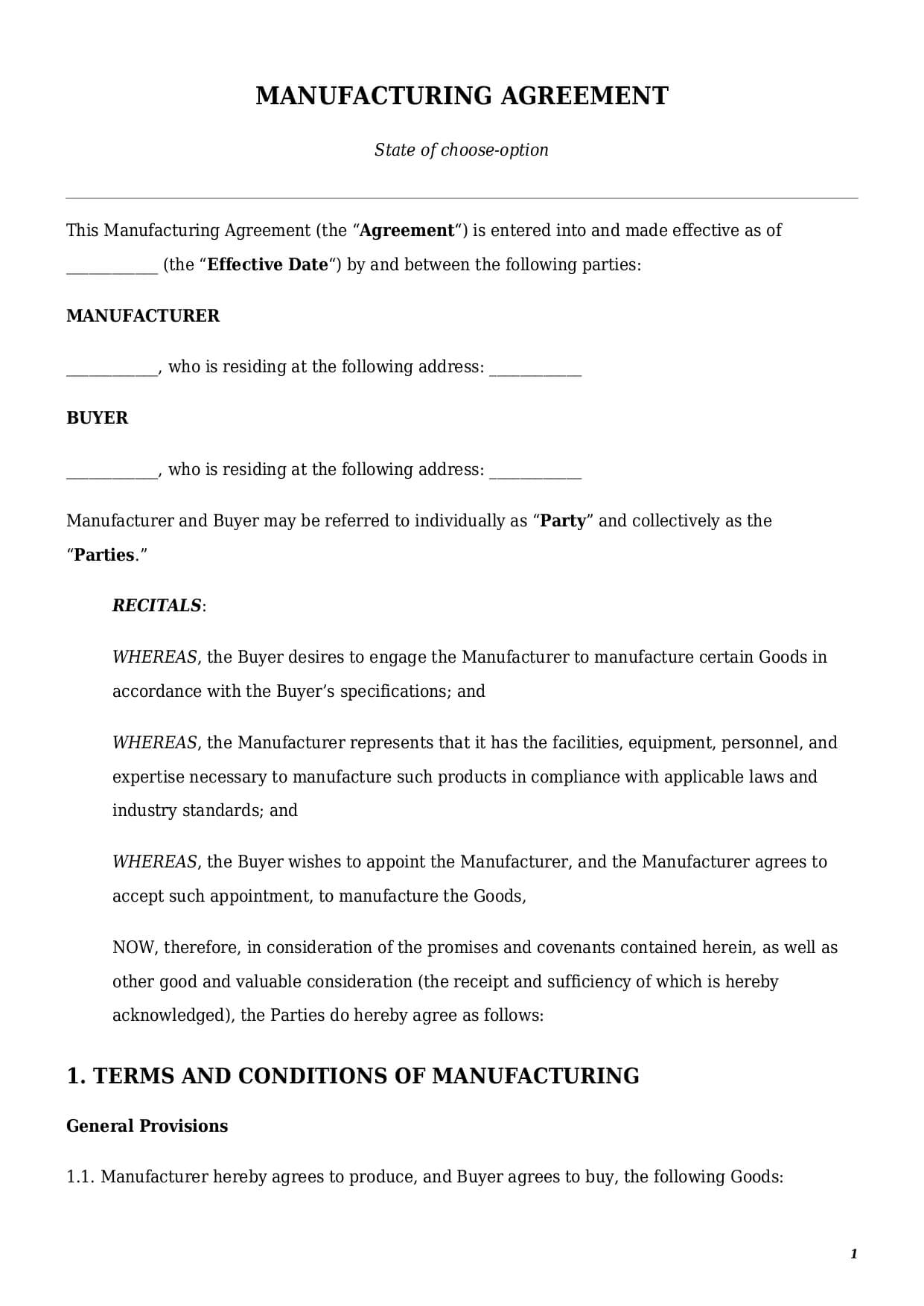
A manufacturing agreement is a legally binding contract between a manufacturer and a buyer that outlines the terms under which products or goods will be produced. The contract defines the responsibilities, rights, and obligations of both parties to ensure that the manufacturing process is conducted according to agreed specifications, quality standards, timelines, and legal requirements.
The parties involved in a manufacturing agreement template are a client and a manufacturer. A client is usually a person who orders the manufacture of certain goods according to the provided specification. A manufacturer is a business that has the necessary equipment, facilities, and personnel to produce the required quantity of goods or products. A client could be an individual, business, or organization that wants to order the manufacture of goods.
The manufacturing agreement could be of several types:
- a toll manufacturing agreement when a client provides raw materials for the goods products;
- a product manufacturing agreement when a client orders specific custom goods or services without a provision of raw materials.
When do you need a manufacturing agreement?
A solid manufacturing agreement template is an essential legal tool for the following common scenarios:
- when a company plans to hire an external manufacturer to produce an extra number of products;
- when a private label wants to hire a contractor with necessary capacities and equipment to produce goods under their label;
- when a business needs a custom product to be manufactured for their commercial needs, etc.
Having a well-drafted contract manufacturing agreement ensures clarity of contractual terms and reduces conflicts between the parties along the road.
What to include in a contract manufacturing agreement?
Drafting a contract manufacturing agreement is a challenging task that requires attention to detail. While neither federal nor state laws define the list of clauses the final document should include, inclusion of certain clauses is essential for the document’s validity. Therefore, below we made a list of the most essential clauses every solid contract manufacturing agreement must have.
Description of Goods
At the heart of every product manufacturing agreement is a detailed description of goods to be manufactured. This is basically what a buyer expects to get once a manufacturer completes the process. Description of goods has a complex meaning and includes:
- final measurements;
- quantity;
- testing, inspection, and acceptance criteria from a buyer;
- packaging and labeling requirements for final goods, and much more.
As a rule of thumb, a manufacturing contract template shall reflect the general description only, while all technical, quality, and manufacturing requirements for goods shall be provided in a separate addendum to the existing contract.
Obligations of the Parties
A well-drafted manufacturing agreement template represents a balance between mutual parties’ rights and obligations. For a manufacturer the main list of duties includes:
- to produce goods in accordance with the agreed specifications and description;
- to deliver goods on time;
- to ensure the quality of used materials (applicable for a toll manufacturing agreement);
- to comply with applicable industry and regulatory standards when it comes to the manufacture of goods.
For a buyer, the main list of duties usually includes:
- to provide all required and necessary specifications for the final goods;
- to pay for manufactured goods and all additional agreed expenses on time;
- to immediately inform a manufacturer about a non-conformity of final goods with the agreed description.
Payment Terms
Every text of a manufacturing agreement sample shall define the price a buyer must pay for manufactured goods. The payment terms shall reflect the arrangement between the parties regarding the following:
- purchase price (e.g., per shipment, per unit, or total)
- payment of any additional costs (e.g., a buyer has to cover packaging costs);
- acceptable payment methods (e.g., cash, bank transfer, Bitcoin);
- invoicing period or when exactly a buyer must pay (e.g., upon the issuance of invoice, after delivery).
Having a clear payment terms clause significantly reduces potential disputes between the parties.
Delivery Terms and Risk of Loss
Once the goods are manufactured, they should be delivered to a buyer. Thus, a manufacturing agreement format shall provide:
- What is the place of delivery (e.g., a specific warehouse, dock, buyer’s address, etc.)?
- When the goods shall be sent (e.g., after the final payment is made, upon a buyer’s request, etc.);
- When the goods are considered to be delivered to a buyer (e.g., once the goods are shipped, upon the physical delivery to a buyer’s address, etc.).
The delivery terms are closely connected to the risk of loss. In simple words, this is a legal concept that defines the exact moment from which a buyer shall be solely responsible for the physical loss or damage of manufactured goods.
For international manufacturing agreement templates, it is common to state that a buyer bears the whole risk of loss once the goods are shipped from a manufacturer. However, from a local contract within the US, the risk of loss could be tied to a moment when a buyer gets the full possession of goods.
Contract Termination
The content of a termination clause largely depends on the number of planned shipments under a toll manufacturing agreement.
If the parties plan to have only one shipment, in that case the present contract may end automatically upon complete delivery of manufactured goods to a buyer. For more convenience, the parties may also set up a final termination date.
On the other hand, if there are two or more shipments planned under a manufacturing agreement, in that case the parties could choose either of the following options:
- The contract ends upon the complete delivery of goods from the last shipment.
- The contract lasts indefinitely and ends when either party decides to end it.
- When the contract ends, a buyer shall pay in full for all manufactured and delivered goods.
Governing law
Governing law is a law of a state that shall apply to the execution of a manufacturing agreement. The choice of a governing law for a product manufacturing agreement depends on the parties’ will. All in all, the parties could choose the laws of any state they want. However, the most common options usually include:
- the state where a manufacturer’s business is based;
- the state where a buyer or a client is located;
- the state where physical manufacture takes place.
How to customize a document template at FasterDraft?
To get a fully customized manufacturing agreement, follow a few easy steps below:
- Click the “Create Document” button.
- Answer simple questions in the form.
- Select a template’s format—manufacturing agreement PDF or Word.
- Make a payment.
- Download, print, and sign the document.
Table of content
Frequently Asked Questions (FAQ)
-
1. What is the difference between a manufacturing agreement and a supply agreement?
A supply agreement is a type of commercial contract under which one party (supplier) undertakes to deliver to the other party (buyer) goods of a certain quality in one or several shipments.
Contrary to that, a manufacturing agreement template is a more complex legal document. Under this type of a contract, one party (manufacturer) undertakes to both manufacture and deliver certain goods to another party (buyer).
-
2. Who owns the intellectual property?
Most manufacturing agreement templates provide that the buyer shall retain all IP rights in produced and manufactured goods.
At the same time, a buyer undertakes to provide a manufacturer with a free, non-transferable, non-exclusive license to use the buyer’s IP rights during the process of production and manufacture of goods. Buyer’s IP rights could include trademarks, patents, know-how, etc.
-
3. Can this template be used for international manufacturing?
Yes, the present template could be customized as an international manufacturing agreement template. Besides the list of standard clauses the usual manufacturing agreement must include, international contact shall also define parties’ rights and obligations related to:
- international taxation of imported goods;
- trans-border shipment and delivery of goods; and
- risk of loss of manufactured goods.
-
4. Can materials be supplied by the buyer?
Yes, the parties to a product manufacturing agreement can decide who shall be responsible for the provision of materials necessary for the manufacture of goods. That party could be a manufacturer or a buyer. There are a number of important legal considerations to keep in mind:
- First, if materials are provided by a buyer, a manufacturer cannot be responsible for defects of goods caused by the low-quality materials.
- Second, if materials are provided by a manufacturer, the quality of materials shall correspond to the industry standards as well as specifications provided by a buyer.

Looking for something Different?
Start typing to find out our collection of legal documents and contract templates